Emergency Medical Care in Costa Rica: What Every Expat Needs to Know
Imagine waking up in the middle of the night in your Guanacaste rental with crushing chest pain or realizing a simple fever has spiked into something far more sinister while you're deep in the jungle of the Osa Peninsula. In Costa Rica, the "Pura Vida" lifestyle quickly vanishes when a medical crisis hits, leaving you to navigate a complex, bifurcated system of public and private care. This guide provides the critical, boots-on-the-ground knowledge you need to handle life-threatening situations, find the nearest trauma centers, and manage the high costs of emergency care without losing your cool.
Understanding the Dual Healthcare System in Emergencies
When you land in Costa Rica, you’ll hear a lot about the two-tiered healthcare system. There is the public side, known as the Caja Costarricense de Seguro Social (CCSS), and the flourishing private sector. In a non-emergency, you have the luxury of time to choose, but when the clock is ticking, the choice usually depends on your location and the severity of the trauma. Understanding how these two entities interact during a crisis is the first step toward survival and sanity.
The Role of the Caja (CCSS) in Emergency Situations
The Caja is the backbone of Costa Rican healthcare. By law, every public hospital is required to stabilize any patient in a life-threatening condition, regardless of their residency status or whether they have paid their monthly quotas. This is a fundamental human right in Costa Rica. If you are in a remote area, the local Caja hospital is likely your only option for immediate stabilization. These facilities, known for their high-quality trauma surgeons and specialized doctors, are where you go for major accidents, gunshot wounds, or severe cardiac events that require specialized equipment not found in smaller clinics.
However, once you are stabilized, the experience changes. If you are not a legal resident contributing to the system, you will be billed for every minute of care. Furthermore, public emergency rooms are often overcrowded. You might find yourself on a gurney in a hallway for 12 hours waiting for a bed in a ward. This is why many expats prefer to use the public system for initial stabilization and then transfer to a private facility as soon as they are "fit for transport." Understanding How Costa Rica's Health System Works: The Caja (CCSS) vs Private Explained (2027) is essential to knowing which door to run through when the sirens are wailing.
Private Hospitals: When Speed and Comfort Matter
For most expats living in the Central Valley, private hospitals are the preferred destination for emergencies that aren't immediately catastrophic. Facilities like CIMA in Escazu or Clinica Biblica in San Jose offer emergency rooms that look and feel like top-tier American or European hospitals. The wait times are significantly shorter, and the staff is almost entirely bilingual. In a private ER, you aren't just a number; you are a client, and the speed of diagnostic imaging like MRIs or CT scans is remarkably fast compared to the public sector.
The trade-off, of course, is the cost. Private emergency care is expensive by local standards. Even a minor visit for stitches or a nebulizer treatment can run several hundred dollars, while a cardiac intervention or emergency surgery can quickly climb into the tens of thousands. If you are a digital nomad or a long-term traveler, having a flexible plan like SafetyWing can be a lifesaver here, as it provides a safety net for these unexpected, high-cost visits. Most private hospitals will require a credit card "hold" or a cash deposit the moment you walk through the door, so being prepared financially is just as important as knowing the hospital's address.
Triage and the Realities of Public Wait Times
If you do end up in a public ER (Urgencias), you will encounter the triage system. It is colored-coded: Red (immediate), Orange (critical), Yellow (urgent), and Green/Blue (non-urgent). If you walk in with a broken finger and the hospital is currently dealing with a multi-car pileup on the Autopista del Sol, you will wait. I have seen expats wait eight hours for a simple consult because they didn't realize they were "Green" on the triage scale.
This is a point of major frustration for many foreigners who are used to the "customer service" aspect of medicine. In the Caja, the most critical patients always go first, regardless of social status or wealth. To better prepare for these logistics, you should read up on Navigating the Costa Rican Healthcare System: An Expat's Roadmap (2027) to understand how to move through the different levels of care without getting stuck in administrative limbo.
Critical Contact Information and Dispatch Services
One of the biggest shocks for new arrivals is that the emergency dispatch system in Costa Rica is not always as seamless as 9-1-1 in North America. While the number is the same, the infrastructure behind it faces unique challenges, including the lack of standardized street addresses in many parts of the country.
Dialing 9-1-1: What to Expect
When you dial 9-1-1 in Costa Rica, you will reach a centralized dispatch. While there are bilingual operators, it is never guaranteed. In a moment of panic, your Spanish might fail you, or the operator might struggle with your accent. It is highly recommended to have a "script" in Spanish near your phone that includes your "address" in the local format—for example, "300 meters south of the old pulperia, house with the black gate."
The 9-1-1 system coordinates with the police (Fuerza Publica), the fire department (Bomberos), and the Red Cross (Cruz Roja). Be prepared to stay on the line and provide very specific landmarks. Without a formal street name and house number, the ambulance driver is relying entirely on your description of the neighborhood. Knowing Understanding Emergency Numbers (911) and Ambulance Care in Costa Rica is vital for anyone living outside the highly urbanized pockets of San Jose.
Private Ambulance Services vs. Red Cross (Cruz Roja)
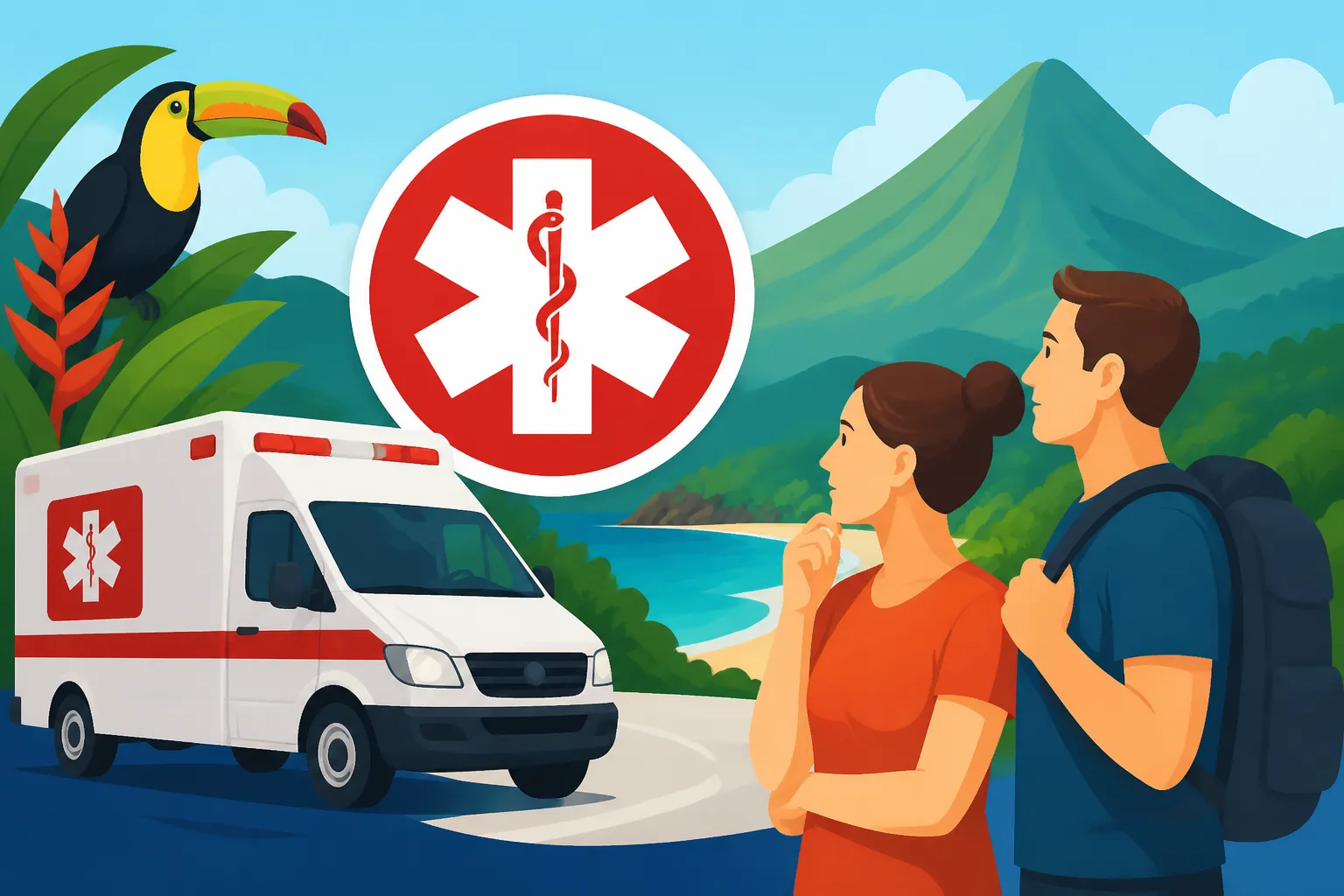
The Cruz Roja is a non-profit organization that provides the vast majority of ambulance services in Costa Rica. They are heroes, but they are often underfunded and overstretched. In many rural towns, there might only be one Cruz Roja ambulance for an entire district. If that ambulance is already transporting a patient to a hospital two hours away, you are out of luck.
For this reason, many expats in the Central Valley subscribe to private ambulance services like Emergencias Médicas or UCIMED. These services operate like a membership. For a monthly fee, you get access to their private fleet of ambulances, which are essentially "ERs on wheels" staffed with doctors or highly trained paramedics. In a heart attack scenario, having a doctor arrive at your door in 10 minutes is worth every penny of the subscription. For those without a permanent residence or who move around frequently, products like SafetyWing offer the peace of mind that if you need to be transported, your financial bases are covered.
Communicating in a Crisis: Language Barriers
Language is perhaps the most significant hurdle in an emergency. While doctors in private hospitals often speak perfect English, the paramedics, nurses, and administrative staff often do not. In a high-stress situation, miscommunication can lead to errors in medication or delays in treatment.
I always advise expats to keep an "Emergency Card" in their wallet and taped to the fridge. This card should list your allergies, current medications, blood type, and insurance details in both English and Spanish. If you are unconscious, this piece of paper speaks for you. Also, consider learning the basic Spanish terms for "chest pain" (dolor de pecho), "difficulty breathing" (dificultad para respirar), and "bleeding" (sangrado). For more help on finding medical professionals who can communicate with you, check out How to Find an English-Speaking Doctor in Costa Rica.
Navigating Emergency Departments at Major Private Hospitals
If you have the means or the insurance, the private emergency rooms in San Jose are where you want to be for serious but non-trauma-center-specific issues. These hospitals are JCI-accredited, meaning they meet international standards for patient care and safety.
CIMA, Clinica Biblica, and Hospital Metropolitano
These are the "Big Three." CIMA is located in Escazu and is the hospital of choice for most North Americans due to its modern campus and proximity to expat neighborhoods. Clinica Biblica is in the heart of San Jose and has a long, storied history of excellence. Hospital Metropolitano has been expanding rapidly, offering more affordable private care with several locations, including some outside the Central Valley.
Each of these hospitals has a fully staffed 24/7 emergency room. They have on-call specialists for everything from neurology to orthopedics. If you arrive with a suspected stroke, they have the protocol and the imaging technology to act immediately. However, it’s important to understand the nuances of How to Use Private Hospitals Like CIMA, Clinica Biblica and Hospital Metropolitano before you actually need them. Knowing which one is closest to your home or office can save precious minutes.
Admission Requirements and Payment Deposits
The biggest "culture shock" in a private ER is the bill. Unlike in the US, where you are treated first and billed later, Costa Rican private hospitals operate on a "pay as you go" or "deposit first" model. If you need to be admitted for surgery, the hospital will likely ask for a deposit ranging from $5,000 to $20,000 before they wheel you into the operating room.
This can be devastating if you aren't prepared. They will accept major credit cards, but you must ensure your daily limit is high enough to cover such a charge. If you have international insurance, the hospital's billing department will work to get a "Letter of Guarantee" (LOG) from your provider, but this can take hours. Until that LOG arrives, you are personally responsible for the costs. This is where Understanding Hospital Admission and Billing in Costa Rica becomes a critical read for any expat planning to stay long-term.
Direct Billing and International Insurance
Some international insurance plans have "direct billing" agreements with major private hospitals. This means the hospital bills the insurance company directly, and you only pay your deductible or co-pay. However, these agreements are specific and can change. Always check with the international department of the hospital (usually called "Convenios") to see if your specific policy is on their "green list."
If you are using a more flexible, nomad-style insurance like SafetyWing, you typically pay out-of-pocket and then submit your itemized receipts for reimbursement. In an emergency, this means you need liquid cash or a high-limit credit card ready. It’s also wise to understand How to Claim Reimbursement from INS or Private Insurance in Costa Rica so you aren't left holding a massive bill for months while waiting for paperwork to clear.
Regional Realities: Emergency Care Outside the Central Valley
If you live in the "real" Costa Rica—the beaches of Nosara, the mountains of Perez Zeledon, or the jungles of Puerto Viejo—emergency care is a different beast entirely. The infrastructure is thinner, and the distances are greater.
Coastal Living and Limited Resources
In many beach towns, the only medical facility is a small private clinic or a local EBAIS (the community-level public clinic). These are great for treating a stingray barb or a minor infection, but they are not equipped for major trauma or cardiac events. In these areas, the "Emergency Room" is often a single room with a basic monitor and an oxygen tank.
The strategy here is stabilization and transport. The local doctor will do their best to keep you alive until an ambulance can get you to the nearest regional public hospital (like the one in Nicoya or Liberia). This transport can take hours due to road conditions, especially in the rainy season. If you're living in a rural area, you absolutely need to know How to Find and Register with an EBAIS Clinic in Costa Rica just to have a starting point for any medical issue.
The Importance of Medevac and Air Ambulance Services
In a true "life or limb" situation in a remote area, an air ambulance is your best bet. There are private companies like Helidocs or AeroDivina that provide helicopter or fixed-wing medical transport. These flights are incredibly expensive—often starting at $10,000—and usually require payment upfront or a confirmed insurance guarantee.
For expats in remote zones, I cannot stress enough the importance of having insurance that specifically covers "emergency medical evacuation." Without it, a medical crisis can easily bankrupt a family. This is another area where a plan like SafetyWing offers immense value, as it is designed for people who travel to more adventurous, less-serviced locations and might need to be airlifted to a major trauma center in San Jose or even back to their home country.
Local EBAIS Clinics and Rural First Aid
In the absence of a hospital, the EBAIS is the heartbeat of rural Costa Rican healthcare. These clinics are staffed by a doctor, a nurse, and a technician. They are experts at local maladies—snake bites, tropical fevers, and machete accidents. While they lack the high-tech bells and whistles of CIMA, they have the local knowledge that can save your life.
If you are a resident, your Caja membership gives you access to the EBAIS. If you are a tourist or in the process of getting residency, you can still be treated, but you will be charged a fee. Understanding the Role of the EBAIS (Local Health Clinic) in Costa Rica will help you realize that while it isn't a "hospital," it is a vital link in the chain of survival when you are far from the Central Valley.
Managing Costs and Insurance During a Medical Crisis
The financial aspect of an emergency in Costa Rica is often just as stressful as the medical one. You need to know how to navigate the costs so you can focus on recovery rather than your bank balance.
Out-of-Pocket Expenses in Private ERs
Even with the best insurance, expect to pay something out of pocket. Many private hospitals charge an "Emergency Room Fee" that covers the use of the facility, which is separate from the doctor's professional fees and the cost of supplies (gauze, IV fluids, medications). In Costa Rica, every single aspirin and every centimeter of medical tape is tracked and billed.
A typical ER visit in a private hospital for something like a severe allergic reaction or a deep cut will likely cost between $300 and $800. If diagnostic tests like an ultrasound or blood work are required, add another $200 to $500. For a detailed breakdown of what things cost, see The Cost of Healthcare in Costa Rica: A Complete Breakdown for Foreigners (2026).
Leveraging Travel and International Health Insurance
If you are a visitor or a "perpetual tourist," your primary source of coverage will be travel insurance or an international health plan. It is imperative that you keep a digital and physical copy of your policy and the 24-hour emergency contact number for your provider. When you arrive at the hospital, the administrative staff will want to see this immediately.
The quality of your insurance dictates how smoothly your admission goes. High-end expat policies from companies like Cigna or Bupa are widely recognized. However, many "standard" travel policies from credit cards or basic agencies have very low limits for medical care—sometimes as low as $10,000, which won't even cover 24 hours in a private ICU. Always check What Health Insurance Options Are There for Expats in Costa Rica? to ensure your coverage matches the reality of Costa Rican medical costs.
SafetyWing for Nomads and Long-term Residents
For those who don't fit into the traditional "retiree" or "employee" categories—like digital nomads or those waiting for their residency to be approved—finding consistent coverage can be tricky. SafetyWing has become a popular choice in the Costa Rican expat community because it operates on a subscription model, much like a gym membership, and provides global coverage that includes emergency medical expenses and evacuation.
The benefit of a nomad-focused plan is that it understands the "between states" reality. If you are doing "visa runs" to Nicaragua or Panama, your coverage follows you. In an emergency in Costa Rica, having a plan that you can manage from your phone and that is designed for the modern traveler can alleviate the panic of "Do I have coverage right now?"
| Feature | Public (Caja) | Private (CIMA/Biblica/Metropolitano) |
|---|---|---|
| Emergency Wait Time | High (Triage dependent) | Low to Moderate |
| Cost for Tourists | Moderate (Standardized rates) | High (Market rates) |
| Medical Technology | Advanced (Trauma centers) | Cutting Edge (Diagnostic/Elective) |
| Bilingual Staff | Limited (Doctor dependent) | Excellent (Most staff) |
| Payment Model | Billed after/during | Deposit required upfront |
| Medevac Access | Limited (Public air assets) | Excellent (Private partnerships) |
Common Expat Emergencies: From Tropical Illnesses to Accidents
Costa Rica is beautiful, but its environment poses specific risks that foreigners often underestimate. Being aware of these common emergencies can help you spot the warning signs early.
Dealing with Dengue and Zika
Mosquito-borne illnesses are a reality here, especially during the transition from the dry season to the rainy season. While many cases of Dengue are mild, "Dengue Hemorrhagic Fever" is a medical emergency. If you experience a high fever along with severe pain "behind the eyes," joint pain (often called "breakbone fever"), or unexplained bruising/bleeding, you need to get to an ER for a blood test immediately.
Dehydration is the biggest risk with these tropical fevers. In the ER, you will likely be given IV fluids and monitored for your platelet count. Do not take aspirin or ibuprofen if you suspect Dengue, as these can worsen bleeding; only acetaminophen (Panadol) is recommended. For more on local health risks, check out What Health Risks Should Expats Be Aware of in Costa Rica?.
Wildlife Encounters and Snake Bites
Costa Rica is home to several venomous snakes, most notably the Fer-de-Lance (Terciopelo). If bitten, do not try to "suck out the venom" or apply a tourniquet—these are myths that cause more damage. Your only goal is to stay calm, immobilize the limb, and get to the nearest hospital.
The good news is that Costa Rica is a world leader in anti-venom production (thanks to the Clodomiro Picado Institute). Every public hospital and most rural clinics are stocked with highly effective anti-venom. This is one situation where the public system is often better prepared than private clinics, as they handle snake bites more frequently. Knowing What Should I Do in a Medical Emergency in San Jose? or in rural areas specifically for wildlife can save your life.
Road Accidents and Trauma Protocol
Driving in Costa Rica is famously hazardous. Narrow roads, lack of lighting, and unpredictable pedestrians make motor vehicle accidents the leading cause of trauma for expats. In the event of a major accident, the "Golden Hour"—the first hour after injury—is critical.
In a serious crash, the Red Cross will usually transport you to the nearest public trauma center, such as Hospital México or the San Juan de Dios in San Jose, regardless of your insurance. These are the "heavy hitters" for neurosurgery and orthopedic reconstruction. You can always transfer to a private room later, but for the initial life-saving surgery, the public trauma centers are where you want to be. Understanding Emergency Medical Care in Costa Rica: What Every Expat Needs to Know means accepting that the public system is your best friend in a car crash.
Essential Documents and Preparation for a Medical Crisis
When the ambulance arrives, you won't have time to look for your passport or your insurance card. Preparation is the difference between a managed crisis and a total disaster.
The Emergency Folder: What to Keep Ready
Every expat household should have a "Grab-and-Go" folder. This folder should be kept in a visible spot (like the kitchen counter) and should contain:
- Clear photocopies of your passport and DIMEX (residency card).
- A copy of your insurance policy and the 24-hour emergency number.
- A list of all current medications and dosages.
- A list of known allergies (especially to antibiotics or latex).
- Contact information for your primary doctor in Costa Rica and your family back home.
Having these documents ready will expedite your admission to any hospital. If you are still in the process of moving, read The Complete Guide to Moving to Costa Rica: Your First 90 Days (2027) to see how to organize your life for these eventualities.
Legal Representatives and Power of Attorney
If you are incapacitated, who makes the decisions? In Costa Rica, medical professionals will look to your closest relative. However, if you are living here alone or with a partner you aren't legally married to, this can get complicated.
It is wise to have a local attorney draft a "Medical Power of Attorney" (Poder) that designates a trusted person to make medical decisions on your behalf. This document must be in Spanish and notarized. Without it, the hospital may be forced to follow strict protocols that might not align with your wishes. For more on legal hurdles, see Understanding How to Move to Costa Rica Legally from Abroad (2027).
Adding Dependents and Notifying Family
If you are a resident and have the Caja, make sure your spouse and children are correctly registered as your dependents. In an emergency, the hospital will check the system to see if the family members are covered. If the system shows them as "inactive," you will be billed as a private patient.
Learn the process of How to Add Dependents to Your Caja Coverage in Costa Rica before a crisis occurs. Additionally, ensure your family back home knows which hospital you would likely be taken to and how to contact your local friends or neighbors.
Post-Emergency Care and Follow-ups
Surviving the emergency is only half the battle. The days and weeks following a crisis involve a lot of paperwork and specialized care.
Obtaining Medical Records and Reports
If you plan to file an insurance claim or if you need to see a specialist for follow-up care, you must obtain your full medical report (Epicrisis) before you leave the hospital. In the private sector, this is usually easy; in the public sector, it can require a formal request through the "Archivo" (records) department, which can take several days.
Always ask for a digital copy of any imaging (CT scans, X-rays) on a CD or via a download link. This is vital if you need a second opinion or if you decide to return to your home country for further treatment. You should also know How to Access My Medical Records in Costa Rica for long-term health management.
Transitioning from Emergency to Specialist Care
The ER doctor's job is to stop the crisis, not to manage your long-term health. Once the emergency is over, you will need a referral to a specialist. If you were treated in the Caja, the ER will refer you to a specialist within the public system, but the wait time for that appointment could be months.
Many expats choose to "jump tracks" here—getting stabilized in the public system and then paying out-of-pocket to see a private specialist the following week. This hybrid approach allows you to get the best of both worlds. For tips on finding the right follow-up care, see How to Get a Specialist Referral Through the Caja in Costa Rica.
Pharmacy Access and Prescription Refills
If you are discharged with new medications, you'll need to find a pharmacy (Farmacia). In Costa Rica, pharmacists have much more authority than in the US or UK. They can often provide advice and even administer injections. However, for specialized emergency medications, you’ll need a valid prescription from a doctor registered with the Costa Rican College of Physicians and Surgeons.
Keep in mind that many medications have different brand names in Costa Rica. Knowing the "generic" or chemical name of your medicine is essential. For a full guide on how to navigate this, read Prescription Medications and Pharmacies in Costa Rica: The Complete Guide.
Disclaimer
The information provided in this guide is for educational and informational purposes only and does not constitute professional medical or legal advice. Healthcare laws, hospital protocols, and insurance requirements in Costa Rica are subject to change. Always consult with a qualified medical professional or a legal expert regarding your specific situation and ensure you have adequate insurance coverage for your needs. The author is a veteran expat, not a licensed medical doctor or attorney.