How Do I Access My Medical Records in Costa Rica?
Imagine standing in the middle of a private clinic in Escazú or a public EBAIS in a rural coastal village, trying to recall the exact name of a medication you were prescribed three years ago, only to realize the records are locked in a system you do not know how to navigate. Whether you are applying for residency, switching doctors, or filing an insurance claim, the administrative hurdle of retrieving your medical history in a foreign country can be incredibly taxing. This guide breaks down exactly how to access your medical records in Costa Rica, covering both the public and private sectors with realistic, boots-on-the-ground advice.
Understanding the Dual Nature of Medical Records in Costa Rica
The first thing you need to realize as an expat is that Costa Rica operates two distinct healthcare universes that rarely talk to one another. There is the Caja (Caja Costarricense de Seguro Social or CCSS), which is the public system, and then there is the thriving private sector. If you have been living here for any length of time, you likely have a foot in both worlds. You might go to the Caja for your monthly medications or standard vaccinations but head to a private specialist when the public wait times become unbearable.
Because these systems are separate, your medical records are fragmented. There is no single "national" database that a private doctor at Hospital CIMA can pull up to see what you discussed last month at your local public clinic. This fragmentation is one of the biggest culture shocks for those coming from countries with more integrated health networks. You are effectively the "bridge" between these two systems. When deciding how to manage your health, it is essential to look at Public vs Private Healthcare in Costa Rica: Which Should Expats Choose? to understand where your data will live.
In the public system, everything is centered around the "Expediente Único Digital en Salud," commonly known as EDUS. This is a massive achievement for Costa Rican bureaucracy, but it is not without its quirks. In the private system, each hospital group—be it Clinica Biblica, CIMA, or Hospital Metropolitano—maintains its own proprietary portal. If you move from one private hospital to another, you often have to start the record-requesting process from scratch. This is why having a global health plan, such as those offered by SafetyWing, can be a lifesaver, as it often provides a more centralized way to manage your international claims regardless of which local hospital you visit.
The Role of the EDUS App in the Public System
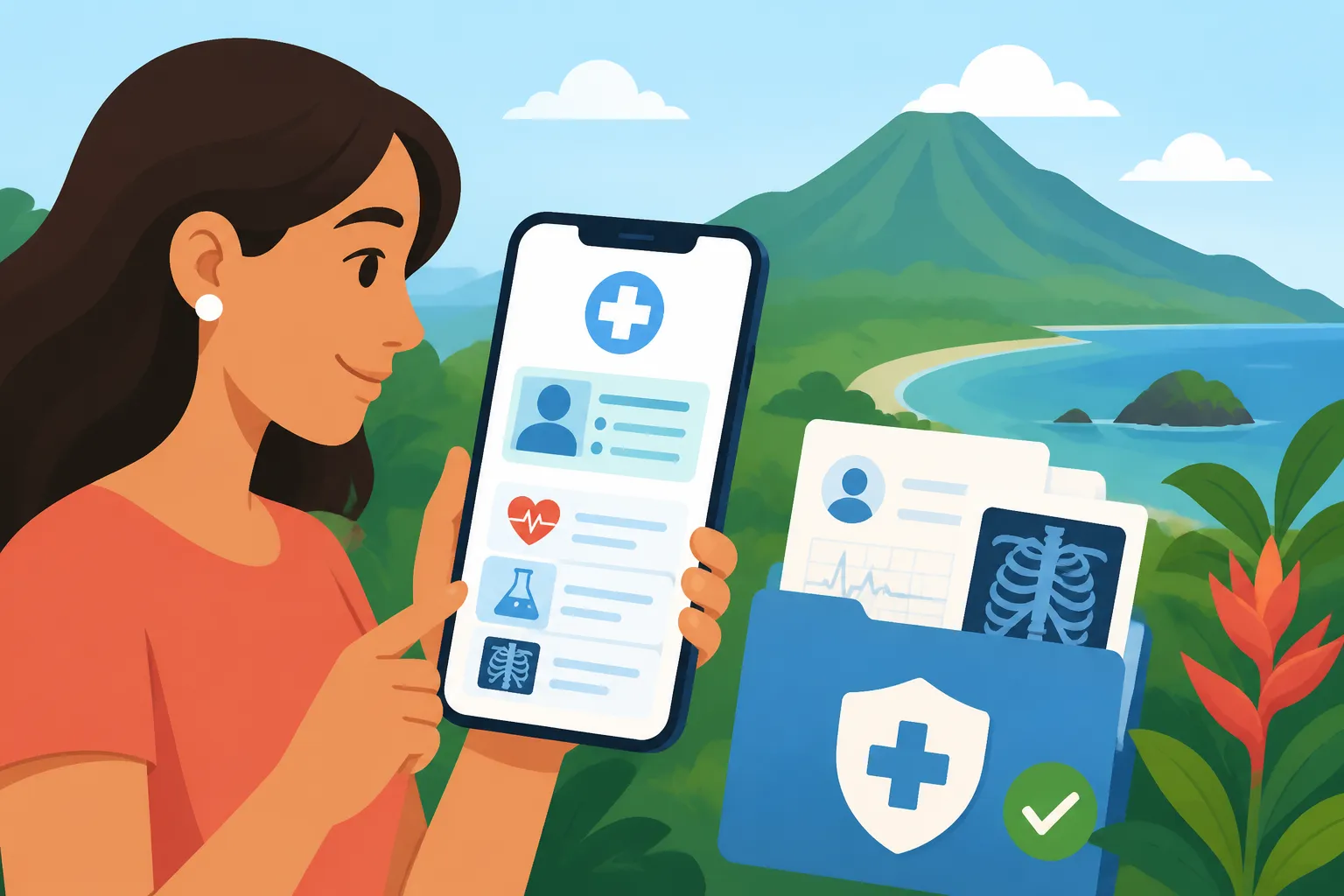
For anyone enrolled in the Caja, the EDUS app is the holy grail of medical information. It tracks your appointments, your prescriptions, and even your surgical history within the public system. However, getting it set up as a foreigner can be a bit of a headache. You cannot simply download the app and sign up; your identity must first be "validated" at your local health clinic.
You will find that your digital record is tied directly to your DIMEX (residency card) or your passport number if you are still in the application phase. It is vital to learn How to Use Your DIMEX to Access Healthcare in Costa Rica because that number is the key to every single medical interaction you will have. Without that validated ID in the CCSS database, the EDUS app will simply show an error message, leaving you in the dark about your own health history.
Private Hospital Portals and Patient IDs
In the private sector, the experience is much more "Americanized." When you first visit a large private hospital, they will create a patient profile for you. Most of these major institutions have sophisticated online portals where you can log in to view lab results, imaging (like X-rays or MRIs), and doctor notes. Unlike the public system, these portals are often available in English, which is a massive relief when you are trying to understand complex medical terminology.
If you are using How to Use Private Hospitals Like CIMA, Clinica Biblica and Hospital Metropolitano, you will quickly see that they pride themselves on efficiency. However, don't expect the records to magically appear. You often have to visit the "Archivo Médico" (Medical Archives) department or the "Contraloría de Servicios" to sign a physical release form if you want a certified copy for legal or residency purposes. If you are an expat working remotely or traveling frequently, having a digital-first insurance like SafetyWing ensures that once you do get those records, the reimbursement process for your private care is significantly smoother.
How to Access and Navigate the EDUS Public System
If you are a legal resident, you are likely already paying into the CCSS monthly. To see your records, you need the EDUS app, but the process begins at the EBAIS. The EBAIS is your neighborhood clinic, and it is where your "physical" presence is converted into a "digital" profile. You cannot bypass this step. You must show up, often early in the morning, with your residency card to ensure your data is synchronized.
Once your profile is active, the EDUS app becomes surprisingly useful. It shows a timeline of your visits, the names of the doctors you saw, and the specific diagnostic codes (CIE-10) associated with your visit. For expats, this is the most reliable way to prove your vaccination history to local schools or for residency renewals. If you aren't sure where to go, you should look into How to Find and Register with an EBAIS Clinic in Costa Rica to get started on the right foot.
Registering and Validating Your Profile
The validation process at the EBAIS is where most foreigners get stuck. The clerk might tell you that your DIMEX isn't "active" in their specific system, or your address doesn't match what is on file. It is highly recommended to bring a utility bill and your original DIMEX card. Once they "apply" your profile to the digital system, you can set a password for the EDUS app.
I remember the first time I tried to use the app; it felt like I was winning a prize when my prescription list finally loaded. It showed every medication I had received over the last five years. This transparency is vital, especially when you consider that Understanding the Role of the EBAIS (Local Health Clinic) in Costa Rica is the foundation of your long-term health management in the country. If you ever have a medical emergency, the doctors at a public hospital will look at this exact digital file first.
Troubleshooting the 2022 Data Gap
It is important to mention a realistic hurdle that veterans often talk about: the 2022 Conti ransomware attack. The CCSS was hit by a massive cyberattack that took the EDUS system offline for months. During this time, doctors went back to paper files. If you had major procedures during the summer of 2022, there is a chance those records might not appear in your digital app today. You may need to visit the hospital where the care was provided to ask for the "expediente físico" (physical file) to be manually digitized or copied for your records.
| Feature | Caja (Public/EDUS) | Private Hospitals (CIMA/Biblica) |
|---|---|---|
| Primary Access | EDUS Mobile App | Web-based Patient Portals |
| Language | Primarily Spanish | Spanish and English |
| Requirement | Validated DIMEX/Passport | Hospital-specific Patient ID |
| Lab Results | Viewed in app (delayed) | Usually available in 24 hours |
| Imaging (X-Rays) | List of reports only | Full DICOM/Digital images often viewable |
| Best For | Vaccinations, General Meds | Specialist Care, Imaging, Fast Results |
Requesting Physical Records and Certified Copies
Sometimes, a screen on an app isn't enough. If you are applying for a specific type of insurance, moving back to your home country, or dealing with a legal matter, you will need a "certified" copy of your medical records. In Costa Rica, this is known as a "Copia Certificada del Expediente." This process is governed by the Law of Protection of the Person against the Processing of their Personal Data, which gives you the legal right to access your information.
Requesting these records is not instantaneous. In the public system, you generally have to submit a formal letter to the "Dirección Médica" of the hospital where you were treated. They have a legal window (often 10 working days) to provide the copies. Be prepared to pay a small fee per page for photocopies. For those who are just starting their journey here, knowing The Complete Guide to Healthcare in Costa Rica for Expats (2027) will give you a broader perspective on why these administrative steps take time.
The Importance of the "Epicrisis"
If you are hospitalized in Costa Rica, the most important document you can receive is the "Epicrisis." This is a formal discharge summary that outlines your diagnosis, the treatment received, medications administered, and follow-up instructions. In many cases, an Epicrisis is all you need for an insurance claim with a provider like SafetyWing or for your doctor back home.
Always ask for a printed and signed Epicrisis before you leave the hospital. Getting it later is significantly harder once the file has been sent to the archives. If you are ever in a situation where you need immediate help, understanding Emergency Medical Care in Costa Rica: What Every Expat Needs to Know is crucial, as the records generated during an emergency are often the most critical for future care.
Utilizing Your Legal Rights (Habeas Data)
Costa Rica has strong privacy laws. If a clinic or doctor refuses to give you your records, you can invoke your "Habeas Data" rights. This is a constitutional protection that ensures individuals have access to information held about them in public or private databases. While it rarely comes to this, simply mentioning that you know your rights regarding your medical information often speeds up the process with reluctant administrative staff.
When you are visiting a new doctor, always bring a folder with your previous records. Do not assume they can "find it in the system." Even in the private sector, unless the doctors are in the same network, they are essentially flying blind without your input. Knowing What Documents Do I Need to See a Doctor in Costa Rica? can help you prepare that folder so your appointment is productive rather than a data-collection mission.
Best Practices for Managing Your Records as an Expat
Living as an expat means you are often your own medical record keeper. Because the systems here are fragmented, the most successful expats I know maintain their own digital cloud storage for medical files. Every time you get a blood test or a prescription, take a photo or scan the document immediately. Apps like CamScanner or even the built-in notes app on your phone are perfect for this.
This is particularly important for those who travel. If you are in Panama or back in the US and something happens, having a PDF of your latest Costa Rican EKG or lab work can save your life. For digital nomads, having a portable medical history combined with a flexible health plan like SafetyWing ensures that you are covered and informed no matter where you are.
Translating Records for International Use
If you need to use your Costa Rican records in the US, Canada, or Europe, you will likely need a certified translation. In Costa Rica, this must be done by an "Official Translator" (Traductor Oficial) certified by the Ministry of Foreign Affairs if it is for a legal process. However, for a simple doctor-to-doctor transfer, a standard professional translation is usually sufficient.
If you are looking for medical providers who might already be comfortable with English, check How to Find an English-Speaking Doctor in Costa Rica. These doctors are often more accustomed to providing notes that are easily understood by international colleagues or insurance adjusters.
Integrating Public and Private Histories
Most expats end up with a "hybrid" medical history. You might have your major surgeries recorded at Clinica Biblica but your chronic blood pressure medication managed by the Caja. It is your responsibility to ensure that your Caja doctor knows what the private specialist is doing, and vice-versa.
When you go to your EBAIS for your yearly check-up, bring the results of any private lab work you have done. The doctors in the public system can actually enter this external data into your EDUS profile, which helps create a more complete picture of your health. This proactive approach is the best way to navigate the system without things falling through the cracks.
Professional Disclaimer
The information provided in this guide is for educational and informational purposes only and does not constitute legal or medical advice. Healthcare regulations and digital systems in Costa Rica are subject to change. Always consult with a qualified legal professional or a medical administrator regarding your specific rights and the current procedures for accessing medical records. I am an expat sharing my personal experiences and research, not a government official or a licensed attorney in the Republic of Costa Rica.