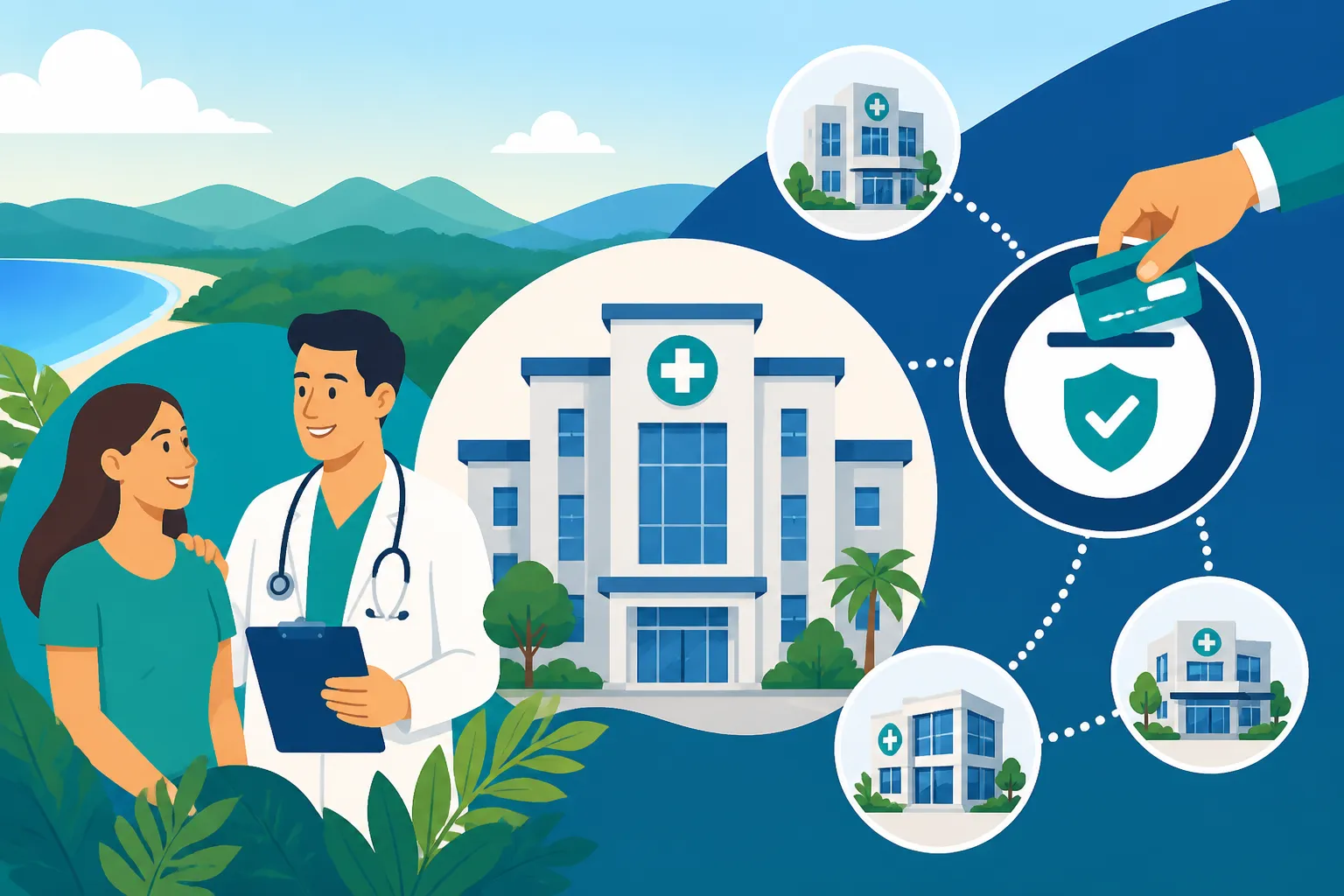
Understanding Private Hospital Networks and Direct Billing in Costa Rica
Most expats arrive in Costa Rica and feel a sudden, sharp anxiety when they realize the public system has long waitlists, but the private system feels like a maze of billing departments and insurance forms. This guide solves that confusion by breaking down how private hospital networks operate, how direct billing works with your insurance, and how to navigate the system without unexpected financial stress.
The Landscape of Private Healthcare in Costa Rica
When you first land in San Jose or move to a beach town like Nosara, the healthcare talk usually centers around the "Caja." But for those of us who have lived here a while, we know that while the public system is a great safety net, the private sector is where you go for speed, comfort, and specialized attention. Understanding how these facilities are structured is the first step toward feeling secure in your new home. Unlike some countries where private hospitals are small boutique clinics, Costa Rica has massive, world-class medical centers that rival those in North America or Europe.
The Big Three Private Hospitals: CIMA, Clinica Biblica, and Metropolitano
Hospital CIMA in Escazu is often the first name expats hear. It is JCI-accredited and feels more like a high-end hotel than a medical facility. It is strategically located near the expat hubs of Santa Ana and Escazu, making it the go-to for many North Americans. Then there is Clinica Biblica, located in the heart of San Jose with a newer branch in Santa Ana. It has a long history and is known for its massive network of specialists. Finally, Hospital Metropolitano has grown rapidly, positioning itself as the more affordable private alternative with locations spanning from San Jose to Liberia and even Huacas near the coast.
Deciding between these often comes down to your insurance coverage and location. If you are exploring Public vs Private Healthcare in Costa Rica: Which Should Expats Choose?, you will find that the private sector offers much faster diagnostics. For instance, an MRI that might take months in the public system can often be scheduled for the same afternoon at Hospital Metropolitano. This efficiency is why many expats maintain both Caja membership for residency requirements and private insurance for their primary care needs.
Why Expats Often Lean Toward Private Care
The primary driver for choosing private care is the "convenience factor." In the public system, you are assigned to an EBAIS based on your neighborhood, and you don't always get to choose your doctor. In the private sector, you have total autonomy. You can research a cardiologist, read reviews, and book an appointment for the following day. This autonomy is vital when you are navigating a new culture and language. Most doctors in the top private networks were trained in the US or Europe and speak fluent English, which removes a massive layer of stress during a medical crisis.
Furthermore, the facilities themselves are designed for comfort. When you are hospitalized at a place like CIMA or Clinica Biblica, you usually get a private room with a sofa for a family member to stay overnight. This level of service is a far cry from the crowded wards often found in public hospitals. If you are looking for more details on the logistics, check out The Complete Guide to Healthcare in Costa Rica for Expats (2027). Understanding these nuances helps you manage your expectations before you ever need to set foot in a waiting room.
Geographical Distribution: Beyond the Central Valley
While the "Big Three" are centered in the San Jose metropolitan area, the private network is expanding. For years, if you lived in Guanacaste or the Southern Zone, a serious medical issue meant a four-hour drive to the city. Today, Hospital Metropolitano has a significant presence in Liberia and Huacas, and there are high-end private emergency clinics in places like Uvita and Tamarindo. This shift has made it much more feasible for retirees and digital nomads to live outside the Central Valley without fearing a lack of medical access.
However, it is important to note that the most complex surgeries and specialized treatments are still concentrated in San Jose. If you live on the coast, your local private clinic will stabilize you and then coordinate a transfer to a major hospital in the city. Services like SafetyWing are particularly popular for those living the nomadic lifestyle in these coastal areas, as they provide a bridge for emergency situations where you might need to be moved to a higher-level facility quickly.
Understanding Private Hospital Networks
A "network" in Costa Rica isn't just a building; it’s an ecosystem of doctors, laboratories, imaging centers, and pharmacies that all communicate through a centralized system. When you enter a network like Clinica Biblica, your records are available to every specialist within that system. This integration is a lifesaver because it prevents you from having to carry a physical folder of X-rays and blood tests from one office to another.
Affiliated Specialist Networks and Doctor Offices
One thing that surprises many expats is that private doctors often "rent" their office space from the hospital. They are independent practitioners who are "affiliated" with the network. This means that while they use the hospital’s infrastructure for surgeries and labs, they manage their own billing for office visits. This is a crucial distinction when it comes to Understanding How to Use Private Hospitals Like CIMA, Clinica Biblica and Hospital Metropolitano.
When you see a specialist for a consultation, you will usually pay them directly at their office. However, if that specialist schedules a procedure—like a gallbladder removal or a biopsy—that procedure happens within the hospital's "theatre," and the hospital's billing department takes over the facility costs. This dual-layer of billing can be confusing, but once you understand that the doctor and the hospital are two separate financial entities, the invoices start to make more sense.
Satellite Clinics and Urgency Centers
To compete for the expat market, major hospital networks have opened "Sucursales" or satellite clinics. For example, Hospital Metropolitano has several clinics that aren't full-scale hospitals but offer primary care, labs, and "Urgencias" (urgent care). These are much more affordable than a full emergency room visit at a major hospital. If you have a minor injury or a stubborn flu, going to a satellite clinic is faster and keeps the major ERs clear for true life-and-death situations.
These satellite clinics are also where many people go for their initial residency check-ups or routine lab work. Understanding the role of these smaller nodes in the network can save you thousands of colones. For a deeper look at the smaller clinics, you might find How to Find and Register with an EBAIS Clinic in Costa Rica useful, though EBAIS refers to the public system, it provides a good contrast to how the private satellite clinics operate.
How Network Loyalty Affects Your Care
Staying within one network has distinct advantages in Costa Rica. If you use Hospital Metropolitano for your labs, CIMA for your specialist, and Clinica Biblica for your pharmacy, your medical history is fragmented. In a country where "digital health records" are still evolving, having one centralized "Expediente" (file) at a single private hospital is the best way to ensure your doctors have the full picture.
Most hospitals now have apps where you can view your lab results, schedule appointments, and even see your billing history. This level of transparency is excellent for expats who are used to the digital portals of the US or UK systems. If you are curious about how this all fits into the bigger picture, Navigating the Costa Rican Healthcare System: An Expat's Roadmap (2027) offers a great bird's-eye view of staying organized.
The Mechanics of Direct Billing
Direct billing, or "Pago Directo," is the holy grail of expat healthcare. It is the process where the hospital bills your insurance provider directly, so you only have to pay your deductible or co-pay out of pocket. Without direct billing, you have to pay the entire bill upfront—which can be tens of thousands of dollars for a major surgery—and then fight for reimbursement from your insurance company later.
What is Direct Billing and How Does It Work?
In Costa Rica, direct billing is not automatic. It is based on "Convenios" (agreements) between the hospital and specific insurance companies. Most major private hospitals have agreements with local insurers like INS (Instituto Nacional de Seguros) and Palig (Pan-American Life), as well as major international carriers. When you arrive at the hospital, the first thing the admissions desk will ask for is your insurance card and your DIMEX or passport.
The hospital’s international insurance department then contacts your provider to "verify benefits." This can take a few hours, so if it’s not an immediate life-threatening emergency, you might be waiting in a comfortable lobby while the paperwork clears. This is why many expats prefer Understanding INS Health Insurance Plans in Costa Rica, as the local connection often makes the direct billing process smoother and faster.
The Pre-Authorization Hurdle
For elective surgeries or expensive diagnostic tests like MRIs and CT scans, you almost always need "Pre-Autorización." Your doctor will fill out a form explaining why the procedure is medically necessary, and the hospital will send this to your insurance company. You cannot simply walk in and demand a surgery be direct-billed without this prior approval.
This is where many expats get frustrated. If the insurance company decides a procedure is "cosmetic" or related to a "pre-existing condition," they may deny the pre-authorization. In that case, you become a "private patient," meaning you pay the full rate out of pocket. It is always wise to keep a copy of The Cost of Healthcare in Costa Rica: A Complete Breakdown for Foreigners (2026) handy so you have an idea of what those out-of-pocket costs might look like if your insurance pushes back.
Deductibles and Co-insurance in Direct Billing
Even with direct billing, you aren't walking away for free. You will still be responsible for your deductible (the amount you pay before insurance kicks in) and your co-insurance (usually 10% to 20% of the total bill). The hospital will calculate this estimate before you are discharged.
One thing to watch out for is that some international plans have a "per-incident" deductible, while others have an "annual" deductible. Knowing which one you have is the difference between a $500 bill and a $5,000 bill. For those using more flexible, nomad-friendly options like SafetyWing, the process often involves paying the initial cost and then submitting a claim, though they do coordinate direct billing for major hospitalizations to ensure you aren't left holding a massive bill.
Navigating Insurance and Private Care
The type of insurance you carry dictates exactly how you will interact with the private hospital networks. There is a significant difference between a local policy designed for Costa Rican residents and an international policy designed for "global citizens." Each has its pros and cons regarding network access and the ease of direct billing.
International vs. Local Private Insurance
Local insurance, primarily through INS or BlueCross BlueShield Costa Rica, is tailored to the local market. These policies are often cheaper but have lower coverage limits and may not cover you if you travel outside the country. However, because they are local, the "Convenios" with hospitals are rock-solid. The billing departments at CIMA or Clinica Biblica deal with INS every single day, so the friction is minimal.
International insurance, on the other hand, offers massive coverage limits (often $1 million or more) and covers you anywhere in the world. This is ideal for the "snowbird" expat or the digital nomad. However, the direct billing process can be slightly more complex because the hospital has to deal with a foreign entity, sometimes in a different time zone. If you are weighing these options, Health Insurance in Costa Rica: Caja, INS and International Options Explained provides a detailed comparison of the costs and benefits.
Using SafetyWing for Emergency Private Care
For many digital nomads and younger expats who haven't yet committed to a permanent local policy, SafetyWing offers a vital middle ground. It acts as a safety net for unexpected injuries or illnesses while you are enjoying the Pura Vida lifestyle. If you end up in a private ER in San Jose due to a surfing accident or a sudden tropical fever, SafetyWing can help cover those high private costs that would otherwise drain your savings.
The key with "nomad insurance" like SafetyWing is understanding that it is primarily for "new" issues. It isn't meant for managing chronic conditions or routine check-ups. However, in a major crisis where you are admitted to a hospital like CIMA, their 24/7 support team works with the hospital's international department to handle the financial side of things, allowing you to focus on recovery. Mentioning SafetyWing to the hospital staff early in the admission process is always a good idea.
Out-of-Pocket Costs and Reimbursement
If your insurance doesn't have a direct billing agreement with your chosen hospital, you will be in "reimbursement mode." You pay the bill, collect every single "Factura Electronica" (electronic invoice), and then submit them to your insurance. In Costa Rica, the "Factura Electronica" is the only document that matters for taxes and insurance. A simple credit card receipt will not suffice.
You must ensure the hospital issues the invoice in your name with your specific ID number (DIMEX or Passport). If there is a typo in the name or ID, the insurance company will likely reject the claim. This administrative hurdle is one of the most common complaints among foreigners. For more on this, Understanding Hospital Admission and Billing in Costa Rica is a must-read to ensure you don't miss a critical piece of paperwork.
Practical Tips for Managing Hospital Admissions
Being admitted to a hospital is stressful enough without the added weight of doing it in a foreign country. In Costa Rica, the process is quite formal. You don't just walk into a room; there is a sequence of administrative "gates" you must pass through. Being prepared for these can change your entire experience from a nightmare into a manageable situation.
Admission Deposits: The Reality of Emergency Care
Here is a reality check that many blog posts skip: if you arrive at a private ER and you do not have a pre-verified insurance plan or a local "Convenio," the hospital will ask for a deposit. This is often called a "Garantía." For a minor issue, it might be $500. For a potential surgery, they may ask for $5,000 to $10,000 on your credit card before they even move you to a room.
This is why we always tell expats to keep a credit card with a high limit specifically for medical emergencies. Even if your insurance eventually covers everything, the hospital needs to know their costs are covered in the interim. If this sounds daunting, Emergency Medical Care in Costa Rica: What Every Expat Needs to Know covers the protocols for both public and private emergencies so you aren't caught off guard.
Language Barriers and Concierge Services
While many doctors speak English, the floor nurses, janitorial staff, and some administrative clerks may not. This can lead to significant frustration during a multi-day stay. Most major private hospitals in San Jose have an "International Patient Department" or "Medical Tourism" office. Their job is to act as your liaison.
If you are struggling to communicate your needs or understand your bill, ask for a "Coordinador de Pacientes Internacionales." They are usually fluent in English and understand the specific anxieties of foreign patients. They can help explain the nuances of Understanding Specialist Referrals Through the Caja in Costa Rica if you are trying to bridge the gap between your private specialist and your public coverage.
Managing Your Medical Records Between Networks
In Costa Rica, you own your medical records, but you have to be proactive about getting them. If you have an MRI at Hospital Metropolitano but your surgery is at CIMA, you need to ask for a digital copy (often on a CD or a cloud link) of your results. Do not assume the systems "talk" to each other across different hospital brands.
Keep a folder (physical or digital) with your blood types, recent lab results, and a list of all medications you are taking (use the generic names, as brand names like Tylenol are called something else here). This is part of the Roadmap for Expats that helps you stay in control of your health journey. Being your own advocate is the most important skill you can develop in the Costa Rican private healthcare system.
Comparison of Major Private Hospital Networks
To help you decide where to go, here is a breakdown of the three primary private hospital systems you will encounter in the country.
| Feature | Hospital CIMA | Clinica Biblica | Hospital Metropolitano |
|---|---|---|---|
| Primary Location | Escazu | San Jose / Santa Ana | Multiple (SJ, Liberia, Huacas) |
| Vibe | High-end, Americanized | Traditional, Comprehensive | Modern, Value-focused |
| English Proficiency | Very High | High | Moderate to High |
| Pricing | Premium | Moderate-High | More Affordable |
| Insurance Coverage | Most Int'l & Local | Most Int'l & Local | Extensive Local (Medismart) |
| Best For | Major Surgeries, Expats | Specialists, Diagnostic Lab | General Care, Budget-conscious |
Choosing a hospital often depends on your specific insurance. For example, if you have a policy that is frequently used by nomads, like SafetyWing, you might find that the international departments at CIMA and Clinica Biblica are very accustomed to their claims process. On the other hand, if you are looking for the most "bang for your buck" and are paying out of pocket for a routine procedure, Hospital Metropolitano’s "Medismart" plan can offer significant discounts.
Ultimately, the private hospital networks in Costa Rica are excellent. They offer a level of care that provides peace of mind to thousands of expats. By understanding how the networks are structured and how the billing departments operate, you can navigate even the most stressful medical situation with the confidence of a seasoned local. Whether you are using a local INS policy or an international plan like SafetyWing, the key is to be prepared, stay organized, and always ask for your "Factura Electronica."
Disclaimer
This guide is provided for informational purposes only and does not constitute professional medical, legal, or financial advice. Healthcare laws, insurance policies, and hospital protocols in Costa Rica can change frequently. Always consult with a qualified insurance broker, legal professional, or medical practitioner regarding your specific situation and coverage needs. The author is an expat sharing personal experiences and research, not a licensed healthcare provider.