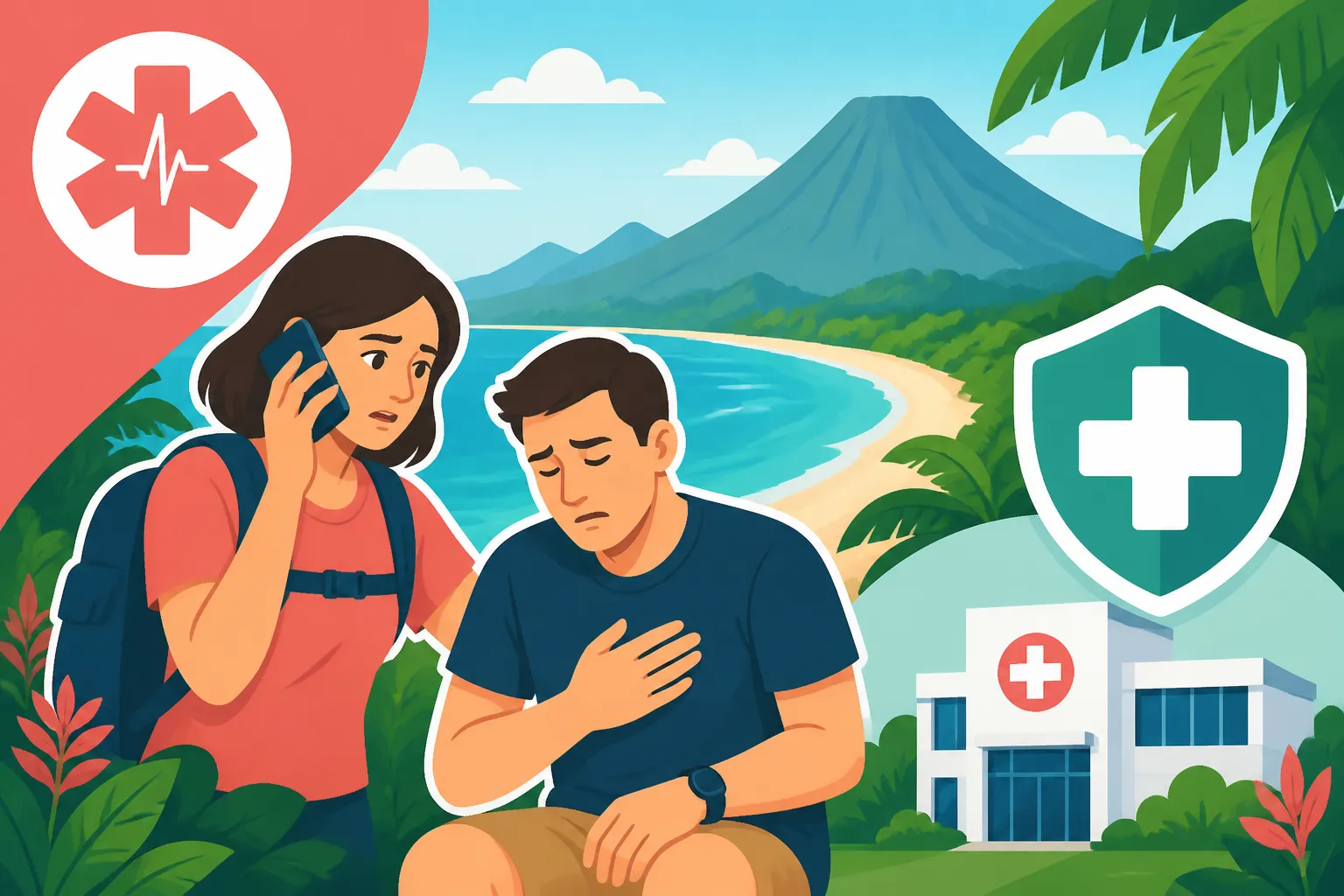
How to Handle a Medical Emergency Abroad with Costa Rican Coverage
One of the most terrifying moments for an expat is realizing that the medical safety net they painstakingly built in Costa Rica suddenly vanishes the moment they step onto an airplane. Many of us spend months navigating the bureaucracy of residency only to find that our local coverage offers zero protection during a family visit back home or a vacation in Europe. This guide explains how to manage a medical crisis outside of Costa Rica, ensuring you don't face financial ruin when your local insurance hits its geographic limits.
The Territorial Reality of the Caja System
When you finally receive your DIMEX card and complete your registration, there is a massive sense of relief. You feel protected. However, the Caja Costarricense de Seguro Social (CCSS) is a strictly territorial system. This means its mandate to provide universal healthcare ends exactly at the border of Costa Rica. If you are a legal resident and you suffer a heart attack while visiting relatives in the United States or trip and break an ankle while on a shopping trip in Panama, the Caja will not pay a single cent toward your foreign hospital bill.
Why the Public System Stops at the Border
The fundamental philosophy of the CCSS is based on national solidarity and local infrastructure. The system is funded by the contributions of workers and employers within the country to maintain clinics and hospitals located on Costa Rican soil. Because the CCSS does not have bilateral payment agreements with foreign hospital networks, they have no mechanism to reimburse a facility in Miami or Madrid. For an expat, this means that even if you are up to date on your monthly payments, your How to Use Your DIMEX to Access Healthcare in Costa Rica strategy only works within the seven provinces.
I have seen countless expats fall into the trap of assuming that "socialized medicine" carries some form of international weight. It does not. If you find yourself in a foreign emergency room, the staff will not care about your DIMEX or your record at the local EBAIS. You are, for all intents and purposes, an uninsured tourist in their eyes. This is why Understanding the Difference Between the Caja and Private Insurance in Costa Rica is vital not just for your life in the Central Valley, but for your life as a global citizen.
The Myth of Emergency Repatriation
There is a common misconception that if you are "covered by the government" in Costa Rica, the government will fly you back home if you get sick abroad. This is a dangerous myth. The CCSS does not provide medical evacuation services for residents who fall ill while traveling for pleasure or business. If you are stabilized in a foreign hospital and wish to return to Costa Rica to continue treatment under the public system, the cost of an air ambulance—which can easily exceed $30,000 from North America—is entirely your responsibility.
Without a private plan that specifically includes a repatriation rider, you are essentially stuck in the foreign country until you are fit to fly on a commercial airline or until you can pay for private transport out of pocket. This is one of the primary reasons veteran expats look into Health Insurance in Costa Rica: Caja, INS and International Options Explained long before they book an international flight. Relying solely on the public system for international travel is effectively traveling with no insurance at all.
Evaluating Private Insurance and International Portability
If the public system is a "no-go" for travel, many expats turn to private insurance companies like INS (Instituto Nacional de Seguros) or Pan-American Life. These companies offer much more flexibility, but you must be incredibly careful about the fine print. Not every private policy in Costa Rica is created equal, and many have "regional" limits that might cover you in Central America but leave you exposed in the United Kingdom or the United States.
Understanding INS Regional Riders and Limits
The state-owned insurer, INS, is the most common choice for expats seeking private supplemental care. While their local plans are excellent for visiting places like CIMA or Clinica Biblica, their international coverage is often a "rider" or a specific "travel" policy. If you have a standard Understanding INS Health Insurance Plans in Costa Rica, you need to verify if it includes the "Gastos Médicos en el Extranjero" (Medical Expenses Abroad) benefit.
Usually, these international benefits work on a reimbursement basis. This means you pay the foreign hospital upfront with your own credit card, and then you submit a mountain of paperwork to INS once you return to Costa Rica. For a minor infection, this is manageable. For a $100,000 surgical bill in the US, it is an impossible hurdle for most people. Furthermore, these plans often have a "deducible" (deductible) that is significantly higher for incidents occurring outside of Costa Rica.
The Advantage of International Health Plans
For expats who travel frequently, a local policy with a travel rider is often insufficient. This is where global health insurance providers come into play. These plans are designed for people who live in Costa Rica but want the freedom to be treated anywhere in the world. Unlike the Caja or basic INS plans, these premium policies often offer "Direct Billing" with major hospital networks worldwide.
When looking at What Is the Best Health Insurance for Expats in Costa Rica?, you have to weigh the high monthly premiums of international plans against the peace of mind they provide. If you spend three months a year in your home country, a plan from a provider like Bupa or Allianz might be more logical. These plans treat a medical emergency in London the same way they treat a visit to a How to Use Private Hospitals Like CIMA, Clinica Biblica and Hospital Metropolitano specialist in Escazu.
The Role of Dedicated Expat Travel Insurance
For many of us who are settled in Costa Rica and only leave once or twice a year, paying for a massive international health plan feels like overkill. However, we still need protection. This is where specialized travel insurance for nomads and expats, such as SafetyWing, becomes a game-changer. These are not traditional "trip cancellation" policies; they are medical-first policies designed to cover the gaps that local Costa Rican insurance leaves behind.
Why SafetyWing is a Common Choice for Residents
SafetyWing is particularly popular among the expat community because it operates on a subscription model. You can turn it on when you leave the Juan Santamaría Airport and turn it off when you get back. It is designed to handle the exact "worst-case scenarios" we fear: a sudden accident or an unexpected illness while in a foreign country. Since SafetyWing is built for people who are already outside their home country, it understands the unique position of a Costa Rican resident who might be visiting a third country.
Using a service like SafetyWing provides a layer of defense that the Caja simply cannot. For instance, if you are hiking in the Andes and need an emergency evacuation, SafetyWing handles the logistics and the costs that your local Costa Rican coverage wouldn't even acknowledge. It acts as a bridge between your local life in Costa Rica and your international travels, providing a safety net that is both affordable and tailored to the expat lifestyle.
Comparing Costs and Coverage Scenarios
When deciding between relying on a credit card's travel insurance, an INS rider, or a dedicated policy like SafetyWing, you have to look at the maximum limits. A standard credit card might offer $10,000 in emergency medical—which sounds like a lot until you realize that a single day in a US ICU can cost $15,000.
| Feature | Caja (CCSS) | INS Private Policy | SafetyWing / Travel |
|---|---|---|---|
| Coverage Area | Costa Rica Only | Variable (Local/Regional) | Worldwide (incl. home country) |
| Payment Method | Free at point of service | Reimbursement (usually) | Direct Billing / Reimbursement |
| Emergency Evac | Not Included | Optional/Limited | Included (up to policy limit) |
| Ease of Use Abroad | Zero | Requires extensive paperwork | Digital-first, 24/7 support |
| Cost | Percentage of Income | $50 – $200+ per month | Approx. $45 – $60 per month |
By layering your coverage—using the Caja for routine care, private hospitals for Emergency Medical Care in Costa Rica: What Every Expat Needs to Know, and SafetyWing for international travel—you create a comprehensive shield that follows you across borders.
Step by Step Guide to Managing an Emergency Outside Costa Rica
If the worst happens and you are hospitalized abroad, the first hour is critical. You are in a foreign system, possibly with a language barrier (if you aren't in your home country), and the clock is ticking on both your health and your wallet.
Documentation and Initial Contact
The very first thing you must do, even before you see a doctor if you are conscious, is to contact your insurance provider. If you are using a travel policy like SafetyWing, they have a 24-hour emergency line. They need to "open a case" immediately. If you wait three days to tell them you were hospitalized, they may deny the claim based on a lack of prior authorization.
You will need to provide the hospital with your "Letter of Coverage." I always recommend keeping a digital copy of this on your phone and a printed copy in your passport cover. Do not assume the hospital can "look you up." In the chaos of an emergency room, having a physical document that states "This person is covered for up to $250,000 for emergency medical" is the difference between getting a private room and being stuck in a hallway while they verify your credit limit.
The Paperwork Nightmare: Facturas and Medical Records
If your insurance works on a reimbursement basis—which is common for many Costa Rican private plans used abroad—you must become a professional bookkeeper during your crisis. You cannot just leave the hospital with a credit card receipt. You need the "Factura Detallada" (itemized bill) showing every aspirin, every scan, and every doctor's fee.
Furthermore, you must ask the attending physician for a "Medical Summary" or "Clinical Record" in English or Spanish. Most Costa Rican insurers will reject a claim if it doesn't clearly state the diagnosis and the treatment provided. If the records are in a third language (like French or German), you will likely have to pay for a certified translation once you get back to San Jose before How to Claim Reimbursement from INS or Private Insurance in Costa Rica will even be considered.
Specific Scenarios and Financial Realities
Not all emergencies are equal. A broken arm is a nuisance; a complex neurological issue requiring surgery is a life-altering event. You need to understand how your coverage handles these specific high-stakes situations.
Emergency Medical Evacuation
As mentioned, this is the most expensive part of any foreign medical emergency. If the hospital you are in is unable to provide the level of care you need, who pays to move you? Most Understanding Private Hospital Networks and Direct Billing in Costa Rica agreements don't cover international transport.
A dedicated travel policy like SafetyWing often includes a "Bedside Visit" benefit and "Medical Evacuation" to the nearest "Center of Excellence." For an expat in Costa Rica, this might mean being flown from a small clinic in Nicaragua back to Hospital Metropolitano in San Jose. Without this specific coverage, you are looking at a debt that could force you to sell your home in Costa Rica just to pay for the flight.
Returning to Costa Rica for Follow-up Care
Once you are stabilized abroad and return to Costa Rica, the "hand-off" between your travel insurance and your local coverage is where things get complicated. Most travel insurance policies stop paying the moment you return to your "country of residence."
At this point, you must pivot back to your Can I Use International Insurance at Costa Rican Hospitals? strategy or re-enter the Caja system. It is vital to have all your foreign records ready to present to your Costa Rican doctors. If you had surgery in the US, your local EBAIS doctor needs the surgical notes to prescribe your follow-up medications or physical therapy under the Caja. Without that documentation, the Caja might require you to undergo the diagnostic process all over again, causing dangerous delays in your recovery.
Preparing Your International Medical Folder
The best way to handle a medical emergency abroad is to prepare for it while you are healthy and sitting in your living room in Costa Rica. I advise all my fellow expats to create a "Medical Emergency Folder" (both physical and digital) that includes:
- A copy of your DIMEX card.
- Your Caja registration form (even if it doesn't cover you abroad, it proves residency).
- Your private insurance policy number and international emergency phone number.
- Your SafetyWing or travel insurance certificate.
- A list of all current medications (use the Spanish and English names).
- A list of allergies and past surgeries.
- The contact information for your primary doctor in Costa Rica.
When you are in a foreign hospital and the doctors are asking questions, you won't be in the right headspace to remember the exact dosage of your blood pressure medication. Having this folder ready to hand to a nurse is a life-saving tool. It also signals to the foreign facility that you are a prepared, insured individual, which often changes the way they handle your administrative intake.
Living in Costa Rica is a dream for many of us, but that dream requires a realistic approach to the borders of our protection. By acknowledging that the Caja has limits and proactively filling those gaps with private riders or specialized expat travel insurance like SafetyWing, you ensure that your adventures outside the land of Pura Vida don't turn into a financial nightmare.
Disclaimer
This guide is for informational purposes only and does not constitute legal or medical advice. Insurance regulations and CCSS (Caja) policies in Costa Rica are subject to change. Always verify your specific coverage limits with your insurance provider or a licensed insurance broker before traveling internationally. The author is not responsible for any claims denied by insurance companies or for medical expenses incurred during travel.