How Long Does It Take to Get Caja Coverage as a New Resident in Costa Rica?
One of the most jarring wake-up calls for new arrivals in Costa Rica is realizing that "applying for residency" and "having health insurance" are two entirely different timelines. You might have your paperwork submitted, but until you have that physical DIMEX card or a valid resolution in hand, you are essentially flying solo in a medical system that doesn't move fast. This guide breaks down exactly how long the wait is and how to protect yourself during the gap.
The Brutal Reality of the Residency to Caja Pipeline
When you first land in Juan Santamaría International Airport, the "Pura Vida" vibe is infectious, but the administrative side of the country—specifically the Caja Costarricense de Seguro Social (CCSS)—operates on a much more traditional, often glacial, schedule. The first thing you need to understand is that you cannot simply walk into a Caja office on day one and sign up. Enrollment is legally tied to your residency status.
For most expats, the journey starts with the submission of a residency application, whether as a Pensionado, Rentista, or under the new Digital Nomad laws. However, the Caja does not grant coverage based on a "pending" application. You generally need to reach the stage where your residency is approved (the resolución) before you can even begin the formal enrollment process. In the current administrative climate of 2026, this waiting period for residency approval can range from 12 to 24 months depending on the backlog at Migración.
During this time, you are in a state of medical limbo. You aren't yet a "member" of the public system, but you are no longer a "tourist" in your own mind. This is where many people get caught off guard. If you have a medical emergency during this 18-month wait for your residency approval, the Caja will treat you in an emergency room, but they will bill you as a private patient, which can result in thousands of dollars in costs. This is exactly why veteran expats often maintain a flexible policy like SafetyWing during the transition period to ensure they aren't wiped out financially before their public coverage even begins.
The Multi-Step Enrollment Timeline
Once you finally receive your residency approval notice, the clock for Caja coverage starts ticking, but it isn't an instant "on" switch. There are several distinct phases you have to navigate, each with its own set of delays and requirements.
Phase 1: The Appointment for DIMEX and CCSS
After your residency is approved, you must schedule an appointment to get your fingerprints taken and process your DIMEX (Documento de Identidad Migratorio para Extranjeros). In many regions, getting this appointment can take anywhere from two weeks to two months. At this appointment, you are usually required to show proof that you have initiated your Caja payment or "afiliación."
The frustration here is circular: Migración wants to see you are paying into the Caja to give you your card, but the Caja sometimes wants to see your card to let you pay. Usually, you will use your resolución (approval letter) to open your file at the local CCSS branch. This specific step—visiting the CCSS office to get your "order of payment"—usually takes one full morning of standing in line, but the actual processing of your file into their computer system can take 5 to 10 business days.
Phase 2: First Payment and Card Issuance
Once the CCSS has calculated your monthly contribution—a process detailed in Understanding How Caja Contributions Are Calculated in Costa Rica—you will receive a bill. You must pay this at a local bank or through an online portal. Only after this first payment is registered in the system are you technically "insured."
However, you still don't have a medical record at your local clinic. It typically takes another week for your payment status to migrate from the central CCSS database to the local EBAIS (Equipos Básicos de Atención Integral en Salud) database. If you try to book a doctor's appointment the day after you pay, the receptionist at the clinic might still see you as "inactive." For a deep dive into how the local clinics work, see How to Find and Register with an EBAIS Clinic in Costa Rica.
Phase 3: Registering at Your Local EBAIS
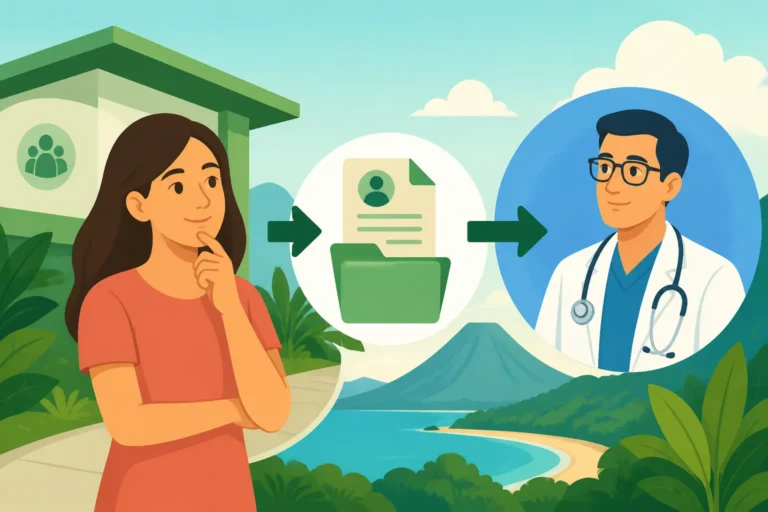
The final "mile" of the timeline involves physically going to your local EBAIS clinic to register. You cannot just go to any clinic; you must go to the one assigned to your specific neighborhood. You’ll need to bring your DIMEX (or the temporary proof of processing), a utility bill to prove your address, and your proof of Caja payment.
Once you are registered at the EBAIS, you are finally, fully "in the system." From the moment you receive your residency approval to the moment you can actually book a routine check-up at a public clinic, you should expect a total duration of 2 to 4 months. When you add that to the 18 months it took to get residency approved, the total "wait" for Caja coverage can easily span two years.
| Stage of Process | Estimated Timeframe | Critical Document Needed |
|---|---|---|
| Residency Approval Wait | 12 – 24 Months | Submission Receipt (Plantilla) |
| CCSS Office Enrollment | 1 – 2 Weeks | Resolución (Approval Letter) |
| First Payment Processing | 3 – 5 Business Days | Bill from CCSS |
| EBAIS Registration | 1 Day (In person) | Utility Bill & DIMEX |
| First Available Appointment | 1 Week – 3 Months | Registered EBAIS Record |
Why the Wait Varies by Region
If you are moving to a high-density expat area like Escazú or Santa Ana, the timelines might be slightly more predictable because the officials are used to the process. However, the sheer volume of applicants in San José can lead to longer lines. Conversely, if you are in a remote area like the Osa Peninsula or the deep mountains of Heredia, you might find that the local CCSS office is less familiar with expat residency categories, which can lead to "consultation delays" where the local clerk has to call San José to verify your paperwork.
The efficiency of the "Caja Digital" system is also a factor. Costa Rica has been moving toward the EDUS (Expediente Digital Único en Salud) app, which allows you to see your status on your phone. If your data is entered correctly from the start, your coverage might appear active within 48 hours of payment. If there is a typo in your passport number or name, it can take weeks of back-and-forth visits to the "Plataforma de Servicios" to fix the error.
Expats often ask: Is the Caja or Private Healthcare Better for Expats in Costa Rica? The answer often depends on how much patience you have for these administrative hurdles. For those who cannot afford to wait two years without any safety net, companies like SafetyWing provide a crucial bridge, offering medical coverage that works while you are still technically a "tourist" in the eyes of the CCSS. This is particularly useful because the Caja will not retroactively cover any medical bills you incurred while your residency was pending.
Documentation Pitfalls That Reset Your Clock
Nothing is more soul-crushing than standing in a line at 6:00 AM only to be told your "document is expired." To ensure your timeline doesn't stretch from months into years, you must be meticulous. One common error is the expiration of the "comprobante" or the proof of address. Most EBAIS clinics require a utility bill (water or electric) that is less than 30 days old. If you bring a bill from two months ago, they will send you home, and you may have to wait another week for a new appointment.
Another delay occurs during the transition from a passport number to a DIMEX number. When you first apply for residency, all your records are tied to your passport. Once you get your residency card, you have a new ID number. You must manually go to the Caja office to "link" these numbers. If you don't, the system might show your payments under your DIMEX but your medical records under your passport, effectively making you "uninsured" when you try to pick up medication. For more on this, read How to Use Your DIMEX to Access Healthcare in Costa Rica.
If you are a retiree, the process involves proving your pension income. If your "Letter of Income" isn't properly apostilled or translated by an official CR-certified translator, the Caja will reject your affiliation. This can add 3-6 months to your timeline as you scramble to get new documents from your home country. You can find more details on this in The Expat Guide to Joining the Caja (CCSS) in Costa Rica (2027).
Managing Health Risks While the Clock Ticks
Since we've established that getting into the Caja can be a multi-year marathon, you need a proactive strategy for the interim. Relying solely on the public system before you are fully enrolled is a high-stakes gamble. Most savvy residents use a three-tier approach to health coverage during the waiting period.
First, they use local private clinics for minor issues like infections, flu, or minor stitches. These "Consulatarios" are affordable and don't require insurance. Second, they keep a "bridge" insurance policy. Since the residency process is so long, many opt for flexible, month-to-month plans like SafetyWing, which can be canceled the moment your DIMEX and Caja card are finally in your wallet. Third, they familiarize themselves with the location of the nearest private hospital, such as CIMA or Clínica Bíblica, just in case a major emergency happens before the public system recognizes them.
It is also important to understand What Happens If I Get Sick Before My Caja Enrollment Is Complete?. If you end up in a public hospital emergency room without an active Caja account, you will be stabilized, but the billing department will treat you as a "private" payer. They will require a credit card or a cash deposit before discharge. Having your private insurance documentation ready during this "gap" period is the only way to avoid a massive out-of-pocket loss.
Final Expectations for the New Resident
In summary, do not expect to be covered the day you move into your new home in Guanacaste or the Central Valley. The timeline for Caja coverage is a slow burn that requires constant monitoring. You are looking at a 12-to-24-month wait for residency approval, followed by a 2-to-4-month administrative shuffle to get your payments and clinic registration finalized.
Be prepared for the "wait and see" culture of Costa Rican bureaucracy. If you approach the CCSS with a "Pura Vida" attitude—expecting some delays but staying persistent—the process is manageable. But if you come in expecting North American or European speed, the frustration will be immense. While you navigate this, make sure to read The Complete Guide to Healthcare in Costa Rica for Expats (2027) to understand the full scope of what you are waiting for, and consider Public vs Private Healthcare in Costa Rica: Which Should Expats Choose? to decide if you even want to rely solely on the public system once your coverage finally kicks in.
Disclaimer
The information provided in this guide is for educational and informational purposes only and does not constitute legal or professional medical advice. Immigration laws and CCSS regulations in Costa Rica are subject to frequent change. Always consult with a qualified immigration attorney or a certified insurance broker in Costa Rica to verify current requirements and timelines for your specific situation. Operating without health insurance in a foreign country carries significant financial and personal risk.