How to Choose Between Caja and Private Maternity Care in Costa Rica
Navigating the prospect of childbirth in a foreign country is a daunting experience that blends deep emotional vulnerability with intense administrative confusion. Whether you are currently staring at a positive test or planning your future family in the land of Pura Vida, this guide solves the ultimate dilemma: deciding between the public Caja system and the high-end private hospitals for your maternity journey.
Understanding the Philosophical Difference Between Public and Private Care
The choice between the public and private sectors in Costa Rica is not merely a matter of budget; it is a choice between two distinct medical philosophies. The Caja Costarricense de Seguro Social (CCSS), commonly known as the "Caja," operates on a model of socialized medicine that prioritizes medical necessity and natural intervention. When you enter the public system for maternity, you are entering a world governed by the "Ley de Parto Humanizado" (Humanized Birth Law). This legislation ensures that women have the right to a companion during birth, the right to move around, and the right to avoid unnecessary medical interventions like episiotomies unless clinically required.
In the public system, the focus is heavily on the health of the mother and baby through a standardized, high-volume protocol. You won't find private suites or gourmet meal options here. Instead, you will find some of the most experienced obstetricians in the world. Because the public hospitals handle the vast majority of high-risk pregnancies and complex neonatal cases in the country, their staff is exceptionally well-trained for emergencies. If you have a high-risk condition, many private doctors will actually recommend you stay within the Caja system because the public neonatal intensive care units (NICUs) are often better equipped than their private counterparts.
The Caja Approach to Natural Childbirth
The Caja is fiercely committed to promoting natural birth. For many expats, this is a breath of fresh air compared to the highly medicalized systems in North America. In a public hospital, midwives (obstetrical nurses) play a central role. They are the ones who will be by your side for the duration of your labor, monitoring your progress with a hands-off approach that allows the body to do its work. Doctors generally only step in during the final stages or if complications arise. This can be a transition for those used to having an OB-GYN present from the first contraction.
However, the "natural" focus also means that pain management options like epidurals are not always guaranteed or readily available upon request in the public system. While the law supports humanized birth, the reality of a busy public ward means resources are stretched thin. You might be in a labor room with several other women, separated only by curtains. This lack of privacy is one of the most significant hurdles for foreigners to overcome. You have to be mentally prepared for a communal experience where the sounds and sights of other labors are part of your journey. Understanding Maternity and Prenatal Care in Costa Rica is essential for setting your expectations regarding these public protocols.
The Private Hospital Experience and Elective Options
On the flip side, the private maternity experience in Costa Rica feels more like a stay in a boutique hotel. Hospitals like CIMA or Clinica Biblica offer private labor and delivery suites where your family can stay with you in total comfort. You choose your specific doctor, and that doctor is guaranteed to be the one who delivers your baby. This continuity of care is the primary reason most expats choose the private route. You build a relationship with your OB-GYN over nine months, and they know your birth plan inside and out.
In the private sector, you have much more control over the "how" and "when" of your delivery. If you want an epidural the moment you hit three centimeters, it is yours. If you prefer to schedule an elective C-section for logistical reasons, private hospitals are generally accommodating. This flexibility is a sharp contrast to the Caja, where C-sections are strictly reserved for medical emergencies. The trade-off, however, is the cost. While the care is world-class, it comes with a price tag that can vary wildly depending on your chosen interventions. For a deeper look at these facilities, you should research How to Use Private Hospitals Like CIMA, Clinica Biblica and Hospital Metropolitano to see which fits your geographic and medical needs.
Cost Analysis What to Expect Financially
The financial aspect of having a baby in Costa Rica is where the most significant divide exists. For residents, the Caja is effectively "free" at the point of service because you are already paying a mandatory monthly percentage of your income or a flat fee as a Pensionado. Once you are enrolled, every prenatal visit, every ultrasound, the delivery itself, and all postnatal care for both mother and child are covered. There are no co-pays, no surprise bills for the anesthesiologist, and no "room fees."
For many expat families, the peace of mind that comes with knowing a three-week NICU stay won't bankrupt them is why they stick with the public system. In the United States, a complicated birth can cost upwards of $50,000; in Costa Rica's public system, that same care is covered by your monthly contribution. This is particularly relevant for those who are still Understanding How Caja Contributions Are Calculated in Costa Rica to ensure their residency status remains valid and their coverage stays active.
The Total Cost of Caja Maternity Care
When we say the Caja is free, we mean the medical services. However, there are "hidden" costs of time and patience. You will likely spend hours in waiting rooms at your local clinic. You may need to take a day off work just for a routine blood test because the lines start at 6:00 AM. Furthermore, the Caja typically only provides two or three ultrasounds during a healthy pregnancy. If you want a 4D ultrasound or more frequent check-ins to see the baby, you will end up paying for those at a private imaging center anyway.
Most expats in the public system adopt a "hybrid" approach. They use the Caja for the actual birth and the major lab work, but they pay out-of-pocket for monthly private checkups to get that personalized attention and those extra ultrasound photos. This allows them to stay in the system for the big-ticket items while maintaining the comfort of a private relationship with a doctor who speaks their native language.
Out-of-Pocket Expenses at Private Facilities
If you choose to go fully private, you need to be prepared for a tiered pricing structure. Private hospitals usually offer "maternity packages" that include the hospital room, the nursery, and the basic supplies. However, these packages often exclude the professional fees for the OB-GYN, the pediatrician, and the anesthesiologist. You are essentially paying two separate bills: one to the hospital and one to the medical team.
A standard, uncomplicated vaginal delivery in a top-tier San Jose hospital can range from $4,000 to $6,000 total. A C-section typically starts at $7,000 and can easily climb to $10,000 if there are minor complications. It is vital to ask: Is Childbirth Expensive at a Private Hospital in Costa Rica? because the answer depends heavily on whether you have insurance or are paying "cash" prices. Many private doctors offer a discount if you pay them directly, but the hospital fees are usually non-negotiable.
| Feature | Caja (Public) | Private Hospital |
|---|---|---|
| Cost | Included in monthly residency fees | $4,000 – $10,000+ USD |
| Room Type | Shared ward (3-6 people) | Private suite |
| Doctor | Whomever is on shift | Your chosen OB-GYN |
| Pain Management | Natural focus; epidural not guaranteed | Epidural available on demand |
| NICU Access | Highly advanced, included | Advanced, but very expensive |
| Language | Primarily Spanish | Often English-speaking doctors |
Infrastructure and Facilities Where You Will Give Birth
The physical environment of your birth can significantly impact your stress levels. In the Caja system, you don't always get to choose your hospital; it is determined by where you live. If you live in the Central Valley, you might be assigned to the Hospital de las Mujeres or the Hospital Mexico. If you live in a rural area like Nosara, you might be looking at a long drive to the public hospital in Nicoya. The facilities are functional and clean, but they are utilitarian. There are no rocking chairs, no dimmable lights, and the food is standard institutional fare.
The infrastructure of the public system is designed for efficiency and safety. While the wards are crowded, the equipment in the operating rooms is modern. The real challenge for expats is the post-delivery period. In the Caja, babies are "roomed-in" with the mother immediately. While this is great for bonding and breastfeeding, it means you are responsible for the baby 24/7 in a shared room while you are still recovering from birth. Nurses are there to help, but they are often managing 10-15 other patients simultaneously.
Public Hospitals and the EBAIS System
Your journey in the public system doesn't start at the hospital; it starts at your local EBAIS (Equipo Básico de Atención Integral en Salud). This is your primary care clinic. You must How to Find and Register with an EBAIS Clinic in Costa Rica as soon as you find out you are pregnant. The EBAIS handles all your prenatal checkups. They will issue your "Carné Perinatal," a little white booklet that becomes the most important document in your life. It tracks every weight gain, every heartbeat, and every blood pressure reading.
The EBAIS system is a wonderful community resource, but it requires you to follow a very strict schedule. If you miss an appointment, it can be a bureaucratic nightmare to get back on the list. For many expats, the cultural hurdle here is the lack of "customer service." In the EBAIS, you are a patient in a system, not a client at a business. Learning to navigate this with grace and a lot of "muchas gracias" is key to a smooth experience.
Private Hospitals Like CIMA and Clinica Biblica
Private hospitals offer an environment that is the polar opposite of the EBAIS. Places like CIMA in Escazu or Clinica Biblica in downtown San Jose are JCI-accredited, meaning they meet international standards for safety and quality. The labor rooms are often "LDR" rooms, meaning you Labor, Deliver, and Recover in the same private space. You have a private bathroom, a sofa for your partner, and sometimes even a view of the mountains.
The staff-to-patient ratio in private hospitals is much lower. You will have a dedicated nurse who checked on you every hour. After the birth, the baby can be taken to the nursery for a few hours if you need to sleep—a luxury that does not exist in the public system. For families who do not speak fluent Spanish, these hospitals are a sanctuary. Most of the specialists and many of the nurses speak excellent English, which reduces the chance of terrifying misunderstandings during the heat of labor. You should know How to Choose a Private Hospital in San Jose based on their neonatal capabilities, as not all private clinics have high-level NICUs.
The Role of Health Insurance and Documentation
One of the most complex parts of maternity in Costa Rica is ensuring you have the right to care. If you are a legal resident, you are required to have Caja coverage. This is non-negotiable. Even if you plan to give birth in a private hospital and pay cash, you still need to be registered with the Caja. Why? Because the Caja is responsible for the official registration of the birth and the mandatory vaccinations for the baby.
If you are in the middle of your residency process, you might find yourself in a "gray zone" where you don't yet have your DIMEX card but are already living in the country. This is where products like SafetyWing can be a literal lifesaver. While many international plans exclude maternity if you are already pregnant, having a robust travel or nomad insurance policy like SafetyWing can cover unexpected emergencies or complications that occur outside of the routine maternity path. It’s a vital safety net while you wait for your residency to be finalized.
Navigating Residency and the Caja Requirement
To use the public maternity system, you must have your paperwork in order. You will need to show your DIMEX or the "comprobante" (receipt) that your residency is in process. It is important to know How to Use Your DIMEX to Access Healthcare in Costa Rica because the clerks at the hospital will ask for it before they even check your dilation. If you are a "Pensionado" or "Rentista," your dependents are typically covered under your plan, but you must ensure your spouse is specifically listed on your account.
If you are not yet a resident and find yourself pregnant, the Caja is still required by law to treat you during an emergency labor situation, regardless of your status. However, they will bill you for the services afterward, and those "tourist" prices in the public system can sometimes be higher than the "cash" prices at a mid-range private hospital. It is always better to be proactive. If you are still in the application phase, make sure you understand How to Enroll in the Caja (CCSS) as a Foreigner in Costa Rica to avoid a logistical nightmare in your third trimester.
Utilizing Private Insurance and Supplemental Coverage
Many expats use a combination of private insurance and the Caja. Local insurance companies like INS (Instituto Nacional de Seguros) offer maternity riders, but they usually have a 10-month waiting period. This means you must have the insurance before you get pregnant. If you are already pregnant, your best bet is to look at your international policy or prepare to pay out-of-pocket. SafetyWing is often used by digital nomads in Costa Rica to cover the "what ifs" that aren't related to the birth itself, providing a layer of protection that the Caja might not cover if you are traveling between regions or countries.
When using private insurance at a hospital like CIMA, you need to understand the concept of "direct billing" versus "reimbursement." Some international plans allow the hospital to bill the insurance company directly, meaning you only pay your deductible. Others require you to pay the full $6,000 upfront and then fight for reimbursement later. Always call your insurance provider three months before your due date to "pre-authorize" the birth. This avoids the stress of your credit card being declined while you are holding a newborn.
Logistical Considerations and Cultural Nuances
Beyond the medical and financial, there are the logistical realities of having a baby in Costa Rica. For instance, the "Apellido" system. In Costa Rica, a baby takes two last names: the father’s first last name followed by the mother’s first last name. If you are from a country that only uses one last name, this can cause confusion with your home embassy later. You need to be very clear with the hospital staff about how you want the name recorded on the birth certificate.
Culturally, Costa Ricans are very warm toward pregnant women and babies. You will find that you are often ushered to the front of lines at the bank or the grocery store (the "Ley de Preferencia"). However, this warmth also comes with a lot of unsolicited advice. Don't be surprised if a stranger in the street tells you your baby is too cold or that you shouldn't be eating pineapple. It’s all meant with love, but for a tired new expat mom, it can be overwhelming.
Postnatal Care and Pediatric Follow-ups
After you leave the hospital, the care continues. If you are in the Caja, you will be expected to bring the baby back to the EBAIS for weight checks and vaccinations according to a strict schedule. The public system is excellent at tracking childhood development. They will provide you with a "Libreta de Salud del Niño," which you must bring to every single appointment. Losing this book is considered a minor tragedy in the Costa Rican medical world. You will need to know How to Add Dependents to Your Caja Coverage in Costa Rica to ensure the baby's appointments are fully covered under your residency status.
If you are going the private route, you will choose a pediatrician who likely has an office near your delivery hospital. Private pediatricians are much more accessible via WhatsApp—the primary mode of communication in Costa Rica. Being able to text your doctor a photo of a weird rash at 9:00 PM is a luxury that many expats find worth every penny of the $80-$100 consultation fee.
Language Barriers and Support Systems
Unless you are fluent in Spanish, the language barrier in the Caja system will be your biggest hurdle. During labor, when you are tired and in pain, trying to translate medical terms can lead to significant stress. While many doctors in the public system speak some English, the nurses and support staff often do not. If you choose the Caja, it is highly recommended to hire a bilingual doula. A doula can act as your advocate, translator, and emotional support, bridging the gap between your needs and the hospital’s protocols.
In the private sector, the language barrier is almost non-existent. However, the support system can still feel thin if you don't have family in the country. Costa Rica doesn't have the same "postpartum doula" or "night nurse" culture that has become popular in the US or Europe. You will largely be relying on your partner or friends you’ve made in the expat community. Fortunately, the expat community in areas like the Southern Zone or Guanacaste is incredibly tight-knit and usually rallies around a new mother with meal trains and advice.
Comparing the Journey Caja vs Private
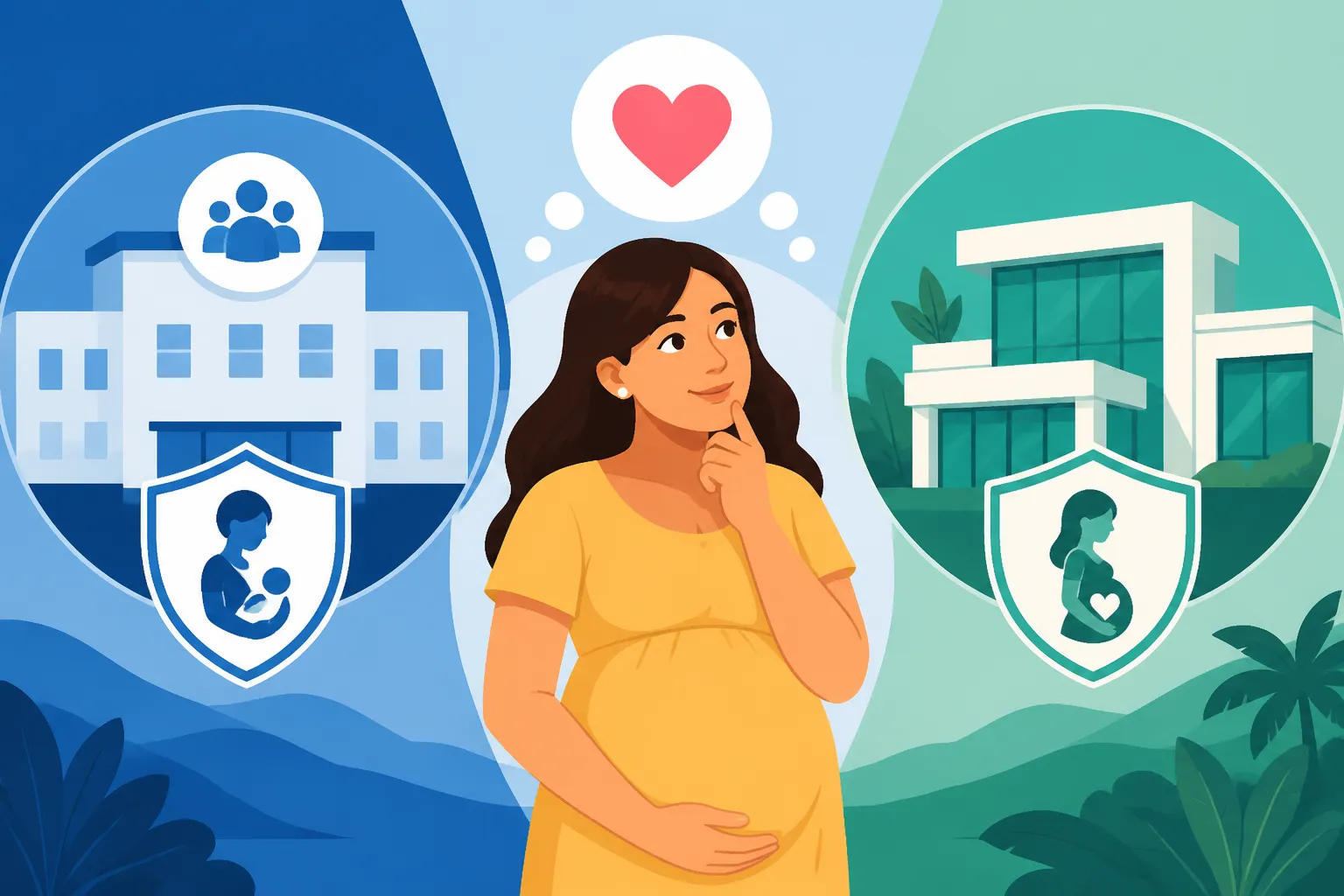
Choosing between these two paths requires an honest assessment of your priorities. Are you a "worst-case scenario" planner who wants the security of the country's best NICU and don't mind a shared room? The Caja is for you. Are you someone who values privacy, English communication, and being able to schedule your care? The private route is likely your best fit.
Many families find the "Middle Path" to be the most successful. They register with the Caja and attend all their EBAIS appointments to ensure the baby is "in the system" for future residency and vaccination needs. Simultaneously, they see a private OB-GYN for monthly checkups and ultrasounds. When the big day comes, they head to a private hospital for a comfortable birth, knowing that if a truly catastrophic medical emergency occurred, they could be transferred to a public specialist facility.
Remember, once the baby is born, you have a whole new set of tasks. You must How Do I Register My Newborn for Caja Coverage in Costa Rica? within the first few weeks to ensure their health is protected from day one. Regardless of the path you choose, the medical care in Costa Rica is among the best in Latin America, and your new "tico" or "tica" will be welcomed into a society that truly values family.
Disclaimer
The information provided in this guide is for educational and informational purposes only and does not constitute professional medical or legal advice. Healthcare regulations and costs in Costa Rica are subject to change. Always consult with a qualified medical professional and a residency attorney to discuss your specific situation and ensure compliance with current Costa Rican laws.