Can My Children Get Residency in Costa Rica Through Me?
Moving to a new country like Costa Rica is exhilarating, but for parents, one of the biggest anxieties is often: how do I ensure my children are legally settled with me? It's not just about finding the right school or making friends; it's about navigating the often-complex immigration system to ensure your whole family has a secure future here. This guide will meticulously walk you through the process of obtaining residency for your children based on your own approved status in Costa Rica, helping you understand the requirements, challenges, and what to expect every step of the way.
The Foundation: Your Residency Status as a Parent
Let's be real, the Costa Rican immigration system, or Migración, can feel like a labyrinth. But for your children, the path to residency is almost always directly tied to yours. Essentially, you need to have a solid, approved residency status first. It's like building a house – you need a strong foundation before you can put up the walls and roof. Without your own legal standing, it's nearly impossible to petition for your kids, so that's where all your initial focus should be.
Different Parent Residency Categories and Their Impact
Costa Rica offers several residency categories that expats typically pursue, and each one can serve as the anchor for your children's applications. Knowing which category you fall under, or plan to apply for, is crucial because it dictates the documentation and even the timeline for your family's applications.
For instance, if you're coming in under the popular How to Get the Pensionado (Retiree) Residency in Costa Rica (2027) category, which requires a minimum of $1,000 USD per month from a permanent pension or retirement fund, your children's applications will lean on your proof of this stable income. Similarly, if you’re a The Expat Guide to the Rentista Residency in Costa Rica (2027), demonstrating $2,500 USD per month in passive income, or providing the required $60,000 USD deposit, forms the backbone of their dependency claim. The Inversionista (Investor) Residency in Costa Rica: A Complete Guide (2027) requires a significant investment in the country, and again, this investment is what supports your family's legal stay. Even the newer The Complete Guide to the Costa Rica Digital Nomad Visa (2027) allows for dependents, linking their approval directly to your digital nomad status and income proof. The key takeaway is: get your own residency sorted and approved first, because it's the bedrock for everyone else.
The Importance of "Vínculo" (Family Tie)
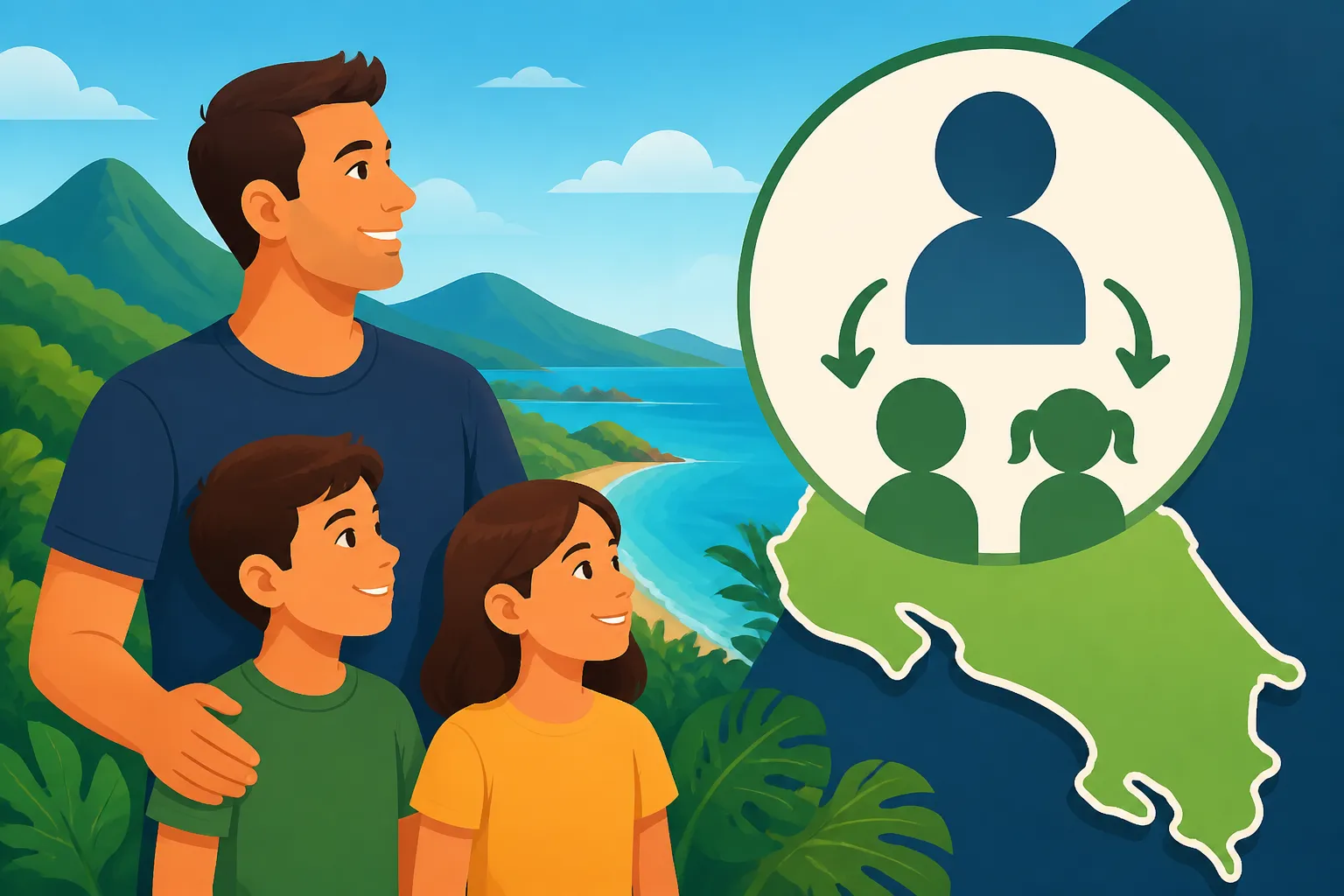
Costa Rican immigration law places significant emphasis on the concept of "vínculo," which translates to "family tie" or "bond." For minor children, this vínculo is pretty straightforward: they are your direct legal dependents. Migración understands that families move together, and the law provides a clear path for children to follow their parents into residency.
This means that once you have your temporary or permanent residency approved, your children can apply under your "amparo" (protection or sponsorship). It’s not a separate, independent application process for them in the same way it would be for you, the primary applicant. Instead, their application relies heavily on proving their direct relationship to you, their legal guardian, and demonstrating their financial dependence. The bureaucratic language might sound cold, but the intent is to keep families together, which is a comforting thought when you're wading through paperwork. This legal framework is what makes it possible for your little ones to join you on your Pura Vida adventure, ensuring they too can legally live, study, and access services in Costa Rica.
Sponsoring Your Minor Children for Residency
Once your own residency is in motion, or ideally, already approved, the focus shifts to bringing your children into the fold. This is where the specific details of their individual applications come into play, always tethered to your primary status. It's a journey that requires patience, meticulous document gathering, and a healthy dose of understanding for the local bureaucracy.
Who Qualifies as a "Child" Under Costa Rican Law?
When we talk about "children" in the context of Costa Rican immigration, there are specific definitions you need to be aware of. Generally, the law considers minors to be individuals under 18 years of age. For them, proving dependency is usually quite simple – they're minors, and their legal guardians (you!) are naturally responsible for their care and upkeep.
However, it's not always a strict cut-off at 18. In some cases, Costa Rican law may extend the dependency to children up to 25 years old if they are unmarried, solely dependent on their parents, and enrolled in a recognized educational institution. This is a crucial point for families with older children attending university or vocational schools. You'll need to provide robust proof of their enrollment and financial dependence, such as tuition receipts, letters from the educational institution, and bank statements showing your support. Furthermore, the "child" category generally includes biological children and legally adopted children. Stepchildren can also be included, but this often requires additional documentation to prove the legal relationship and the step-parent's full legal responsibility and care for them, which can add another layer of complexity to the already hefty stack of paperwork.
The Application Process: Key Steps and Documents
The application process for your children will mirror many of the steps you took for your own residency, but with a few key differences focused on proving their identity and their relationship to you. It's a paper-heavy process, so get ready to organize!
Firstly, you'll need all the standard identification documents for each child: a valid passport, authenticated birth certificate, and if applicable, adoption papers or marriage certificates for step-parents. Just like your own documents, these generally need to be apostilled in their country of origin and then translated into Spanish by an official translator here in Costa Rica. I can't stress enough how important it is to have these translations done by an approved translator; Migración is very particular about this. You can find more comprehensive details about this often-frustrating step in Understanding the Documents and Apostille Needed for Residency in Costa Rica.
Next comes proof of your relationship. Their birth certificates, clearly listing you as a parent, are paramount. For adopted children, the official adoption decree is required. If only one parent is applying and sponsoring the children, you’ll typically need a notarized letter of consent from the other parent, granting permission for the children to reside in Costa Rica, or proof of sole custody. Finally, you’ll need to provide proof of their financial dependence on you. This ties back to your own residency application; your income or investment documents (bank statements, pension letters, company records) will serve as proof that you can support your entire family. These documents are submitted to the Directorate General of Migration and Foreigners (DGME). While the official language is Spanish, don't worry, many immigration lawyers who specialize in expat cases are bilingual and can help bridge that gap. Expect this process to be lengthy; it's part of the charmingly slow pace of Costa Rican bureaucracy, so brace yourself for the typical Understanding the Cost and Timeline of the Residency Process in Costa Rica.
A Look at Necessary Documents for Your Child's Residency
To give you a clearer picture, here's a general checklist of the documents you'll need for each child. Remember, Migración can always request additional items, so it's best to be over-prepared.
| Document Type | Specific Requirement | Notes |
|---|---|---|
| Identification | Valid Passport | Original and multiple copies of all pages (even blank ones). Must have at least 6 months validity. |
| Birth Certificate | Original, apostilled in country of origin, and officially translated to Spanish. | |
| Parental Relationship | Parental Consent (if applicable) | Notarized letter from non-applying parent granting permission for residency in Costa Rica, or proof of sole custody. |
| Adoption Decree (if applicable) | Original, apostilled, and officially translated. | |
| Financial Dependency | Proof of Parent's Approved Residency | Copy of your DIMEX card or residency approval letter. |
| Parent's Income/Investment Proof | Copies of bank statements, pension letters, or investment certificates that demonstrate your ability to support the family (as submitted for your own residency). | |
| Criminal Record | Criminal Record Check (for children 12+) | From country of origin, apostilled, and translated. Check current age requirements with Migración as these can change. |
| Other | Five Passport-sized Photos | Specific requirements for size and background (usually white), check Migración guidelines. |
| Consular Registration (if requested) | Some countries require their citizens to register with their embassy/consulate in Costa Rica. | |
| Application Form and Fingerprints | Completed application form (provided by Migración), fingerprinting done locally. |
Common Hurdles and Practical Advice for Family Applications
Alright, let's talk turkey. While the path exists, it's rarely a perfectly smooth, straight highway. There are bumps, detours, and sometimes even roadblocks. Having lived through this myself, I can tell you that anticipating these challenges and having a game plan is half the battle. This is where your inner Tico patience really gets tested!
Documentation Challenges and Apostilles
I cannot overstate how much of a headache the documentation process can be, especially the apostille requirement. Every single foreign-issued document – your child's birth certificate, adoption papers, and depending on their age, even their police background check – must have an apostille from the issuing country. This is an international certification that verifies the authenticity of the document's signature and seal. Without it, Migración won't even look at your papers.
Then, once apostilled, these documents must be translated into Spanish by an official Costa Rican translator. Not just any translator, mind you, but one approved by the Ministry of Foreign Affairs. If you use a non-approved translator, even if they're perfectly fluent, you'll be rejected. I know expats who’ve had documents sent back and forth across continents multiple times, costing them precious time and money. It can be incredibly frustrating, especially when you're just trying to get your family settled. My advice? Start gathering and authenticating these documents well in advance of your move, or at least before you start the application process. Consider using a reputable international moving service like Sirelo that can help you understand the logistics of getting sensitive documents safely and efficiently to Costa Rica.
Financial Dependency and Proof
For your children's residency, you'll need to clearly demonstrate that they are financially dependent on you. While this might seem obvious for minors, Migración wants concrete proof. This proof usually comes directly from the same financial documentation you used for your own residency application. If you’re a How to Get the Pensionado (Retiree) Residency in Costa Rica (2027), your pension statements are your proof. If you’re a The Expat Guide to the Rentista Residency in Costa Rica (2027), your bank statements showing the required monthly income or the certificate of deposit will be essential.
For older children (those 18-25 still seeking dependency residency), you’ll need even more robust evidence. This could include tuition invoices from their educational institution, official enrollment letters, and bank transfers showing you regularly provide funds for their living expenses. Be prepared for Migración to scrutinize this, as they want to ensure the child isn't just trying to circumvent other residency requirements. It’s about clearly showing that your income or investment is not just supporting you, but extends to every dependent listed on your application.
Managing Timelines and Expectations
If there's one piece of advice I can give about the Costa Rican immigration process, it's this: Patience is not just a virtue, it's a survival skill. The timelines for residency, especially for family applications, can be lengthy. While your initial application might take anywhere from 6 to 18 months (or even longer, depending on your category and the complexity of your case), adding dependents can sometimes extend this. Each application, even for a child under your umbrella, goes through its own review process.
During this waiting period, your children, like you, will technically be in Costa Rica on a tourist visa until their residency is approved. This means they'll need to adhere to the 90-day tourist visa rules, which might involve doing visa runs to a neighboring country every three months. This can be a huge hassle and a significant expense, especially for a family. This is why many expats choose to work with an experienced immigration lawyer from the outset, to help streamline the process as much as possible and advise on legal ways to maintain status during the wait. While waiting for your full Caja coverage (the public healthcare system) to kick in once residency is approved, it’s also wise to consider private international health insurance options like Cigna Global to ensure your family is covered for any unexpected medical needs. This waiting period is also why it's so critical to understand The Complete Guide to Costa Rica Residency for Expats (2027) in its entirety, as your foundation truly impacts your children's journey.
After Approval: Your Children's DIMEX and Rights
The day you get the call that your family's residency is approved is a momentous occasion, a huge weight off your shoulders. But the journey isn't quite over. There are still crucial steps to take to ensure your children are fully integrated into life in Costa Rica.
Obtaining the DIMEX Card
Once Migración gives the green light, the next step is to obtain your children's DIMEX (Documento de Identificación Migratoria para Extranjeros) cards. This is their official identification card as residents of Costa Rica, similar to a national ID card, and it's absolutely essential. You'll need to schedule an appointment (usually online) at one of the Migración offices or at a local bank like Banco de Costa Rica (BCR) or Banco Promerica that processes DIMEX cards.
For the appointment, each child will need their passport, the official approval letter from Migración, and a receipt proving they've paid the required fees. They will also have their fingerprints taken and photos captured on site. It's a fairly quick process once you get the appointment, but booking it can sometimes be a test of patience, especially during peak times. Ensure you keep copies of everything, and remember to carry your DIMEX card and theirs once you have them. This card is not just an ID; it's their key to How to Use Your DIMEX to Access Healthcare in Costa Rica and other essential services.
Access to Services and Education
With their DIMEX cards in hand, your children officially have the same rights as any other temporary resident in Costa Rica, and that opens up a world of possibilities. One of the most significant benefits is access to the national healthcare system, the Caja Costarricense de Seguro Social (CCSS). Just as you're required to enroll in the Caja as a resident, your children will be added to your coverage. This is a huge relief for parents, knowing that quality medical care is available without the often-exorbitant costs of private care. You can learn more about this vital system in The Expat Guide to Joining the Caja (CCSS) in Costa Rica (2027) and understand How the Caja Requirement Connects to Your Residency in Costa Rica.
Beyond healthcare, your children can now officially enroll in schools, whether that's public, private, or international. This eliminates any ambiguity about their legal right to education. Many expat families prioritize finding the right school, and this step makes the enrollment process much smoother. For a deeper dive into the educational landscape, check out Schools and Education in Costa Rica: A Complete Guide for Expat Families and How to Enroll Your Child in a Costa Rican School. With their DIMEX, they can also pursue other activities, join local sports teams, or simply enjoy life here without the constant worry of visa runs or uncertain legal status. It truly signals the beginning of their new life as official members of the Costa Rican community.
Disclaimer
The information provided in this guide is for general informational purposes only and does not constitute legal or immigration advice. While we strive to keep the information up-to-date and accurate, Costa Rican immigration laws and procedures can change frequently. It is highly recommended to consult with a qualified Costa Rican immigration attorney or official Migración channels for personalized advice regarding your specific situation and the most current requirements. Relying solely on the information presented here without professional verification is at your own risk.