How Costa Rica’s Health System Works: The Caja (CCSS) vs Private Explained (2027)
One of the most daunting challenges foreigners face when moving to Costa Rica is deciphering a medical system that feels like two completely different worlds existing in the same space. You are legally required to pay into a public system that can be notoriously slow, yet the allure of world-class private hospitals is often what draws people here. This guide solves the confusion by breaking down exactly how the Caja and private systems interact, ensuring you never overpay or find yourself without care during a crisis.
Understanding the Foundation of Costa Rican Healthcare
When you first arrive in Costa Rica, the concept of "universal healthcare" sounds wonderful in a brochure, but the reality on the ground is a complex web of bureaucracy and social responsibility. Costa Rica operates on a dual-tier system. On one side, you have the Caja Costarricense de Seguro Social, commonly referred to as "the Caja." On the other side, you have a thriving private sector that rivals the best hospitals in North America or Europe. Understanding how these two entities coexist is the first step toward a stress-free life in the tropics.
The Philosophy of Universal Coverage
The Caja is the backbone of the Costa Rican social fabric. Founded in the 1940s, its mission is to ensure that every person within the borders of the country—regardless of their ability to pay—has access to medical care. This is funded by a mandatory payroll and income-based contribution system. For a Tico (a local), the Caja is a point of national pride. It has led to some of the highest life expectancy rates in the Western Hemisphere, often outperforming the United States.
However, for an expat, the philosophy can sometimes clash with the practical need for efficiency. Because the system is designed to be all-encompassing, it is frequently overwhelmed. You will see lines at the local clinics before the sun rises, and specialist appointments can sometimes be scheduled months or even years into the future. It is a system built on the principle of equity, not necessarily speed. This is why many expats find that The Complete Guide to Healthcare in Costa Rica for Expats (2027) is essential reading for setting realistic expectations.
The Mandatory Nature for Residents
If you are planning to obtain legal residency in Costa Rica, the Caja is not optional. Whether you are applying as a Pensionado, Rentista, or Inversionista, you will be required to prove that you are an active, paying member of the CCSS before your DIMEX (residency card) is issued or renewed. This often leads to a "double-paying" scenario where expats pay their mandatory monthly Caja dues but also maintain private insurance or pay out-of-pocket for private care.
This mandatory contribution is often a sticking point for many. You might feel frustrated paying hundreds of dollars a month into a system you rarely use, but it is important to view this as a "social tax" that grants you the right to live in this beautiful country. It also serves as a critical safety net for catastrophic care, which we will discuss later. For those in the transitional phase of moving, a temporary solution like SafetyWing can provide necessary coverage while the residency paperwork and Caja enrollment are being processed.
The Evolution of the System
As we move forward, the system has seen significant digital upgrades. The EDUS (Expediente Digital Único en Salud) app is now the standard for interacting with the public system. It allows you to see your appointments, check your medication history, and even view where you are in the queue for certain procedures. While the technology has improved, the core tension between the high volume of patients and the limited number of specialists remains.
Furthermore, the government has become more stringent about ensuring that income declarations for Caja payments match the figures reported to the tax authorities (Hacienda). This means the days of "estimating" a low income to save on health contributions are largely over. Expats are now navigating a more transparent but more expensive landscape. Understanding Public vs Private Healthcare in Costa Rica: Which Should Expats Choose? is more relevant now than ever as the cost-benefit analysis continues to shift.
The Caja (CCSS): Your Mandatory Public Safety Net
The Caja is a comprehensive system that includes everything from neighborhood clinics to high-tech trauma centers. It covers doctor visits, surgeries, hospitalizations, and all medications. There are no deductibles, no co-pays, and no premiums based on age or pre-existing conditions. Once you are in, everything is covered. This is the ultimate peace of mind for many, even if they choose to go private for their day-to-day needs.
How Contributions are Calculated
The cost of your Caja membership is not a flat fee; it is a percentage of your declared income. For employees, this is deducted directly from the paycheck. For independent contractors or those on residency visas, the calculation is done by a CCSS officer during your registration. They will look at your residency category and the income you used to qualify for that residency.
For example, if you are here as a Pensionado, your fee is based on your pension amount. If you are an Inversionista, it may be based on a projected income or a minimum threshold set by the state. This leads to a lot of questions among retirees, specifically Do Pensionado Residents Have to Pay Into the Caja in Costa Rica? because the answer is a definitive yes, and the amount can vary significantly based on the current exchange rate and the brackets set for the year. Currently, you can expect to pay anywhere from 7% to 12% of your declared income.
What is Covered Under the Public System
The breadth of coverage under the CCSS is staggering. It includes preventive care, emergency services, dental (mostly extractions and basic cleaning), maternity, and even complex oncology or cardiac treatments. If you are diagnosed with a chronic condition like diabetes or hypertension, the Caja will provide your monthly medications for life at no additional cost.
However, the "Caja list" of medications is specific. They typically provide generic versions or specific brands they have contracted with. If you require a very specific, high-end brand of medication not on the list, you may still need to purchase that at a private pharmacy. This is a common realization for many foreigners, and it's worth checking How Much Does Caja (CCSS) Cost per Month in Costa Rica in 2026? to see how the rising costs of medication procurement are affecting the monthly contribution tiers.
The EBAIS: Your First Line of Defense
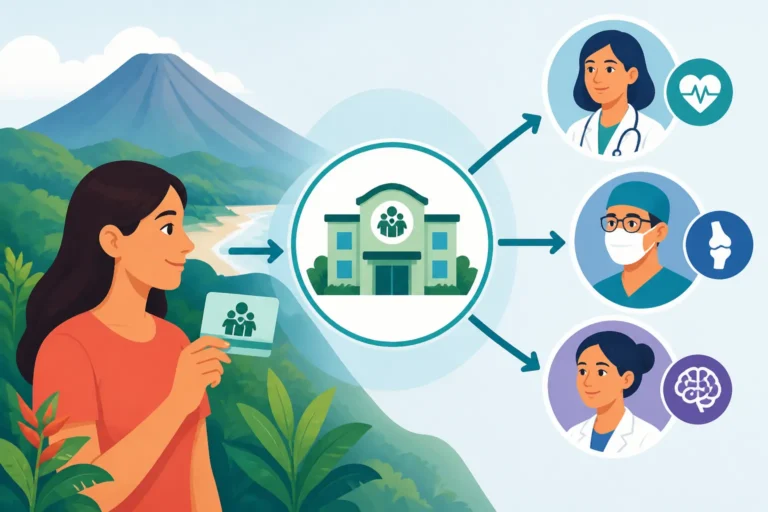
The EBAIS (Equipos Básicos de Atención Integral en Salud) are the local clinics found in almost every community. This is where your journey in the public system begins. You are assigned to a specific EBAIS based on where you live. For routine issues like a flu, a minor infection, or a referral to a specialist, you must go here first.
Learning How to Find and Register with an EBAIS Clinic in Costa Rica is one of the first administrative tasks you should tackle after getting your residency. You will need to bring your DIMEX, a utility bill to prove your address, and your Caja payment receipt. Once registered, you are "in the system." The EBAIS experience is very "local"—doctors are often young residents doing their community service, and while many are excellent, English is not guaranteed. It is a humble but functional part of the system that handles the vast majority of the country's medical needs.
Private Healthcare: Quality and Speed for a Price
For many expats, the private healthcare system is where they spend most of their time and money. It offers the convenience of same-day appointments, luxury hospital rooms, and a high concentration of English-speaking specialists who have often trained in the United States or Europe. In the private sector, you are the customer, and the service reflects that.
The Major Private Hospitals in the Central Valley
Most of the top-tier private healthcare is concentrated in the Greater Metropolitan Area (GAM), specifically in San José, Escazú, and Santa Ana. The "Big Three" are Hospital CIMA, Clínica Bíblica, and Hospital Metropolitano. Each of these facilities is JCI-accredited, meaning they meet international standards for patient safety and care.
Hospital CIMA in Escazú is often the first choice for North Americans because of its proximity to expat hubs and its ultra-modern facilities. Clínica Bíblica, located in the heart of San José, is the oldest private hospital and has a stellar reputation for complex surgeries. Hospital Metropolitano has grown rapidly by offering a more "middle-ground" price point while still maintaining high standards. Knowing How to Use Private Hospitals Like CIMA, Clinica Biblica and Hospital Metropolitano can save you a lot of time when you are trying to decide where to go for a specific procedure or emergency.
English-Speaking Doctors and Personalized Care
One of the greatest anxieties for expats is the language barrier during a medical crisis. In the private system, this barrier almost disappears. A large majority of private specialists are fluent in English. They are accustomed to working with international patients and are often more than willing to spend 30 to 45 minutes explaining a diagnosis—a luxury you rarely get in the time-strapped public system.
This personalized care extends to how you book appointments. You can often WhatsApp a doctor's office directly to schedule a visit for the following afternoon. There is no need for a "gatekeeper" referral from a general practitioner; if you want to see a cardiologist, you simply call one and book it. This level of autonomy is why many choose to pay the out-of-pocket costs, even while being enrolled in the Caja.
Out-of-Pocket Costs vs. Insurance
Private care in Costa Rica is significantly cheaper than in the U.S., but it is not "cheap." A specialist consultation will typically run you between $80 and $150. An MRI might cost $500 to $800. For minor issues, many expats simply pay out-of-pocket. However, for major surgeries or hospitalizations, costs can quickly climb into the tens of thousands of dollars.
This is where private insurance comes in. You can opt for local policies from INS (the state insurance provider) or international policies. Many nomads and those in transition rely on SafetyWing for its flexibility and ease of use before they commit to a long-term local plan. Having a solid understanding of Health Insurance in Costa Rica: Caja, INS and International Options Explained is vital for protecting your savings. While a $20,000 surgery in Costa Rica is a bargain compared to $100,000 in the U.S., it’s still a significant hit if you aren't insured.
Navigating the Administrative Hurdles of Both Systems
Living in Costa Rica requires a certain level of "patience with paperwork." Neither the public nor the private system is entirely immune to bureaucracy, though they manifest it in different ways. Success in navigating healthcare here depends on having your documents in order and knowing the local "rules of the game."
Using Your DIMEX for Access
Your DIMEX is your golden ticket. In the public system, it is your primary identifier. Every time you visit the EBAIS or a hospital, you will be asked for your "cedula" (the local term for ID). The system is now integrated, so once they scan your card, your entire medical history and your current payment status pop up on the screen.
If your Caja payments are not up to date, you will likely be denied non-emergency care until the balance is cleared. This is a common headache for people who forget to pay their monthly bill or whose automatic bank transfer fails. It is also important to know How to Use Your DIMEX to Access Healthcare in Costa Rica for non-medical interactions, as your health status is often linked to other government services. In the private system, the DIMEX is also preferred, though they will often accept a passport for tourists or those with pending residency.
The Specialist Referral Maze
This is where the public system's "philosophy of equity" becomes a practical hurdle. You cannot simply walk into a Caja hospital and ask to see a neurologist. You must go to your EBAIS, see a general practitioner, and convince them that your condition warrants a specialist. If they agree, they enter a request into the system.
The wait time for that referral can be the most frustrating part of living here. For non-life-threatening issues, you might wait six months for an initial consult. This is why the "Hybrid Approach" is so popular: expats will see a private specialist for a quick diagnosis and then take that private report back to their EBAIS doctor. While the Caja isn't required to honor a private doctor's recommendations, a well-documented report from a respected private surgeon can often help "grease the wheels" of the referral process. This nuance is explored deeply in How Specialist Referrals Work Through the Caja in Costa Rica.
Comparing the Systems at a Glance
| Feature | The Caja (CCSS) | Private Healthcare |
|---|---|---|
| Cost | Mandatory % of income (No co-pays) | Out-of-pocket or Insurance |
| Wait Times | Can be very long (months/years) | Immediate to same-week |
| Language | Primarily Spanish | High English fluency |
| Facilities | Functional, sometimes crowded | Modern, luxury amenities |
| Medication | Included (Caja list generics) | Full price (Brand name available) |
| Coverage | Universal (no exclusions) | Policy-dependent (pre-existing rules) |
Health Insurance Options for Expats
By 2026, the insurance market in Costa Rica has matured significantly. Expats no longer have to rely solely on the state-run INS policies, which used to have strict age limits and exclusions. Today, there are various ways to bridge the gap between the mandatory Caja and the high cost of private hospitals.
Public vs Private Insurance: Which Should Expats Choose?
The decision between relying solely on the Caja or adding a private policy often comes down to your budget and your health history. If you are young and healthy, you might feel that the Caja is enough for emergencies and you can pay cash for the occasional private doctor visit. However, as you age, the desire for comfort and speed usually wins out.
A private policy through a provider like INS or an international company allows you to bypass the Caja queues entirely for surgeries and diagnostic tests. It gives you access to the "Big Three" hospitals without worrying about the final bill. When weighing these options, reading Public vs Private Healthcare in Costa Rica: Which Should Expats Choose? can help you calculate the "real cost" of each path based on your specific age bracket and medical needs.
International Policies and Digital Nomad Coverage
The rise of the Digital Nomad visa has introduced a new category of healthcare needs. These individuals are often in Costa Rica for a year or two and don't want to get tangled in the long-term residency/Caja process immediately. For this group, international travel medical insurance like SafetyWing is a literal lifesaver. It meets the government's insurance requirements for the visa and provides global coverage.
International policies are also popular with "perpetual tourists" or those who split their time between Costa Rica and their home country. These plans often cover you in both locations, which the local INS plans do not. The flexibility to be treated at CIMA in San José or a hospital in Miami is a major selling point for high-net-worth expats.
Medication and the Farmacia System
The pharmacy (farmacia) in Costa Rica is more than just a place to pick up pills; it is a primary healthcare hub. Pharmacists here have more authority than in many other countries. For minor ailments—a skin rash, a stomach bug, or a mild respiratory infection—the pharmacist (regente) can often recommend and dispense treatment without a doctor's prescription.
Prescription Protocols in Costa Rica
While the system is flexible, it is not a free-for-all. Since 2022, Costa Rica has moved to an electronic prescription system (Receta Digital) for many controlled substances, including antibiotics, strong painkillers, and psychotropic drugs. You can no longer just walk in and buy Amoxicillin because you have a sore throat. You will need a prescription from a licensed Costa Rican doctor, which is then uploaded to a national database.
This digital shift has made Understanding the Costa Rican Pharmacy (Farmacia) System a critical task for anyone with chronic conditions. If you bring a prescription from the U.S. or Canada, a local pharmacy cannot fill it directly. You must take that foreign prescription to a local doctor (either private or Caja), who will then issue a Costa Rican equivalent.
Generic vs Brand Name Availability
In the Caja, you get what is on the list—period. In the private sector, you have much more choice. Most private pharmacies carry both the expensive brand-name drugs from international pharmaceutical giants and the much cheaper "genéricos." Costa Rica has a robust domestic pharmaceutical industry, and many of the local generics are of high quality.
However, be aware that some brand-name drugs can actually be more expensive here than in the U.S. due to import taxes and the smaller market size. If you are on a specific medication, it is wise to research the local name and price before you move. Many expats find that their monthly "maintenance" drugs are one of their largest recurring expenses if they choose to buy them privately rather than going through the Caja process.
Making the Choice: A Hybrid Approach
After years of living here, most veterans will tell you that the "correct" way to do healthcare in Costa Rica is not an "either/or" choice, but a "both/and" strategy. This hybrid approach allows you to leverage the strengths of both systems while mitigating their weaknesses.
Why Most Expats Use Both Systems
The strategy is simple: use the private system for anything where time, comfort, or communication is paramount. This includes specialist consultations, diagnostic imaging (ultrasounds, MRIs), and minor outpatient surgeries. You get your answers in days, not months, and you can speak to your doctor in English.
Then, you use the Caja for the "big stuff." If you are in a major car accident or require a $100,000 heart surgery, you want to be in the Caja. The public hospitals, like Hospital México or San Juan de Dios, have the most advanced trauma equipment and the highest-ranked surgeons in the country. By being a paying member of the Caja, you have a "catastrophic insurance policy" that never expires and can't cancel you. This dual-layered protection is the secret to long-term peace of mind in Costa Rica.
Budgeting for Total Healthcare Costs
When you sit down to do your monthly budget, you should account for three things:
- Your mandatory Caja contribution (the "social tax").
- A "slush fund" or private insurance premium for the private system.
- Out-of-pocket costs for brand-name medications.
For a couple in their 60s, this might look like $150-$300 for the Caja and another $200-$400 for a solid private insurance policy. While $700 a month might sound high, remember that this covers everything with virtually zero additional risk. Compared to the deductibles and out-of-pocket maximums in the U.S., it is often still a massive saving. For those still in the planning stages, using a flexible option like SafetyWing can help bridge the gap while you figure out your long-term residency and insurance needs.
Disclaimer
This guide is for informational purposes only and does not constitute professional medical or legal advice. Healthcare laws, Caja contribution rates, and insurance regulations in Costa Rica are subject to change. Always consult with a licensed Costa Rican attorney or a certified insurance broker to verify requirements for your specific residency status and health needs. Use of any mentioned brands is based on general expat popularity and does not imply a medical guarantee.