How Do I Get a Driving License with My DIMEX in Costa Rica?
You've finally got your DIMEX, your golden ticket to legal residency in Costa Rica. ¡Felicidades! It's a huge milestone, and now you're probably eager to tick off the next item on your "Becoming a Tico" checklist: getting your Costa Rican driver's license. Trust me, I remember the feeling. The sheer relief of no longer having to worry about those pesky visa runs, only to be hit with the reality that your foreign driver's license has a ticking clock on it, too. It's a common expat frustration, a bureaucratic dance unique to this beautiful country, but one we'll navigate together. This comprehensive guide will meticulously walk you through every step, ensuring you understand how to seamlessly transition your driving privileges and cruise the carreteras of Costa Rica with confidence.
Understanding Your Foreign License and the DIMEX Connection
Before you dive headfirst into the process of getting a Costa Rican driver's license, it's absolutely crucial to understand how your existing foreign license interacts with your new residency status here. This is where many expats get tripped up, thinking their old license is valid indefinitely once they have their DIMEX. Unfortunately, that's not quite how it works in Pura Vida land.
The Temporary Validity of Your Foreign License
When you first arrive in Costa Rica as a tourist, your foreign driver's license is generally valid for the duration of your visa stamp, typically 90 days. You're allowed to drive using your home country's license, provided you carry your passport with the entry stamp and a copy of your visa. This is a blessing and a curse; it allows you to hit the road immediately, but it also creates a false sense of long-term security. Many expats have been caught off guard by this rule when they've been here for months or even years, only to realize their foreign license is technically no longer valid.
Once you become a legal resident and receive your DIMEX (your official residency card), the rules shift. Your foreign driver's license is now valid for only three months from the date your DIMEX was issued. Yes, you read that right – three months from your DIMEX issuance date, not from your last entry stamp. This is a critical detail. Mark your calendar! This grace period is specifically designed to give you enough time to go through the conversion process. If you go beyond that three-month window without converting, you'll be driving illegally, and if you get pulled over, you could face fines, vehicle impoundment, or even have your foreign license confiscated by the traffic police. It’s a harsh reality, but an important one to grasp. For more general advice on getting around, check out our guide on Driving in Costa Rica: Licenses, Registration and Rules for Expats (2027).
Why the DIMEX is Your Key
Your DIMEX is more than just an ID; it's the document that officially declares you a legal resident. Without it, the process of obtaining a Costa Rican driver's license, especially converting a foreign one, simply cannot begin. The Costa Rican transit authority, known as COSEVI (Consejo de Seguridad Vial), uses your DIMEX number as your primary identifier for all driving-related matters. It links you to the national system, confirming your legal status to live and, therefore, legally drive in the country.
This means that if you're still in the process of applying for your residency and haven't received your physical DIMEX card, you cannot convert your license. You're stuck in that cycle of needing to keep your foreign license current with your tourist visa stamps, which often means inconvenient border runs. We cover the ins and outs of getting your residency in our The Complete Guide to Costa Rica Residency for Expats (2027), and specifically how to obtain your card in How Do I Get Your DIMEX Residency Card in Costa Rica. The moment that DIMEX is in your hand is when the clock truly starts ticking for your license conversion. Don't procrastinate on this; the Costa Rican bureaucracy, while often charming, moves at its own ritmo, and appointments for COSEVI can take weeks to secure.
Step-by-Step: Converting Your Foreign License to a Costa Rican One
Now, let's get down to the nitty-gritty. This is the most common path for expats who arrive with a valid driver's license from their home country and have successfully obtained their DIMEX. The process, while seemingly straightforward on paper, requires attention to detail and a good dose of patience.
Gather Your Essential Documents
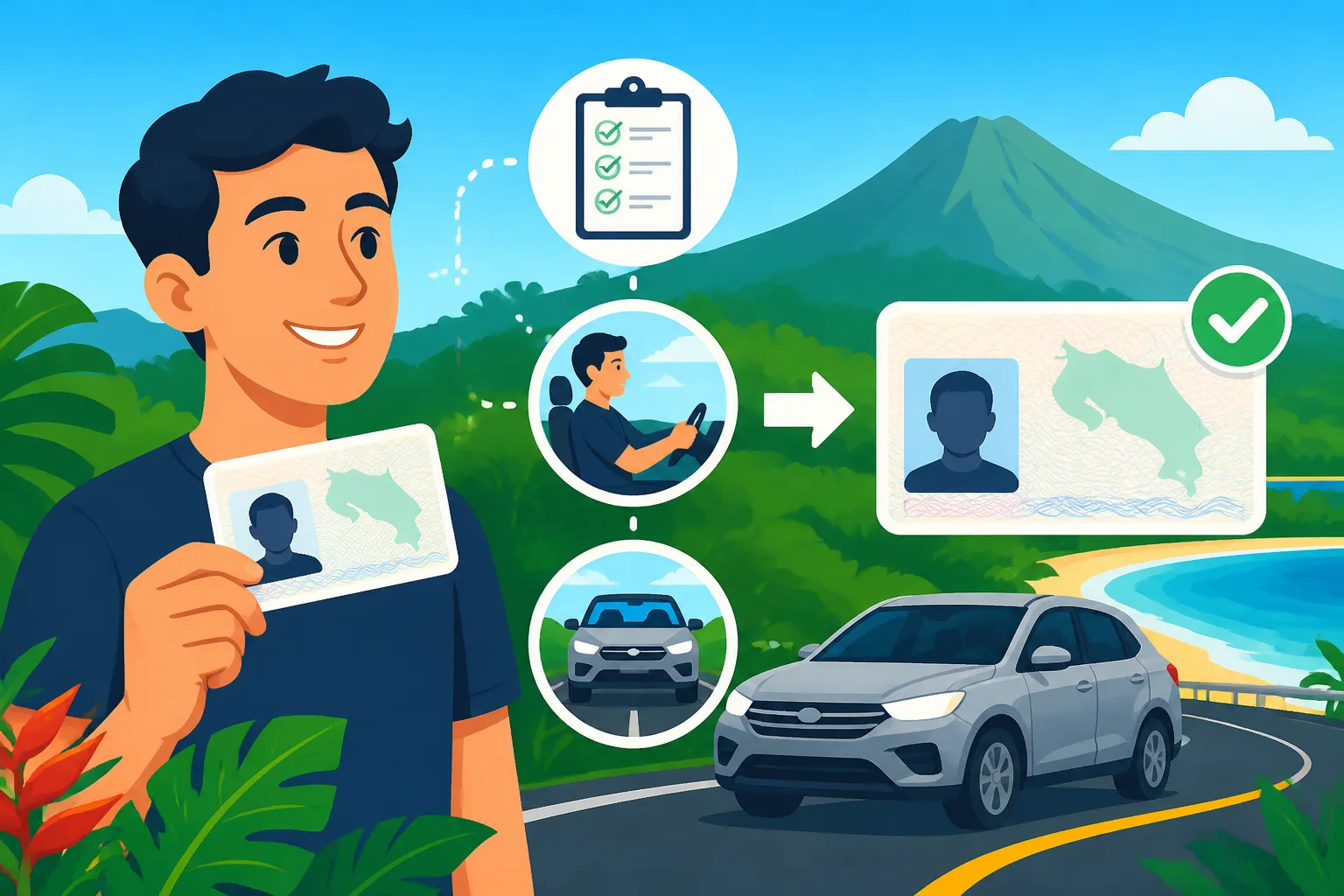
This is where the preparation truly begins. You absolutely must have all your ducks in a row before heading out. Missing even one document will send you right back to square one, costing you time and likely another appointment booking. Here’s your checklist:
- Your Original, Valid Foreign Driver's License: This must be current, not expired. If it's expired, you'll need to follow the full process of getting a new Costa Rican license, which we'll discuss in the next section.
- Your Valid DIMEX: The physical card itself, not a copy. Make sure it's within the three-month validity period for conversion from its issuance date.
- Your Passport: Again, the physical passport. They will check your entry stamp to ensure you weren't driving illegally before your DIMEX was issued, and it also serves as a secondary ID.
- A Photocopy of Your Foreign Driver's License (Both Sides): Make sure it's clear and legible.
- A Photocopy of Your DIMEX (Both Sides): Same as above.
- A Photocopy of the Main Page of Your Passport: The one with your photo and personal details.
- A Photocopy of Your Latest Entry Stamp in Your Passport: This proves your legal entry.
- Proof of Address (Optional but Recommended): While not always strictly required for license conversion, having a utility bill in your name (like an ICE or AyA bill) or a letter from your landlord can sometimes smooth things over, especially if there are any discrepancies. We have a guide on The Expat Guide to Setting Up Utilities (ICE/AyA) in Costa Rica that can help if you need to get these in your name.
It's a good practice to have multiple copies of everything, just in case. They're often very particular about specific copies. For those who used services like Sirelo to ship their household goods and vital documents, ensuring these original driving licenses were included and arrived safely is a crucial step in this preparation.
The Medical Exam (Dictamen Médico)
This is a non-negotiable step. Every person applying for or renewing a driver's license in Costa Rica, foreign or national, must undergo a medical examination, called a Dictamen Médico. This isn't a full physical, but rather a quick check to ensure you meet the basic health requirements to drive safely.
You can get this done at almost any clínica or private doctor's office. Look for signs that say "Se hace Dictamen Médico para Licencia." The cost typically ranges from 20,000 to 30,000 colones. The examination usually involves:
- Vision Test: Reading letters on an eye chart.
- Hearing Test: A simple conversational check.
- Blood Pressure Check.
- Motor Skills Assessment: Basic coordination tests.
- Interview: Questions about your medical history, any chronic conditions, or medications. Be honest! If you have certain conditions, they might impose restrictions on your license (e.g., "must wear glasses").
The doctor will then issue you a digital Dictamen Médico. It’s directly uploaded to the COSEVI system, so you won't get a physical paper certificate (though some doctors might give you a printout for your records). This digital dictamen is only valid for six months, so don't get it too far in advance of your COSEVI appointment. This is similar to needing a medical check for other official procedures, as detailed in our guide What Documents Do I Need to See a Doctor in Costa Rica?.
Paying the Fees
Before you can even think about booking your appointment, you need to pay the official fee for the license itself. This fee needs to be paid at a bank, usually Banco de Costa Rica (BCR) or Banco Nacional. When you go, you'll specify that you're paying for a "Licencia de Conducir por Primera Vez" (First Time Driver's License) or "Homologación" (Homologation, which is the term for converting a foreign license). The cost is typically around 5,000 colones. You'll receive a receipt, which is another crucial document to bring to your COSEVI appointment. Make sure to hold onto this receipt like gold!
Booking Your Appointment at COSEVI
Gone are the days of just walking into COSEVI and waiting in line (mostly). Now, you almost always need an appointment, especially for license conversions. You can book an appointment online through the COSEVI website or by calling their central number (though Spanish is often required for the phone service). The website can be tricky to navigate, often requiring patience and good translation skills, but it's usually the most reliable way.
When booking, select the "Homologación" option. You'll need your DIMEX number. You can choose from various COSEVI offices across the country – San José, Heredia, Alajuela, Cartago, Liberia, Puntarenas, Limón, etc. Pick the one most convenient for you, but be prepared for limited availability. Slots often fill up quickly, so be persistent. This waiting period is why it’s vital not to delay once your DIMEX is in hand.
The Big Day: What to Expect at COSEVI
So, you’ve got your documents, your Dictamen Médico is in the system, your fee is paid, and your appointment is finally here. Arrive early! "Pura Vida time" often means things start a little late, but being early shows respect and gives you breathing room for any last-minute surprises.
When you enter, you’ll typically be directed to a waiting area. They’ll call your number (which you usually get at the entrance by scanning your DIMEX or showing your appointment confirmation). When called, you’ll go to a window. The official will scrutinize all your documents. They will:
- Verify your identity against your DIMEX and passport.
- Check your foreign driver's license for validity and authenticity.
- Confirm your Dictamen Médico is in their system.
- Verify your payment receipt.
- Take your fingerprints.
- Take your photo (so try to look somewhat presentable!).
They might ask you a few questions in Spanish, perhaps about your home country or how long you've been driving. Keep your answers clear and concise. Once everything checks out, they'll print your new Costa Rican driver's license right there on the spot! It's a moment of pure relief and accomplishment. This whole process is essentially the formal side of How to Convert or Use a Foreign Driver's License in Costa Rica.
What if You Don't Qualify for Conversion or Need a New License Entirely?
Sometimes, the straightforward conversion isn't an option. Maybe your foreign license expired, or perhaps you never held a driver's license to begin with. Don't despair! You can still obtain a Costa Rican driver's license, but the path is a bit longer and involves formal testing. This is the route you'd take if you were applying for How Do I Get My Costa Rican Driver's License? from scratch.
Expired Foreign License or No Previous License
If your foreign license has expired, or if it's from a country not recognized for direct conversion (which is rare for major developed nations but worth checking), or if you simply never learned to drive before moving to Costa Rica, you'll need to go through the entire Costa Rican driver's education and testing system. This means taking both a written theory exam and a practical driving test.
This process is generally more involved and time-consuming. You’ll need to register with COSEVI, often through the same online portal used for appointments, but selecting the option for a first-time license application.
The Written Exam (Examen Teórico)
The examen teórico tests your knowledge of Costa Rican traffic laws, road signs, and driving regulations. It's offered in Spanish, and increasingly, in English (especially in larger COSEVI offices). You can purchase study guides (Manual del Conductor) at bookstores or even some COSEVI offices, or find resources online. There are also private driving schools that offer courses specifically to prepare you for this exam, which can be invaluable for understanding the nuances of local driving culture and laws.
Booking the written exam is also done through the COSEVI website or a phone call. These appointments can be hard to come by, sometimes requiring weeks or even months of waiting, so plan accordingly. Passing this exam is a prerequisite for taking the practical driving test.
The Practical Driving Test (Examen Práctico)
Ah, the examen práctico. This is often the most nerve-wracking part for many. After passing your written exam, you'll need to book your practical driving test. Again, appointment slots are limited and require persistence to secure. You'll need to arrive with a vehicle (either your own, a friend's, or a rental) that has all its current documentation (Marchamo, Riteve, insurance) in order. You also need a licensed driver (a Costa Rican with a valid license) to accompany you, as you don't have a learner's permit in the traditional sense.
The test itself is generally quite strict. It involves a series of maneuvers at a COSEVI test track, including parallel parking, driving in reverse, navigating cones, and sometimes a short road test. The examiners are meticulous, and even small mistakes can lead to failure. Many expats opt to take driving lessons with a local instructor who knows the test routes and what the examiners look for. They can rent you a car for the test and act as your accompanying licensed driver. It's an investment, but it significantly increases your chances of passing on the first try.
Practical Tips and Avoiding Common Pitfalls
Even with all the information, the process can still feel like a maze. Here are some seasoned expat tips to help you navigate it with a little less stress.
Overcoming the Language Barrier
Costa Rica is a Spanish-speaking country, and while many officials in tourist areas or expat-dense regions might speak some English, you cannot count on it, especially at government offices like COSEVI. If your Spanish isn't up to snuff, consider bringing a trusted friend or hiring a translator for your appointments. Having someone who can clearly articulate your situation and understand instructions can save you immense frustration and prevent misunderstandings that could delay your application.
Don't be afraid to use Google Translate on your phone, but understand that subtle nuances can still get lost. It's often better to have a human who can interpret the tone and context of questions.
Finding Reliable Help
There are many facilitators and agencies in Costa Rica that offer to help with bureaucratic processes, including driver's license conversions. While some are legitimate and incredibly helpful, others are less so. Ask for recommendations from other expats in local groups or forums. A good facilitator can save you hours of frustration by guiding you through booking appointments, explaining documents, and even accompanying you to COSEVI. Just be sure to do your due diligence and check their references.
Remember, even with a facilitator, you will still need to show up in person for your appointments, especially for the medical exam and the final COSEVI visit. No one can get your license for you.
Keeping Your License Current and Insured
Once you have your shiny new Costa Rican driver's license, the journey doesn't end there. Like any other official document, it has an expiration date, usually tied to your DIMEX expiration. You'll need to renew it before it expires, which again involves a Dictamen Médico and an appointment at COSEVI (though usually a simpler renewal process than the initial conversion).
Beyond the license itself, ensure that any vehicle you drive is properly registered, has its annual Marchamo (road tax) paid, and has passed its Riteve (vehicle inspection). Our guide to Understanding the Marchamo (Annual Vehicle Tax) and Riteve in Costa Rica delves deep into these requirements. Driving without current vehicle documentation is a surefire way to invite trouble from traffic police.
Furthermore, make sure you have adequate vehicle insurance. While the Marchamo includes a basic third-party liability insurance from INS (Instituto Nacional de Seguros), it's often not enough to cover significant damages or medical costs in an accident. Many expats opt for additional private insurance to protect themselves and their assets. Companies like Cigna Global offer comprehensive health insurance plans that might cover medical emergencies abroad, but for vehicle-specific coverage, you'll typically look to local providers like INS or other private options. Understanding How Much Is Car Insurance in Costa Rica? is key to protecting yourself on the road. Remember, having a valid license is only one piece of the puzzle for safe and legal driving in Costa Rica. If you're considering buying a vehicle, you'll also want to read How to Buy a Car as a Foreigner in Costa Rica for essential tips.
Driving with Your DIMEX: A Summary of Key Actions
Here's a quick rundown to keep you on track. This table outlines the critical steps and reminders for obtaining your Costa Rican driver's license once you have your DIMEX.
| Step | Description | Important Notes |
|---|---|---|
| 1. Secure Your DIMEX | Obtain your official Costa Rican residency card. | Your foreign license is only valid for 3 months from your DIMEX issuance date. |
| 2. Gather Documents | Collect your valid foreign license, passport, DIMEX, and photocopies of all. | Ensure foreign license is current. If expired, you'll need to take full tests. Consider apostilling your original license if requested, a step detailed in How Do I Get My Documents Apostilled for Costa Rican Residency?. |
| 3. Get Your Dictamen Médico | Undergo a medical exam at an approved clinic or private doctor. | This is a digital certificate uploaded to COSEVI. Valid for 6 months. Cost: 20,000-30,000 colones. |
| 4. Pay the License Fee | Pay the license conversion fee at Banco de Costa Rica (BCR) or Banco Nacional. | Specify "Homologación" or "Licencia por Primera Vez." Keep the receipt. Approx. 5,000 colones. |
| 5. Book COSEVI Appointment | Schedule your "Homologación" appointment online via the COSEVI website or by phone. | Appointments can take weeks to secure; start early. Choose the most convenient COSEVI office. |
| 6. Attend COSEVI Appointment | Bring all original documents and photocopies. Undergo verification, photo, and fingerprinting. | Arrive early. Be prepared for potential language barriers; consider bringing a translator. Your new license is usually printed on the spot. |
| 7. For New Licenses (No Conversion) | If your foreign license is expired/invalid or you never had one, prepare for written and practical tests. | Study for the examen teórico (written test), ideally in Spanish. Prepare for the examen práctico (practical test) with a suitable vehicle and accompanying licensed driver. Consider professional driving lessons. |
| 8. Stay Current | Renew your Costa Rican license before it expires, and ensure your vehicle documents are up-to-date. | Renewals also require a new Dictamen Médico. Keep Marchamo and Riteve current annually. Consider additional car insurance beyond the basic INS coverage. |
Getting your Costa Rican driver's license with your DIMEX is a process that demands diligence, but it's entirely doable. By following these steps and preparing thoroughly, you'll soon be enjoying the freedom of the open road, exploring all the hidden gems of this incredible country, and truly feeling like a local. ¡Pura Vida!
Disclaimer
Please remember that while I strive to provide the most accurate and up-to-date information based on current regulations and typical expat experiences in Costa Rica, policies and procedures can change. It is always advisable to consult official government websites (like COSEVI and Migración) or seek professional legal and administrative advice for your specific situation. This guide is for informational purposes only and does not constitute legal counsel.