How Do I Buy a Scooter or Motorcycle in Costa Rica?
Alright, my fellow expat, let’s talk about something near and dear to many of our hearts here in Costa Rica: the open road and the freedom it offers, especially when you’re not stuck in gridlock. Navigating Costa Rica’s traffic, especially around the Greater Metropolitan Area (GAM), can be a real headache, and let’s not even start on parking. This guide is going to walk you through everything you need to know about buying a scooter or motorcycle in Costa Rica, from the initial dream to getting your wheels legally on the road.
The Allure and Practicality of Two Wheels in Costa Rica
Living in Costa Rica often means adjusting your expectations for transportation. While the idea of a shiny SUV might seem appealing, the reality of city traffic, winding mountain roads, and the sheer cost of fuel and maintenance can quickly sour the dream. This is where scooters and motorcycles truly shine, offering a blend of practicality and exhilaration that many expats find irresistible.
Dodging Traffic and Finding Parking
If you've spent any time driving in San José, Escazú, or Heredia, you'll know that traffic can be absolutely brutal. During rush hour, a 10-kilometer drive can easily take over an hour. This is where a scooter or motorcycle becomes your secret weapon. While you need to be cautious and aware of local laws, the ability to weave through slower traffic (within reason and safety) and navigate narrow streets is a game-changer. You'll find yourself reaching your destination in a fraction of the time it would take in a car.
Beyond just the movement, consider parking. Finding a spot for a car in any major Costa Rican town or city is often an exercise in patience and frustration, frequently involving expensive paid lots or the dreaded parallel parking on a steep incline. With a scooter or motorcycle, parking becomes significantly easier. You can often tuck into smaller spaces, closer to your destination, saving both time and money. It’s a huge relief when you just want to grab a quick coffee or run an errand without circling the block five times. The freedom from parking headaches alone is enough to convert many to two-wheeled living.
Cost-Effectiveness and Fuel Efficiency
Let's face it, living in paradise doesn't always come cheap, and fuel costs here in Costa Rica can definitely add up. This is another area where a scooter or motorcycle offers a significant advantage. The fuel efficiency of these machines is generally far superior to that of a car, meaning your trips to the gas station will be less frequent and less painful on the wallet. While gasoline prices fluctuate, getting more kilometers per liter makes a real difference over time.
Beyond just fuel, the overall cost of ownership tends to be lower. The annual Marchamo (vehicle tax) is typically much less for a motorcycle or scooter compared to a car, and routine maintenance is often more affordable. For expats on a budget or those simply looking to minimize their recurring expenses, a motorcycle or scooter can significantly reduce your monthly transportation costs. Think about it: fewer colon going into the tank means more colon available for those delicious casados or weekend trips to the beach. For a broader understanding of overall expenses, check out The Complete Guide to Cost of Living in Costa Rica for Expats (2026).
Navigating the Purchase: New, Used, and the Paperwork Maze
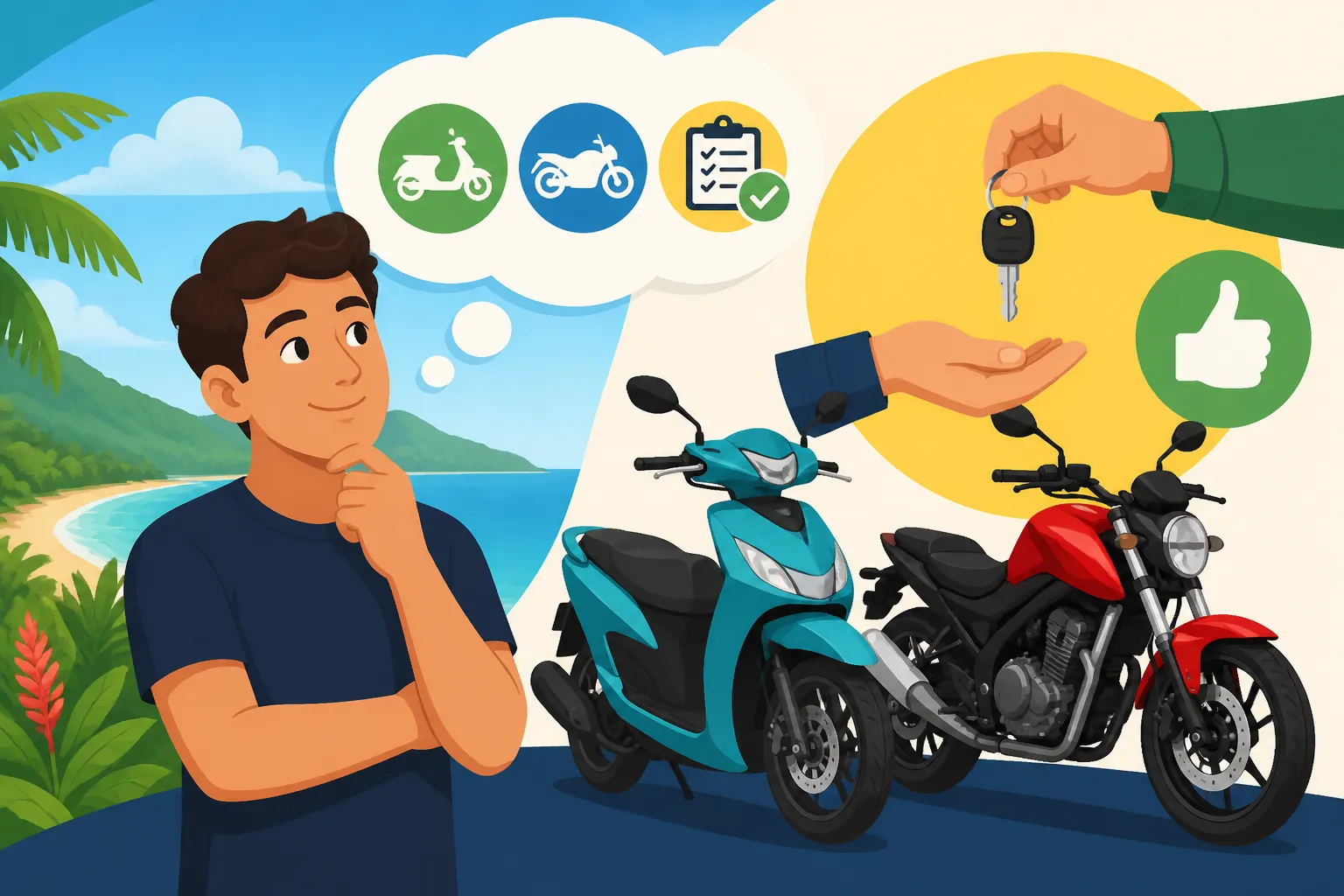
So, you're convinced two wheels are for you. Now comes the exciting part: actually buying one! Like buying any vehicle here, it involves a few more steps and a bit more paperwork than you might be used to back home. But don't worry, it's totally manageable with a clear plan.
Buying New from a Dealership
Purchasing a new scooter or motorcycle from a reputable dealership is often the path of least resistance, especially for expats who might be less familiar with the local market or less comfortable with the intricacies of used vehicle transactions. Major brands like Honda, Yamaha, Suzuki, and Bajaj have a strong presence here, with dealerships scattered across the country, particularly in the larger cities like San José, Alajuela, and Heredia.
When you buy new, you benefit from a warranty, brand-new components, and the peace of mind that comes with knowing the vehicle's full history. Dealerships will usually handle the initial registration process for you, including the first Marchamo and Riteve, which is a huge convenience. You’ll visit the showroom, pick your model, negotiate the price (though less common for new vehicles here than in some other countries), and then they'll guide you through the financing and paperwork. Do inquire about what's included in the "on-the-road" price, as sometimes accessories or certain fees might be extra. While financing options are available, securing them as a new expat without established credit in Costa Rica can be challenging, so be prepared for a cash purchase or to use funds from your home country.
Scouting for a Used Bike
For those looking to save some money or find a specific model, the used market is vibrant. Online platforms like Facebook Marketplace and Encuentra24 are popular places to start your search, along with local classifieds and even word-of-mouth within expat communities. You'll find a wide range of makes and models, from basic commuters to more powerful touring bikes. However, this route requires more diligence and a keen eye.
When buying used, it's absolutely crucial to proceed with caution. Many bikes on the market have been heavily used, sometimes poorly maintained, or even have legal issues with their titles. Always insist on seeing the bike in person, take it for a test ride (if you have a valid license), and, most importantly, have a trusted mechanic inspect it thoroughly. This small investment can save you from costly repairs down the road. Common red flags include sellers pushing for a quick sale, reluctance to provide documentation, or an unwillingness to let you have it inspected. If you're exploring options for buying a used car, many of the same precautions apply, as detailed in How Do I Buy a Used Car in Costa Rica?. Reliable internet access is key when you're scouring these listings and coordinating viewings. Think about securing an eSIM from providers like Airalo to ensure you have consistent data to check those last-minute listings or Google directions.
Essential Documents for a Smooth Transfer
Whether new or used, the transfer of ownership is a legal process that must be handled by a notario público (public notary). This isn't something you can do at a DMV equivalent like in other countries; it’s a legal transaction overseen by a licensed attorney who specializes in property transfers. The notary will ensure all legal requirements are met and that the title is properly transferred into your name.
Here’s a general rundown of the documents you’ll need for the transfer:
- Original Título de Propiedad: This is the vehicle’s title certificate, proving ownership. Ensure the seller has it and that it matches their ID.
- Valid Identification: Both buyer and seller will need their official IDs (DIMEX for residents, passport for tourists, though buying as a tourist can be more complex and usually requires residency for full registration).
- Boleta de Revisión Técnica (Riteve): A valid vehicle inspection certificate.
- Marchamo: Proof that the annual vehicle circulation tax has been paid for the current year.
- Payment: The agreed-upon purchase price.
The notary will draw up a escritura de traspaso (transfer deed) and register it with the Registro Nacional (National Registry). You will also pay a transfer tax (impuesto de traspaso), which is typically a percentage of the vehicle's registered value. This entire process can feel a bit like wading through quicksand, but having a good, bilingual notary makes all the difference. For a deeper dive into vehicle registration, you might find How to Register and Title a Vehicle with the Registro in Costa Rica helpful.
The Bureaucracy of Riding: Registration, Insurance, and Annual Checks
Buying your bike is just the first step. To legally cruise the beautiful roads of Costa Rica, you’ll need to navigate a few annual bureaucratic requirements. These are non-negotiable and essential for your peace of mind and legal standing.
Marchamo: The Annual Vehicle Tax
Ah, the Marchamo. This is Costa Rica's mandatory annual vehicle circulation tax, and it covers both the road tax and the basic third-party liability insurance (SOA, which we'll discuss next). It's due by December 31st each year, and you absolutely do not want to be late. If you miss the deadline, you'll incur penalties and fines, and if you're caught driving without current Marchamo, your vehicle can be impounded.
The cost of the Marchamo varies depending on the make, model, year, and engine size of your motorcycle or scooter. Generally, it's significantly lower than for cars, which is another point in favor of two-wheeled transport. You can pay your Marchamo at most banks, online through their banking portals, or at authorized collection points. You’ll receive a sticker to place on your license plate and a paper receipt, which you should always keep with your vehicle documents. Trust me, it’s a hassle you want to avoid, so mark that December deadline on your calendar! For more specific information on this annual ritual, refer to Understanding the Marchamo (Annual Vehicle Tax) and Riteve in Costa Rica.
The Mandatory INS Insurance (SOA)
Included within your Marchamo payment is the Seguro Obligatorio de Automóviles (SOA), or Mandatory Automobile Insurance. This is a basic third-party liability insurance provided by the National Insurance Institute (INS) that covers injuries or death to third parties in an accident. It does not cover damage to your own vehicle or personal injury to you.
While the SOA is mandatory, many expats choose to purchase additional, more comprehensive insurance coverage through INS or other private providers. These optional policies can cover damages to your own motorcycle, theft, and medical expenses for yourself. Given the driving conditions and accident rates in Costa Rica, investing in more robust insurance is highly recommended. It’s a small price to pay for significant peace of mind. Learning about other vehicle insurance options can provide helpful context; you can read more at Understanding Car Import, Registration and Insurance (INS) in Costa Rica or How Much Is Car Insurance in Costa Rica?.
Riteve: The Vehicle Inspection
The Revisión Técnica Vehicular (Riteve) is Costa Rica's mandatory vehicle inspection, now handled by Dekra. It's designed to ensure that all vehicles on the road meet safety and environmental standards. For motorcycles and scooters, the frequency of inspection depends on the vehicle's age. Newer bikes typically get a grace period before their first inspection, and then it's an annual affair.
You’ll need to book an appointment online through the Dekra website, which can sometimes be a test of patience due to limited availability in certain areas. On the day of your appointment, you’ll take your bike to the Dekra station, where technicians will check everything from brakes and lights to tire tread and exhaust emissions. It's common for vehicles, especially older ones, to fail on the first attempt, requiring repairs and a re-inspection. This can be a frustrating process, but it’s a necessary part of legal vehicle ownership here. Ensure your bike is in tip-top shape before you go to save yourself time and a headache. The fees are relatively modest, but the time commitment can be substantial.
Staying Legal and Safe on Costa Rican Roads
Getting your bike and having it registered is one thing; riding it legally and, more importantly, safely on Costa Rica's diverse and sometimes challenging roads is another. This requires a proper license, an understanding of local driving culture, and a commitment to safety.
Obtaining Your Costa Rican Motorcycle License
Unless you’re coming from a country with a reciprocal agreement, or you plan to only use your home country license during your tourist visa period (which is generally 90 days, and only valid if your license from back home is also current), you will eventually need a Costa Rican motorcycle license. This process, overseen by COSEVI (Consejo de Seguridad Vial), can feel like a mini-saga, but it's entirely doable.
If you have a foreign driver’s license, you might be able to convert it if you hold legal residency here. The process involves validating your foreign license at COSEVI and then taking a theoretical and practical driving test, often requiring a bit of legwork to gather documents like your passport, DIMEX, and proof of address. For those starting from scratch, you'll need to pass both a theoretical exam (knowledge of road laws) and a practical riding test. The practical test often involves demonstrating control and maneuverability in a closed course, followed by a short ride on public roads. It's best to prepare thoroughly for both, as the theoretical exam is in Spanish, and the practical can be tricky. You can dive deeper into the general licensing process by checking out How to Convert or Use a Foreign Driver's License in Costa Rica and How Do I Get a Costa Rican Driver's License?.
Road Realities and Riding Etiquette
Riding in Costa Rica is an experience that demands hyper-awareness and defensive driving. Road conditions vary wildly – you’ll encounter beautifully paved highways one moment and pothole-riddled dirt tracks the next. Animals can dart into the road, rain can create slick surfaces in an instant, and other drivers may not always adhere strictly to traffic laws. It’s a wild card, truly.
Lane splitting is common, especially in congested areas, but always exercise extreme caution and only do so when it is safe and prudent. Speed limits are often ignored, and aggressive driving is not uncommon. Always assume other drivers don't see you. Your mirrors are your best friends, but a quick head check before any maneuver is even better. Be especially wary during the rainy season when roads become slick, and visibility drops. Understanding the general nuances of driving here can be broadened by reading Driving in Costa Rica: Licenses, Registration and Rules for Expats (2027).
Essential Safety Gear and Practices
This isn't just about following the law; it's about staying alive. In Costa Rica, wearing a helmet is legally required for both the driver and any passenger on a motorcycle or scooter. But don't just grab any helmet – invest in a high-quality, full-face helmet that meets international safety standards. Your head is worth it.
Beyond the helmet, consider these essential safety items:
- Protective Jacket: Abrasion-resistant material with armor. Even on a hot day, a mesh jacket is better than none.
- Gloves: Protect your hands in a fall and improve grip.
- Sturdy Footwear: Boots that cover your ankles are ideal, definitely no flip-flops!
- Bright Clothing: Make yourself as visible as possible, especially during dawn, dusk, or in the rain. Reflective gear is a plus.
- Defensive Riding: Always anticipate what other drivers might do. Maintain a safe following distance. Use your horn to alert others to your presence.
Remember, the freedom of riding a scooter or motorcycle in Costa Rica is incredible, but it comes with responsibility. Be prepared, be smart, and always prioritize your safety. If you're coordinating your larger move to Costa Rica, including any specialized gear you might want to bring, remember that services like Sirelo can assist with the logistics of shipping your belongings, ensuring your protective gear arrives safely.
Here’s a quick overview of the pros and cons of buying new versus used:
| Feature | New Scooter/Motorcycle | Used Scooter/Motorcycle |
|---|---|---|
| Initial Cost | Higher upfront cost | Lower upfront cost, more budget-friendly |
| Maintenance | Covered by warranty, less frequent initial issues | Potentially higher immediate maintenance, no warranty |
| Paperwork | Dealership handles initial registration | Buyer/notary handles all transfer and registration |
| Condition | Pristine, no prior damage | Variable condition, potential hidden issues |
| Financing | Available, but challenging for new expats | Typically cash purchase |
| Peace of Mind | High, knowing it's new and under warranty | Lower, requires thorough inspection and due diligence |
| Availability | Limited to current dealership models | Wide variety of makes, models, and years |
Disclaimer
The information provided in this guide is for general informational purposes only and does not constitute legal, financial, or professional advice. While we strive to provide accurate and up-to-date information, regulations and procedures in Costa Rica can change rapidly. It is highly recommended to consult with local legal professionals, notaries, and relevant government agencies (like COSEVI, Registro Nacional, INS, and Dekra) for personalized advice pertaining to your specific situation before making any decisions related to purchasing or operating a vehicle in Costa Rica.