What Vaccinations Are Required for Children in Costa Rican Schools?
Moving your family to Costa Rica is a dream for many, but the reality of the first week of school enrollment often brings an unexpected hurdle: the "Carné de Vacunación." This guide breaks down the mandatory vaccines required for every child entering the Costa Rican school system, explains how to transfer foreign records into the local system, and helps you navigate the legal requirements to ensure your child's education isn't delayed by administrative red tape.
Understanding the Legal Mandate for School Vaccinations
In Costa Rica, vaccination is not merely a recommendation; it is a legal requirement governed by the General Health Law and the National Vaccination Law. The state views the health of the community and the protection of minors as a priority that supersedes individual parental preference. This can be a significant cultural shift for expats coming from regions where exemptions are more easily obtained. Here, the Ministry of Health and the Caja Costarricense de Seguro Social (CCSS) work in tandem to ensure that every child—whether in a public or a private institution—is protected against preventable diseases.
When you walk into a registrar's office at a school in Heredia, Escazú, or even a remote coastal village, the first document they will ask for, alongside the birth certificate, is the vaccination record. If the records are not up to date according to the Costa Rican national schedule, the school is legally obligated to report the situation. In extreme cases of non-compliance, the Patronato Nacional de la Infancia (PANI), which is the child welfare agency, can become involved. This is why Understanding Vaccination Schedules and Requirements in Costa Rica is critical before you even pack your bags.
The rationale behind such a strict stance is the success Costa Rica has had in nearly eradicating diseases like polio and rubella. The government maintains a high "herd immunity" threshold, and schools are the primary checkpoints for this health initiative. While the bureaucracy might feel heavy-handed, it is the reason the country remains one of the healthiest in Latin America.
The Mandatory Vaccination Schedule for Children
The Costa Rican vaccination schedule is comprehensive and begins at birth. For school-aged children, the requirements focus on ensuring all primary series are completed and boosters are administered at the correct intervals. Schools will specifically look for the completion of the following series.
Primary School Requirements (Ages 4 to 6)
As children enter the "Preescolar" or "Primer Grado" levels, school administrators meticulously check for the DTaP (Diphtheria, Tetanus, and Pertussis) boosters and the second dose of the MMR (Measles, Mumps, and Rubella) vaccine. If your child was vaccinated in the US or Europe, they likely have these, but the timing must align with the Costa Rican window.
Usually, the "Pentavalente" vaccine is a staple here, covering five different diseases in one shot. During the transition period, if you are still waiting for your residency to be approved, having a plan like SafetyWing can provide a temporary cushion for medical consultations to verify these requirements. While SafetyWing is primarily for travel and transition periods, it helps bridge the gap until you are fully integrated into the local health system.
The HPV and Tdap Boosters for Adolescents
For children entering middle school (Colegio), the requirements shift. The Ministry of Health recently integrated the Human Papillomavirus (HPV) vaccine as a mandatory requirement for girls (and increasingly for boys in certain cohorts) starting around age ten. Additionally, a booster for Tetanus and Diphtheria (Tdap) is often required for teenagers to maintain their status in the school database.
| Vaccine Category | Specific Disease Coverage | Common Age of Administration |
|---|---|---|
| Pentavalente | Diphtheria, Tetanus, Whooping Cough, Hep B, Hib | 2, 4, and 6 months |
| Polio (IPV/OPV) | Poliomyelitis | 2, 4, 6, 15 months, and 4 years |
| MMR (SRP) | Measles, Mumps, Rubella | 15 months and 4 years |
| Varicella | Chickenpox | 15 months |
| HPV | Human Papillomavirus | Age 10 (Two-dose series) |
| Tdap Booster | Tetanus, Diphtheria, Pertussis | Every 10 years after age 4 |
How Expats Can Transfer Foreign Vaccination Records
One of the biggest headaches for expat parents is the "homologación" or the validation of foreign records. You cannot simply hand a US or UK vaccination card to a school principal and expect them to understand it. The records must be officially recognized by the local health authorities.
Step 1: Translation and Notarization
If your records are in English, you will technically need an official translation by a government-certified translator in Costa Rica. However, many local EBAIS (Equipos Básicos de Atención Integral en Salud) clinics are becoming more accustomed to English records. To be safe, always have a clear, typed copy of your child’s history. Hand-written, smudged records from a pediatrician back home are a recipe for a three-hour argument at a government window.
Step 2: Visiting the EBAIS
You must take your child and their foreign records to the EBAIS clinic that corresponds to your neighborhood. This is where you will learn How to Find and Register with an EBAIS Clinic in Costa Rica. The nurses there will review the foreign dates and "translate" them into the Costa Rican "Libreta de Salud" (the blue or white health book). This little book is the gold standard for school enrollment.
During this process, if the nurse notices a gap—for example, if your home country doesn't require the Hepatitis A vaccine at the same interval—they will insist your child receives the "missing" dose immediately. This is free of charge through the public system once you are registered, but if you are still in the "tourist" phase, you may have to pay a small fee or visit a private clinic. In these early months of moving, products like SafetyWing can be useful for general peace of mind as you navigate these local clinics.
Step 3: Obtaining the Official Carné
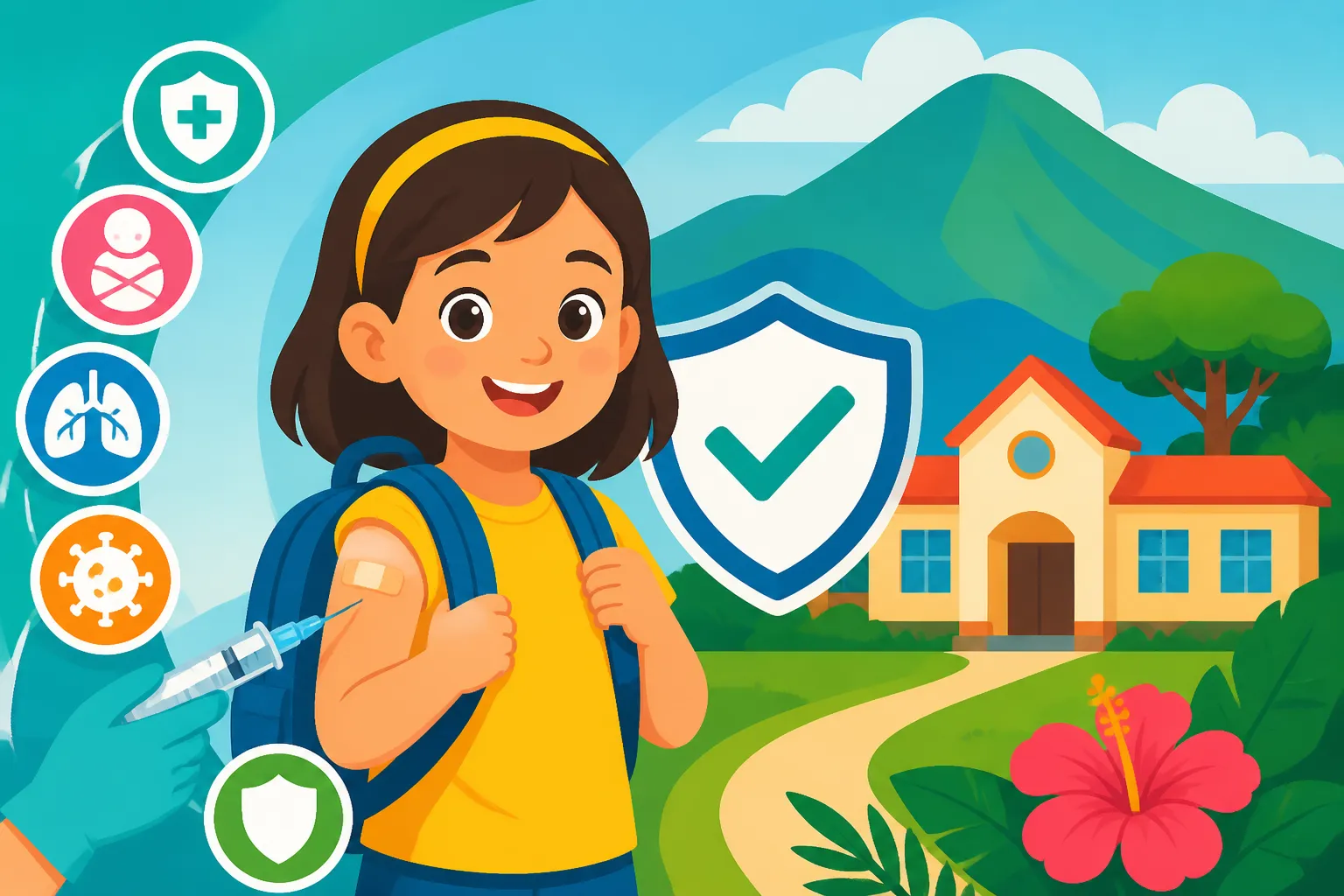
Once the EBAIS nurse has transferred the data, they will stamp the Carné de Vacunación. This stamped document is what you present to the school. Without that specific stamp from the Ministry of Health or the Caja, many private schools—even the high-end international ones—will not finalize your child’s registration.
Private vs. Public: Where to Get Vaccinated
In Costa Rica, you have the choice between the public system (Caja) and private hospitals like CIMA or Clínica Bíblica. Both are excellent, but they handle documentation differently.
The Public System (The Caja)
The benefit of the public system is that it is free at the point of service and your child’s records are immediately entered into the national digital database (EDUS). If you are wondering How Do I Enroll in the Caja After Moving to Costa Rica?, remember that it is a mandatory part of your residency process. Once you are in the system, vaccinations are streamlined. The downside is the wait times; you might spend a whole morning at the EBAIS waiting for a five-minute appointment.
The Private Sector
Many expats prefer to see an English-speaking pediatrician in the private sector. You can buy the vaccines there, often with shorter wait times and more personalized care. However, even if you vaccinate privately, you are still legally required to ensure those records are reported to the Ministry of Health. Most private pediatricians will provide you with a certificate that you must then take to your local EBAIS to update the official "Blue Book."
If you are using the private system, it is vital to know How to Find an English-Speaking Doctor in Costa Rica who understands the specific requirements of the local school system. They can often provide the necessary paperwork in a format that the EBAIS will accept without further translation. While your private insurance or a service like SafetyWing might cover the consultation, the vaccines themselves in the private sector can be quite expensive, ranging from $60 to $150 per dose depending on the vaccine.
Common Obstacles and Frustrations for Expats
Navigating a new medical system while trying to settle your children into school is inherently stressful. One of the most common frustrations is the "missing" vaccine. For instance, the Costa Rican schedule might require a booster at age four, while your home country does it at age five. The school will not accept "we were going to do it next year." They will require it now.
Another hurdle is the lack of centralized records if you’ve moved between multiple countries. Costa Rican officials love stamps and official letterheads. If you are arriving from a third country, try to get your records apostilled or at least signed by a medical director. It sounds like overkill until you are standing in a line in San José being told your photocopies aren't "official."
If you find yourself caught in a bureaucratic loop, it helps to understand Navigating the Costa Rican Healthcare System: An Expat's Roadmap (2027). Knowing the hierarchy—from the local EBAIS to the regional Ministry of Health office—allows you to escalate issues when a clerk is being particularly difficult.
Lastly, be aware of the "Vacunación Casa por Casa" (house-to-house vaccination) campaigns. Occasionally, health workers in neon vests will knock on your door to verify children's records during a national drive. Do not be alarmed; this is a standard and very effective health practice in Costa Rica. They will ask to see the Carné de Vacunación. If your child is enrolled in school, you should already have this ready.
Summary of Steps for New Residents
To make your transition smoother, follow this checklist as soon as you arrive in the country:
- Gather all original records: Ensure you have the original, signed vaccination cards for every child.
- Contact your school: Ask for the specific list of vaccines they require, as some international schools have additional requirements beyond the national mandate.
- Register with the EBAIS: Don't wait for a medical emergency. Register as soon as you have your lease or utility bill to prove your address.
- Get the Blue Book: Ask the nurse to initiate the "Carné de Desarrollo" for younger children or the "Carné de Vacunación" for older ones.
- Schedule gaps: If your child is missing a booster, get it done immediately, either through the Caja or a private clinic.
- Maintain coverage: Ensure you have transition insurance like SafetyWing during your first 90 days to cover any unexpected medical visits while you are sorting out your permanent residency and Caja affiliation.
By staying proactive, you can turn a potentially week-long bureaucratic nightmare into a simple afternoon chore. Costa Rican schools are generally very welcoming to expat families, but they will not budge on the health of their students. Show them that you take the community's health as seriously as they do, and your enrollment process will be much smoother.
For those still in the planning stages, it is also wise to check What Vaccinations Do I Need Before Moving to Costa Rica? to ensure the adults in the family are also protected, as some residency categories may eventually ask for adult health screenings as well. Being prepared is the best way to enjoy the "Pura Vida" lifestyle without the stress of unnecessary paperwork.
Disclaimer
This guide is provided for informational purposes only and does not constitute professional medical or legal advice. Vaccination requirements and government regulations in Costa Rica are subject to change. Always consult with the Costa Rican Ministry of Health (Ministerio de Salud), the CCSS, or a licensed medical professional in Costa Rica to verify current requirements for school enrollment. Use of third-party services should be reviewed based on your specific residency status and needs.