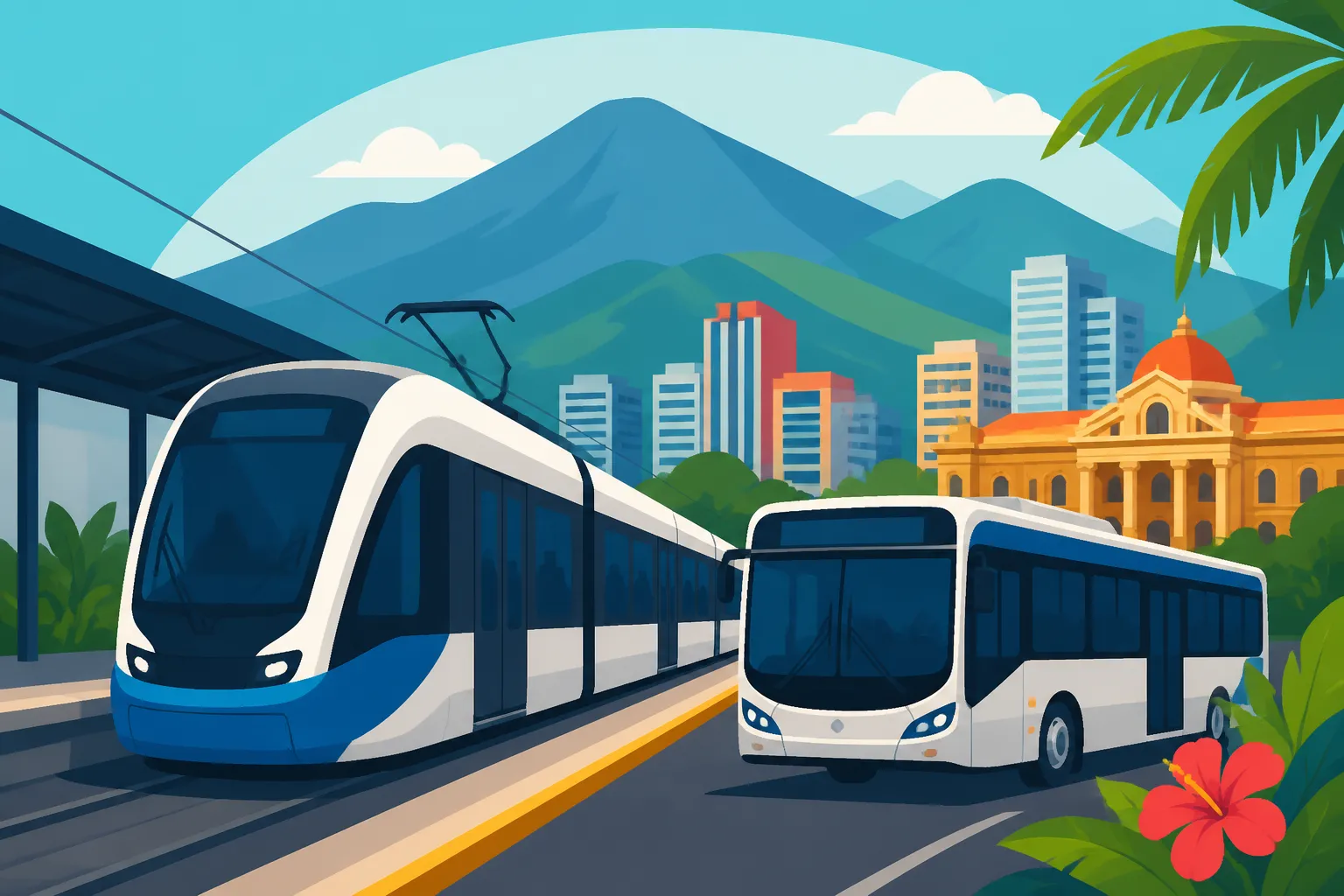
Understanding the Tren Urbano and Public Transit in San Jose
If you've just arrived in San José, or even if you've been here a while but haven't quite mastered the art of getting around without a car, you know the feeling. The sheer volume of traffic, the often-congested streets, and the seemingly endless stream of buses can feel utterly overwhelming. Trying to understand the public transit system can be like cracking a secret code, but don't worry, mae, you're not alone. This guide is here to unravel the mysteries of San José's public transportation, from the elusive Tren Urbano to the omnipresent bus network, giving you the real-world lowdown to navigate like a local.
The San José Public Transit Maze: An Overview
Let's be honest, San José's public transit system isn't exactly renowned for its simplicity or efficiency, especially compared to some meticulously planned European or North American networks. It’s a beast that grew organically, shaped by the city's unique geography, historical development, and the tico way of doing things. For newcomers, it can feel like a chaotic free-for-all, but once you understand its underlying logic (or lack thereof), it becomes a vital part of urban life here.
Why Public Transit is Different Here
The first thing to wrap your head around is that San José's public transit isn't a single, unified system run by one entity. Instead, it's a patchwork of dozens of private bus companies, each operating specific routes and often with little coordination between them. This means you might take one bus from your home in Escazú to San José, but need a completely different bus, run by a different company, to get to another part of the city. There's no single "San José Transit Authority" that dictates all routes, fares, and schedules. This fragmentation is the root cause of much of the confusion.
Unlike cities with large, integrated metro systems, San José relies heavily on its bus network. The bus companies, while private, are regulated by the Public Transport Regulatory Authority (ARESEP) for fares and general service quality, but the route planning largely evolved based on historical demand and concession. This results in a system that often bottlenecks in downtown San José, as many routes converge there. For an expat still figuring out the lay of the land, this can be incredibly frustrating. You might assume there's a direct route between two neighborhoods, only to find out you have to go all the way downtown and then catch another bus out. It’s a right of passage, really, and a learning curve that every long-term expat eventually conquers.
Understanding the Zones and Connections
While there's no official "zone" system in the way, say, London or Paris might have, you can think of San José's public transit in terms of major hubs and arterial routes. Downtown San José (often referred to simply as "El Centro") is the undisputed nerve center. Nearly every major bus route either originates, terminates, or passes through downtown. This means that if you're trying to travel between two peripheral areas, you'll almost certainly have to pass through downtown to transfer.
Beyond downtown, other significant hubs include popular commercial areas like Sabana, Zapote, and the area around La Uruca, though these are more secondary connection points. Many suburbs and smaller towns surrounding San José, such as Escazú, Santa Ana, Heredia, Alajuela, and Cartago, have their own dedicated bus lines that connect directly to downtown San José. However, direct routes between these suburbs are often non-existent or require multiple transfers. This is where the taxi or ride-sharing apps become invaluable, as they can bypass the downtown bottleneck entirely. When considering The Complete Guide to Cost of Living in Costa Rica for Expats (2026), understanding these transit patterns will greatly influence your transportation budget and choice of where to live. If you're pondering Understanding the Best Towns and Regions for Expats in Costa Rica, proximity to a direct bus line to your workplace or favorite spots in San José should definitely be a factor.
Delving into the Tren Urbano (The Urban Train)
Ah, the Tren Urbano. When new arrivals hear "train," they often picture a sleek, modern light rail or subway system. Let's manage those expectations right now: the Tren Urbano, run by Incofer (Instituto Costarricense de Ferrocarriles), is a charmingly rustic, rather limited commuter train system. It's not a subway, and it doesn't span the city like a true urban rail network, but it serves a vital purpose for those living along its routes.
What is the Tren Urbano and Where Does It Go?
Currently, the Tren Urbano primarily serves commuters during peak hours, connecting parts of San José with surrounding provinces like Heredia, Alajuela, and Cartago. There are four main lines:
- San José – Heredia (via Alajuela): This line starts from the Estación del Atlántico in downtown San José, passes through the Universidad de Costa Rica (UCR) area, and then heads north, stopping in towns like Tibás, Santo Domingo, and eventually Heredia. Some trains continue to Alajuela.
- San José – Cartago: Also starting from Estación del Atlántico, this line heads east, passing through the UCR area, and then through towns like Curridabat, Tres Ríos, and ending in Cartago.
The trains themselves are not high-speed, and they often share tracks with freight trains, which can lead to delays. The stations are relatively basic, open-air platforms, and don't expect many amenities. However, for those living near a station and commuting along its specific corridor, it can be a godsend to bypass the notorious traffic jams. The route often runs alongside major roads, offering a different perspective of the landscape as you chug along.
Buying Tickets and Schedules
Getting a ticket for the Tren Urbano is straightforward, if a little old-school. You typically buy your ticket directly at the station from a ticket agent, or sometimes from a conductor on the train itself if there's no station booth. Fares are very affordable, usually just a few hundred colones, making it one of the most economical ways to travel these routes. There isn't an electronic card system like a MetroCard or Oyster Card, so be prepared with small bills or coins.
Schedules are the trickiest part. The train runs predominantly during weekday morning and afternoon rush hours, with very limited service outside these times and often no service on weekends or holidays. It’s crucial to check the most up-to-date schedule on the Incofer website or by asking at a station, as they can change. Relying solely on the train for all your transportation needs would be a mistake, but for a predictable daily commute along its path, it’s quite reliable during its operational hours.
The Train Experience: Pros and Cons
For many expats, the Tren Urbano is an interesting novelty, but not a primary mode of transport. Here’s why:
Pros:
- Avoids Traffic: This is the biggest advantage. While buses can get stuck for hours, the train, on its dedicated (mostly) tracks, can often cut down commute times significantly for specific routes.
- Affordable: It’s incredibly cheap, often cheaper than the equivalent bus ride.
- Relaxing: You can often find a seat, read a book, or simply enjoy the view without the constant stop-and-go of bus travel.
- Cultural Experience: It’s a genuine slice of tico life, often filled with students and workers.
Cons:
- Limited Routes: The biggest drawback. It only serves a few corridors, making it impractical for most inter-city travel within San José.
- Limited Hours: Primarily a weekday commuter service. Forget about it for evening or weekend excursions.
- Basic Amenities: Don't expect air conditioning, fancy seating, or modern stations.
- Potential Delays: While it avoids road traffic, track issues or freight train conflicts can still cause delays.
- No Integrated Payment: Cash only, no seamless transfers or electronic tickets.
The Tren Urbano is a specific solution for a specific problem. If you happen to live and work along one of its routes, count yourself lucky! Otherwise, it's probably not going to be your go-to.
Navigating San José's Bus System: Your Daily Lifeline
If the train is a niche player, the bus system is the undisputed king of public transport in San José. This is where the vast majority of Costa Ricans get around, and as an expat, you'll need to embrace it if you want to truly experience local life and save money on transport. It's sprawling, sometimes confusing, but ultimately indispensable.
Decoding the Bus Routes and Stops
This is probably the biggest hurdle for new arrivals. As mentioned, many different companies operate various routes. There isn't one central bus terminal; instead, different companies have their own paradas (stops) scattered throughout downtown San José, and often these are just unmarked spots on a street corner.
- Look for the Name, Not Just the Number: Buses usually display the name of their destination neighborhood (e.g., "ESCAZÚ," "HEREDIA," "SAN PEDRO") on the front. Some also have route numbers, but the destination name is often more reliable.
- Ask, Ask, Ask: This is Costa Rica. Don't be shy! Ask locals which bus to take or where the parada is for your destination. Learn phrases like "¿Dónde tomo el bus para [destination]?" (Where do I catch the bus for [destination]?) or "¿Este bus va a [destination]?" (Does this bus go to [destination]?). People are generally very helpful.
- Google Maps and Moovit: These apps are becoming increasingly useful for navigating San José buses. Google Maps has integrated many routes and often provides accurate real-time-ish information. Moovit is another great option, specifically designed for public transit. Make sure you have mobile data – an eSIM from a provider like Airalo can be a lifesaver for connectivity when you're out and about, especially in those initial weeks when you're still figuring out a local phone plan. Keeping connected helps you find your way and feel more secure.
- Knowing Your Stops: Bus stops are not always clearly marked with signs, especially outside of downtown. You'll often see groups of people waiting at certain corners; that's your clue. To get off, yell "¡Parada!" (Stop!) or ring the bell if there is one. If you're nervous about missing your stop, tell the driver where you're going and ask them to let you know.
Paying Your Way: Cash, Cards, and Apps
Historically, cash (colones, specifically) was the only way to pay for a bus ride. You pay the driver directly upon boarding, often having to hand over a small bill or coins. Fares are fixed and inexpensive, typically ranging from ¢300 to ¢800 colones (around $0.50 to $1.50 USD), depending on the distance. Always try to have small change, as drivers may not always have change for large bills.
However, things are slowly changing! Costa Rica is moving towards electronic payments. Many urban bus routes, especially those operated by larger companies or those serving popular routes like Escazú, Curridabat, or Heredia, now accept credit/debit card payments directly on the bus. Look for the card reader near the driver. This is a huge convenience for expats who might not always have local currency on hand. It’s also worth noting that the government is pushing for a unified electronic payment system across all public transport, which could eventually include the train and even some taxis, but this is a gradual rollout. Keep an eye out for updates; it will make things much smoother in the future.
The Reality of Bus Travel: A Local's Perspective
Taking the bus in San José is an experience. It's usually crowded during rush hour, and you'll get up close and personal with your fellow passengers. Buses can be older, loud, and sometimes lack air conditioning, especially on longer routes or older models. But they are also incredibly efficient at moving large numbers of people.
Pros:
- Extensive Network: Buses go everywhere. Seriously, almost any neighborhood or town within the Greater Metropolitan Area (GAM) is accessible by bus.
- Extremely Affordable: It’s by far the cheapest way to get around.
- Cultural Immersion: You'll witness the daily life of ticos, hear the local slang, and perhaps even strike up a conversation.
- Convenience for Specific Routes: Once you know "your" bus, it becomes second nature.
Cons:
- Can Be Slow: Traffic congestion is a major issue in San José, and buses get stuck in it just like cars.
- Confusing for Newcomers: The fragmented system and lack of clear signage can be intimidating.
- Comfort Levels Vary: Some buses are modern and comfortable, others are… less so.
- Safety Concerns (Minor): While generally safe, pickpocketing can occur in crowded areas or on busy buses, so always be aware of your belongings, especially your phone and wallet.
- Not 24/7: Most routes stop running around 10 PM or 11 PM, with limited late-night service.
Don't be afraid to embrace the bus! It's an essential part of living in Costa Rica and a fantastic way to stretch your budget. Just remember to be patient, ask for help, and keep an eye on your surroundings. When you're thinking about How to Find a Home to Rent in Escazu, knowing the bus lines that serve that area will be crucial for your daily commute.
Beyond Buses and Trains: Other Transit Options
While buses and the Tren Urbano form the backbone of public transit, there are other crucial options that many expats rely on, especially when the bus system feels too daunting or just doesn't go where you need it to.
Taxis and Ride-Sharing Services
For many expats, especially in the beginning, taxis and ride-sharing services are a preferred mode of transport due to their convenience, privacy, and direct routes.
- Red Taxis (Taxis Rojos): These are the official, regulated taxis in Costa Rica. They are red with a yellow triangle on the side, and they use marías (meters) to calculate fares. Always insist the driver uses the maría to avoid being overcharged, especially if you look like a tourist. Fares are reasonable, but significantly more expensive than the bus. You can hail them on the street, find them at designated taxi stands (like outside malls or hospitals), or call a radio taxi service.
- Ride-Sharing Apps (Uber, DiDi): Uber has been operating in Costa Rica for years and is incredibly popular, especially among expats and younger locals. DiDi, a Chinese ride-sharing giant, has also entered the market and offers competitive rates. These apps provide transparent pricing, GPS tracking, and cashless payment, which makes them very appealing. They are generally reliable and drivers are typically polite. While technically in a legal grey area for a long time, their widespread use and general public acceptance make them a primary transit option for many. I personally find Uber invaluable for those times I need to get somewhere quickly, directly, and without fuss. They are particularly useful for getting to and from the airport.
Both taxis and ride-sharing services are excellent alternatives when you have luggage, are traveling at night, or simply want to avoid the complexities of the bus system. For detailed cost considerations, remember to check resources like How Much Does a Private Doctor Visit Cost in Escazu? if you're planning on utilizing private healthcare, as taxi fares to these clinics can add up.
Motorcycle Taxis Moto-Taxis and Shuttles
- Moto-Taxis (Informal Motorcycle Taxis): While not officially sanctioned, in some smaller towns or less accessible neighborhoods, you might find moto-taxis. These are individuals on motorcycles who offer rides for a fee. They're typically much cheaper than a regular taxi but come with increased safety risks as they are unregulated and often don't provide helmets. It's generally advisable for expats to avoid these for safety reasons unless you have local knowledge and trust a specific driver.
- Shared Shuttles (e.g., Interbus, Caribe Shuttle): These are private door-to-door shuttle services that operate between popular tourist destinations and major cities. While not "public transit" in the urban sense, they are excellent for inter-city travel, for example, from San José to La Fortuna, Manuel Antonio, or the Caribbean coast. They offer a comfortable, convenient, and often safer alternative to public inter-city buses, especially if you're traveling with luggage. Book these in advance, especially during high season. They are not cheap, but they are reliable.
Here’s a quick comparison of the common San José transit options:
| Mode of Transport | Cost (Approx. USD) | Convenience | Speed (Traffic Dependent) | Payment | Pros | Cons |
|---|---|---|---|---|---|---|
| Local Bus | $0.50 – $1.50 | Low – Medium | Low | Cash / Card | Cheapest, extensive routes, cultural immersion | Slow, confusing, crowded, no late night |
| Tren Urbano | $0.70 – $1.20 | Low | Medium – High | Cash | Avoids traffic, cheap for specific routes | Very limited routes/hours, basic |
| Red Taxi | $5 – $20+ | High | Medium | Cash / Card | Door-to-door, regulated, metered | More expensive, traffic delays |
| Uber/DiDi | $4 – $15+ | High | Medium | Card (App) | Door-to-door, transparent pricing, safe | More expensive, traffic delays, legal status |
| Shared Shuttle | $50 – $100+ (Inter-city) | High | Medium – High | Card (Online) | Comfortable, reliable, direct inter-city | Expensive, not for urban transit |
Practical Tips for Expats Using Public Transit
Navigating San José's public transport can be an adventure, but with a few insider tips, you'll be zipping around like a tico in no time.
Safety, Apps, and Local Customs
- Be Aware of Your Surroundings: As in any urban area, petty crime like pickpocketing can happen, especially on crowded buses or in busy terminals. Keep your valuables secure, preferably in a front pocket or a cross-body bag. Avoid openly displaying expensive phones or jewelry.
- Use Navigation Apps: Google Maps and Moovit are your best friends. Download offline maps if you can, but having a reliable data connection is key. As I mentioned before, if you're just landing, consider something like an Airalo eSIM to get data right away, so you can call an Uber or check bus routes from the moment you step off the plane. It seriously reduces arrival stress. If you're planning your move, services like Sirelo can help you compare moving companies, and it’s always good to consider local transportation options in the areas you’re considering before committing to a move.
- Plan Ahead (Especially for Evening Travel): If you're heading out in the evening, know your last bus times. If you miss it, you'll be relying on taxis or ride-shares, which can get pricey. Many bus routes stop relatively early.
- "¡Parada!" is Your Magic Word: When you want to get off the bus, shout "¡Parada!" (pah-RAH-dah) loudly and clearly, or ring the bell. Don't wait until the last second. Drivers generally don't stop unless requested.
- The Pura Vida Pace: Buses might sometimes run a little late, or a little early. Embrace the Pura Vida mentality and don't stress too much. Build a little buffer time into your schedule.
- Keep Your DIMEX Handy: While you don't typically need ID to ride the bus, if you're a resident, it's always good to have your DIMEX (residency card) on you, especially for official matters. If you're wondering How to Use Your DIMEX to Access Healthcare in Costa Rica, know it's also your primary ID for daily life.
Language Barriers and Asking for Help
Even if your Spanish isn't perfect, making an effort goes a long way. Most Costa Ricans are incredibly patient and willing to help, especially when they see you trying.
- Basic Spanish Phrases:
- ¿Dónde está la parada para…? (Where is the stop for…?)
- ¿Este bus va a…? (Does this bus go to…?)
- ¿Cuánto cuesta? (How much does it cost?)
- Una parada, por favor. (One stop, please – often said when you want to get off).
- Gracias. (Thank you.)
- Don't Be Afraid to Look Lost: Sometimes, looking a little lost is the quickest way to get a helpful local to offer assistance. Someone will almost invariably ask if you need help, or point you in the right direction.
- Write it Down: If you're struggling with pronunciation, write down your destination. Show it to the driver or a fellow passenger. This can be very effective.
Remember, every expat goes through this learning curve. There will be times you get on the wrong bus, or miss your stop, or feel completely bewildered. It's all part of the adventure! Just breathe, smile, and know that you'll eventually figure it out. Understanding The Complete Guide to Moving to Costa Rica: Your First 90 Days (2027) really sets the stage for mastering these daily challenges. And if you’re still trying to understand How Do I Get Around San Jose Without a Car?, this comprehensive dive into public transit should give you a solid roadmap.
Disclaimer
The information provided in this guide is for general informational purposes only and is subject to change. While we strive to keep the content up-to-date and accurate, public transportation routes, schedules, fares, and regulations in Costa Rica can change without prior notice. Always verify current information with local authorities, transport providers, or reliable apps before making travel plans. This guide offers personal insights and general advice and should not be considered legal or professional consultation.