Can Foreigners Open a BAC or Banco Nacional Account in Costa Rica?
Navigating the banking system in Costa Rica as an expat can feel like trying to explain quantum physics to a sloths – confusing, slow, and often leaving you wondering if you're even speaking the same language. Many newcomers arrive with dreams of Pura Vida, only to hit a wall when trying to simply open a bank account. This guide is here to cut through the bureaucratic fog, specifically addressing whether foreigners can open accounts at prominent institutions like BAC Credomatic and Banco Nacional, and what the journey actually looks like.
The Initial Hurdles: Why Banking as a Foreigner Feels Like Climbing Chirripó
Let's be honest, the Costa Rican banking system wasn't exactly designed with the transient expat or investor in mind. It often feels like a series of hoops specifically engineered to test your patience and commitment to your new life here. The biggest reason for this is deeply rooted in international anti-money laundering regulations and local "Know Your Customer" (KYC) laws, which all financial institutions, public and private, must adhere to. They need to know everything about you, and for a foreigner, that documentation trail can be extensive and, frankly, a bit invasive by North American or European standards.
Imagine walking into a bank in your home country with just your passport and trying to open a checking account. Easy, right? Now try that here in Costa Rica. You'll quickly learn that your passport is just the appetizer; the main course involves utility bills, income verification, tax declarations, and sometimes even a blood sample (okay, maybe not the last one, but it can feel like it!). This isn't because they don't want your business – they do – it's because they're legally obligated to thoroughly vet everyone, especially non-citizens who might not have a long credit history or a local address registered in the national system.
Navigating the "Know Your Customer" Rules
"Know Your Customer," or KYC, is the golden rule for Costa Rican banks, just like everywhere else. But here, the interpretation and enforcement can feel particularly stringent for foreigners. They need to establish beyond a reasonable doubt who you are, where your money comes from, and that you're not involved in anything illicit. This means providing a comprehensive dossier of personal and financial information.
For starters, you'll absolutely need your passport – and make sure it's valid for at least six months. Beyond that, expect to provide proof of address, which can be tricky if you're new to the country and don't have a utility bill in your name yet. A rental agreement can sometimes suffice, but it needs to be legally registered and stamped. Banks will also demand proof of income, often requiring bank statements from your home country, letters from employers, or even tax returns. If you're self-employed or a digital nomad, this can be a real headache. They'll scrutinize these documents to understand your financial profile and ensure consistency. Sometimes, they'll even ask for a reference letter from a bank in your home country, vouching for your good standing. This level of detail is precisely why many expats find the initial banking process daunting.
The Residency Requirement: A Common Misconception
One of the most pervasive myths floating around expat forums is that you absolutely must have residency to open a proper bank account in Costa Rica. While having your DIMEX (residency card) certainly makes the process smoother, it's not always a strict prerequisite for opening some type of account. However, what you can open without residency is often limited.
Typically, as a tourist or someone awaiting residency, you might be able to open a basic "cuenta ahorro" or savings account, but it often comes with restrictions, such as limits on transaction amounts, types of transactions, and daily balances. You might not get a debit card that works internationally, or even full online banking access. These accounts are usually seen as temporary solutions until you regularize your status. Once you obtain your residency – whether it's through the Pensionado (Retiree) Residency, the Rentista Residency, or even the Digital Nomad Visa – the doors open much wider. Your DIMEX card becomes your primary identification for all financial matters, greatly simplifying the process and granting you access to a full range of services, including checking accounts, credit cards, and robust online banking. Don't underestimate how much easier life becomes once you understand the Caja Affiliation Requirement for Residency in Costa Rica and have that official card in hand.
Opening an Account at BAC Credomatic: The Private Sector Path
BAC Credomatic is one of the largest and most prominent private banks in Costa Rica, and indeed, across Central America. Many expats gravitate towards BAC because it often offers a more "familiar" banking experience, similar to what you might find in North America or Europe, with good online banking platforms and more English-speaking staff than some of the state-owned institutions. However, their requirements for foreigners can be rigorous.
My experience, and that of many friends, is that BAC is generally more receptive to foreigners, especially if you have an established income stream or intend to make significant transactions. They're keen on attracting higher-value clients. But don't expect them to roll out the red carpet without solid documentation. Their branches are typically modern, and their customer service often strives for efficiency, though "efficiency" in Costa Rica is a relative term, as you'll quickly learn. It’s definitely worth looking into if you’re trying to figure out How to Open a Bank Account at a Costa Rican Bank as a Foreigner.
Required Documents for BAC: It's More Than Just a Passport
Alright, let's get down to brass tacks. If you walk into a BAC branch, here's a detailed list of what they'll likely ask for, and a few tips on getting it right:
- Valid Passport: Original, and make sure it's not expiring soon. They'll make copies.
- Proof of Legal Status:
- If you have residency: Your original DIMEX card is paramount. This is your golden ticket.
- If you're awaiting residency (but have an expediente number): Some branches might consider opening a limited account, but this is entirely at the branch manager's discretion and not guaranteed. You'll need proof of your residency application, usually a letter from your immigration lawyer or the Dirección General de Migración y Extranjería (DGME).
- If you're a tourist: It's tough. You might only be able to open a cuenta de ahorro (savings account) with strict limits, and often only after proving a significant deposit (e.g., $1,000-$5,000 initial deposit) and a clear purpose for the account. You'll likely need to show your entry stamp proving legal stay.
- Proof of Address: This is where many expats stumble.
- A utility bill (electricity, water, internet) in your name is ideal. If you've just rented, this might not be possible.
- A notarized rental contract (Contrato de Alquiler) can sometimes work, but it needs to be very clear, legally registered, and sometimes requires a landlord's utility bill as backup.
- A letter from a utility company confirming your address (less common but possible).
- Proof of Income/Funds Origin: This is crucial for KYC.
- Bank Statements: Original statements from your foreign bank account, typically for the last 3-6 months, showing consistent income. They might need to be translated and apostilled or notarized, depending on the amount and source.
- Letter from Employer: If employed, a letter on company letterhead stating your position, salary, and employment duration. Again, translation might be needed.
- Tax Returns: Your most recent tax returns from your home country. For example, if you're a US citizen, your IRS tax return. Firms like Taxes for Expats can often provide documentation that helps with this process.
- Business Registration Documents: If you're self-employed, proof of your registered business, invoices, or contracts.
- Pension Statements: If retired, official pension statements.
- Tax Identification Number (NITE or TIN): You'll need a Costa Rican tax ID. If you don't have one, you'll need to register with Hacienda. Knowing How to Get a NITE or Tax Number as a Foreigner in Costa Rica is an essential step that many overlook until they are asked for it.
The Application Process: Expect Patience, Not Speed
Once you gather your mountainous stack of documents, the application process at BAC usually involves:
- Initial Interview: You'll sit down with a bank representative, who will review your documents, ask questions about your financial history, your purpose for opening the account, and your expected transaction volume. Be prepared to answer thoroughly and honestly.
- Form Filling: Lots of forms. In Spanish. Even if they have an English-speaking rep, the forms themselves are almost always in Spanish. Take your time, or bring someone fluent to help.
- Document Submission and Verification: They will scan, copy, and meticulously review every single document. Expect them to call previous banks or employers for verification. This is where the "patience" part really comes in. It's not uncommon for this verification to take days, sometimes even a week or two.
- Account Activation: If all goes well, your account will be activated. You'll likely get immediate access to online banking and possibly a temporary debit card, with your personalized card arriving later. Don't be surprised if the full functionality takes a bit longer to kick in.
A critical piece of advice: go to a larger branch in a city like San José or Escazú. Smaller, rural branches might be less accustomed to dealing with complex expat applications and might mistakenly tell you it's impossible. Be persistent, but always polite!
Types of Accounts Available at BAC
BAC generally offers a range of accounts that are quite familiar to foreigners:
- Cuentas de Ahorro (Savings Accounts): These are the most common initial accounts foreigners open. They typically earn a small interest, often have lower fees than checking accounts, and might be available with fewer initial hurdles for non-residents, though with transaction limits.
- Cuentas Corrientes (Checking Accounts): These are usually full-service accounts with debit cards, checkbooks (less common in CR, but available), and full online banking access. These are generally only available to residents with a DIMEX.
- Cuentas en Dólares/Colones (Dollar/Colones Accounts): BAC allows you to open accounts in both USD and Costa Rican Colones. Many expats find it convenient to have both, especially for managing international income and local expenses. For those living here, understanding the Costa Rican tax system, especially with income flowing in various currencies, is critical. Resources like Taxes for Expats can be incredibly helpful for this specific financial planning.
- Term Deposits (Certificados de Depósito a Plazo): For those looking to invest larger sums locally, BAC offers these, similar to Certificates of Deposit.
Always inquire about specific fees associated with each account, minimum balances, and transaction limits.
Banco Nacional de Costa Rica: The Public Bank Experience
Banco Nacional de Costa Rica (BNCR) is the largest state-owned bank and has branches seemingly everywhere, even in the most remote corners of the country. For many years, it was often considered the go-to for locals due to its widespread presence and historical significance. For expats, the experience can be a bit more "authentically Costa Rican" – which means slower, more paperwork, and less English support, but it's a solid, stable institution.
The key difference between state and private banks in Costa Rica often boils down to bureaucracy and customer service style. State banks, while reliable, can feel more rigid in their processes and less flexible. However, they are also deeply integrated into the national infrastructure, handling many government transactions and services. If you're interested in the broader banking landscape, exploring Understanding the Difference Between State and Private Banks in Costa Rica can provide valuable context.
Documentation for Banco Nacional: A Slightly Different Flavor
While the core documents are similar to BAC, BNCR sometimes has its own specific quirks and requirements, and their interpretation can vary from branch to branch.
- Valid Passport and Legal Status: Same as BAC – original passport and your DIMEX if you have residency. Without residency, expect similar restrictions on account types and activity.
- Proof of Address: Again, a utility bill in your name is best. They are often less flexible with notarized rental agreements than private banks, sometimes insisting on a utility bill.
- Proof of Income/Funds Origin: This is usually heavily scrutinized. They'll want official, recent bank statements, employer letters, or pension statements. BNCR can be particularly strict about needing to see a consistent source of funds over several months. If you're dealing with international transfers, documenting the source of funds is paramount for them.
- Tax Identification Number (NITE/TIN): Absolutely required. No getting around this one. If you haven't done it yet, make it a priority to How to Register with Hacienda and Get a Tax ID in Costa Rica.
- Fingerprint Biometrics: This is more common at public banks. They'll often take your fingerprints as part of the identification process.
- "Ficha de Cliente": This is a detailed client profile form that asks about everything from your profession to your family members and where your income comes from. Be prepared to fill this out comprehensively.
A word of caution: if you plan to deal with significant international transfers, BNCR might ask for a deeper dive into the origin of those funds due to stringent compliance regulations.
What to Expect at Banco Nacional Branches
Your experience at a Banco Nacional branch will often be quite different from a BAC branch.
- Longer Wait Times: Prepare to wait. Even with appointment systems, public banks can have significant queues. Bring a book, a fully charged phone, and your patience.
- Less English Support: While larger branches in tourist areas might have some English-speaking staff, don't count on it. If your Spanish isn't strong, bring a trusted Costa Rican friend or a translator.
- More Paperwork and Manual Processes: Expect more physical forms, more signatures, and a generally less digital process than at private banks.
- Security Measures: You'll notice enhanced security, often with guards at the door managing entry and exits, and sometimes even a requirement to remove hats or sunglasses.
- Consistency Varies: The interpretation of requirements can sometimes vary from one branch to another, or even from one teller to another within the same branch. If you get a "no," it might be worth trying a different branch, though always be polite and respectful.
Despite the hurdles, once you're in, BNCR offers reliable and secure banking services, with an extensive ATM network across the country.
The Benefits and Drawbacks of Public Banks
Benefits:
- Widespread Presence: Branches in almost every town.
- Stability: As state-owned institutions, they are seen as highly stable.
- Local Integration: Many government services and payments are processed through BNCR.
- Competitive Rates: Sometimes offer slightly better interest rates on savings or CDs, or lower loan rates for residents.
Drawbacks:
- Bureaucracy and Speed: Slower processes, more paperwork, longer wait times.
- Language Barrier: Less English-speaking staff.
- Online Banking: While it exists, the interface might not be as user-friendly or feature-rich as private banks.
- Customer Service: Can feel less personalized.
Alternative Banking Solutions and Managing Your Money Cross-Border
Let's be real, while getting a local bank account is essential for settling in, it's not the only way to manage your finances, especially in the early days or for cross-border transactions. Many expats leverage a combination of solutions to maintain flexibility and efficiency.
Digital Banking and Fintech Alternatives
Before you even have a local bank account, or to bridge the gap during the application process, digital solutions can be a lifesaver. Companies like Wise (formerly TransferWise) have revolutionized international money transfers and even offer multi-currency accounts that can be incredibly useful. With a Wise account, you can often hold balances in different currencies, get local bank details for various countries, and send money to Costa Rica at competitive exchange rates. This can be a game-changer for someone living in Costa Rica but still receiving income in USD, Euros, or other currencies. This also helps many expats who are still trying to figure out if they can keep their foreign bank account after moving to Costa Rica.
While these services aren't replacements for a full Costa Rican bank account, they provide excellent tools for managing your money before and during your transition. They are fantastic for sending money, getting paid internationally, and often offer much better exchange rates than traditional banks.
Making International Transfers and Paying Bills
Once you have a local account, transferring money into and out of Costa Rica becomes much easier. However, be aware of the fees and exchange rates. Traditional wire transfers through banks can be costly and slow. Again, services like Wise or other international transfer platforms often offer more transparent fees and better rates for moving money between countries.
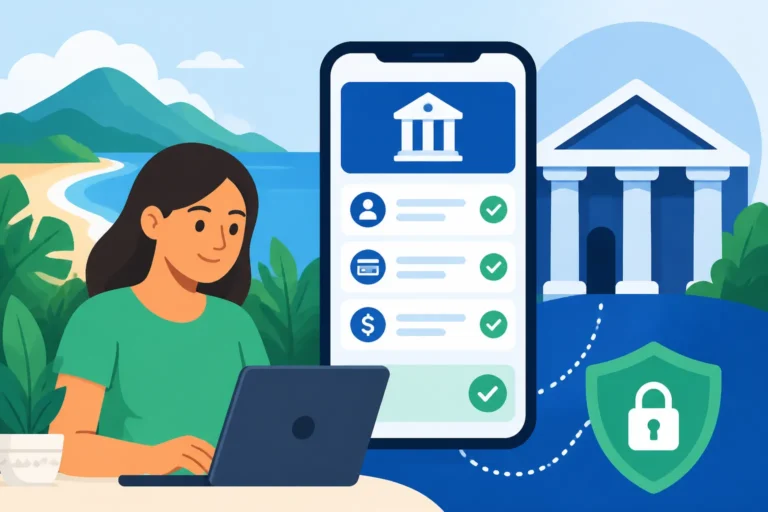
For paying local bills, Costa Rican banks have excellent online portals. You can typically pay your ICE (electricity), AyA (water), internet, and even municipal taxes directly through your bank's online platform or mobile app. This is incredibly convenient once you're set up. For a deeper dive into this, check out How to Set Up Online Banking with a Costa Rican Bank.
It's also worth noting that credit cards are widely accepted in Costa Rica, especially Visa and Mastercard. Having a Costa Rican credit card (which usually requires residency and a local bank account) can be helpful for building local credit and avoiding foreign transaction fees on your international cards.
Considering Professional Assistance for Financial Planning
Given the complexities of banking and taxation for expats, especially if you have significant assets or varied income streams, it's often wise to seek professional help. A local accountant or financial advisor who specializes in expat finances can guide you through the intricacies of Costa Rican tax law, help with Hacienda registration, and ensure you're compliant with all financial regulations.
Furthermore, if you're a US citizen, the tax situation becomes a dual-country challenge. Companies like Taxes for Expats specialize in helping Americans living abroad navigate their US tax obligations while also considering their Costa Rican tax status. They can help you understand concepts like the foreign earned income exclusion and foreign tax credits, ensuring you don't overpay or run into issues with either country's tax authorities. This professional guidance can save you headaches and money in the long run, helping you avoid mistakes when considering How Do I Pay My Costa Rican Taxes from Abroad?
Important Considerations Before You Walk Through the Bank Doors
Before you even step foot into a bank, having a clear strategy and managing your expectations can make a world of difference. The Costa Rican banking experience is unique, and being prepared is half the battle.
Language Barriers and Branch Selection
As mentioned, Spanish is the official language, and while some staff in tourist hubs or large city branches (like those in Escazú or San José) might speak English, it's not a guarantee, especially at public banks.
- Bring a Translator: If your Spanish isn't fluent, bring a trusted Costa Rican friend, a hired translator, or even your immigration lawyer if they offer such a service. This isn't just for understanding, but for accurately conveying your information and asking precise questions. Misunderstandings can lead to delays or incorrect account setups.
- Choose Your Branch Wisely: For your initial setup, stick to larger, more established branches in metropolitan areas. These branches are generally more accustomed to dealing with foreigners and their unique documentation. While it might be tempting to go to the closest local branch, they might be less equipped to handle complex international paperwork. For example, if you are planning on opening an account with BAC Credomatic, a branch in San Rafael de Escazú might be more knowledgeable about expat requirements than a small branch in a rural beach town.
Understanding Banking Fees and Services
Costa Rican banks operate with various fees that might be different from what you're used to. It's critical to ask about these upfront.
- Monthly Maintenance Fees: Some accounts have them, some don't, often tied to minimum balance requirements.
- ATM Fees: While using your own bank's ATMs is usually free, using another bank's ATM will incur a fee. Your international debit card will definitely incur fees if used at a local ATM, both from the local bank and your home bank.
- International Transfer Fees: These can vary significantly. Always compare exchange rates and fees if you're sending or receiving money from abroad.
- Check Fees: While checks are rarely used by individuals, if you somehow get a checking account, there might be fees for checkbooks or bounced checks.
- Debit Card Replacement Fees: If you lose your card, expect to pay for a new one.
Don't be shy about asking for a detailed breakdown of all potential costs. It’s part of understanding the overall Cost of Living in Costa Rica for Expats.
Table: Comparison of Banking Options for Foreigners in Costa Rica
| Feature | Private Banks (e.g., BAC Credomatic) | State Banks (e.g., Banco Nacional) | Digital/Fintech (e.g., Wise) |
|---|---|---|---|
| Ease for Foreigners | Moderate (easier with residency, good English support in major branches) | Moderate to Difficult (easier with residency, less English support) | Very Easy (no residency needed for basic accounts) |
| Primary Use | Daily local banking, international transfers | Daily local banking, government transactions | International transfers, multi-currency holding |
| Residency Req. | Preferred for full accounts, limited options without | Preferred for full accounts, limited options without | Not required for initial setup, but can integrate with local banks |
| Documentation | Extensive (KYC, income, address, tax ID) | Very Extensive (KYC, income, address, tax ID, biometrics) | Basic ID (passport), proof of address often digital |
| Customer Service | Generally more modern, some English staff, online focus | More traditional, longer waits, less English support | Fully online, chat/email support, often 24/7 |
| Fees | Varies by account, competitive for services | Varies, sometimes lower for basic services | Transparent, often lower for international transfers |
| Online Banking | Robust, user-friendly apps | Functional, but can be less modern | Excellent apps, designed for international use |
| Physical Branches | Good network in urban/expat areas | Extensive network nationwide | None, entirely digital |
This table provides a snapshot, but remember that specific experiences can vary. The best approach is often a hybrid: leveraging digital solutions for international money management while establishing a local bank account for daily expenses and long-term integration into Costa Rican life. Understanding Understanding How to Move to Costa Rica Legally from Abroad (2026) will also play a role in your banking journey.
Disclaimer
The information provided in this guide is for general informational purposes only and does not constitute financial, legal, or immigration advice. Banking regulations and requirements in Costa Rica are subject to change. It is highly recommended to consult with a qualified local financial advisor, legal professional, or the specific bank directly for the most accurate and up-to-date information pertaining to your individual circumstances. We are not responsible for any actions taken based on the information presented herein.