Can I Handle My Costa Rica Residency Without a Lawyer?
Many of you, fresh off the plane or even after a few glorious trips to Costa Rica, start dreaming of staying longer. And then the thought hits: residency. Immediately, a second thought often pops up: "Can I do this myself, or do I really need a lawyer?" It's a question that brings a mix of hope and dread, especially when facing the legendary Costa Rican bureaucracy. This guide is here to shed some light on whether navigating the residency process without legal representation is a feasible adventure or a recipe for unnecessary headaches, drawing on the wisdom of expats who've been there and done that.
The DIY Dream: Why Expats Consider Going It Alone
When you first start looking into the possibility of making Costa Rica your permanent home, the idea of tackling the residency application yourself can be quite appealing. It often stems from a few very understandable motivations.
Saving Precious Colones and Dollars
Let's be real, moving to a new country is expensive. From the flights and initial accommodation to setting up a new home and dealing with all the little unexpected costs, every penny counts. When you start researching legal fees for residency, the numbers can feel substantial, often ranging from a few thousand dollars to significantly more, depending on the complexity of your case and the lawyer's reputation. For many, this is the primary driver behind the "I'll do it myself" mindset. You think, "If I can save that money, it could go towards my rent, groceries, or exploring more of this beautiful country." It's a perfectly logical calculation for someone trying to stretch their budget. You might even feel a sense of pride, thinking you're beating the system or proving your independence.
However, it's crucial to remember that these legal fees cover not just the lawyer's time, but their expertise, their understanding of the constantly shifting sands of immigration law, and their ability to navigate a system that often seems designed to confuse. While the upfront saving is tempting, the long-term cost of errors or delays can quickly erode any perceived financial benefit. Think about lost time, potential fines, or even having to leave the country because a critical step was missed.
The Desire for Control and a Learning Experience
For some of us, there's an inherent desire to understand how things work, especially in a new environment. Taking on the residency process yourself feels like a deep dive into the heart of Costa Rican administration. It's an opportunity to learn Spanish in a very practical, sink-or-swim way, to understand the intricacies of government offices, and to connect with local systems on a fundamental level. This hands-on approach offers a unique sense of accomplishment and a deeper immersion into the Pura Vida lifestyle beyond the tourist facade. You might feel that by doing it yourself, you're truly owning your move and becoming a more integrated member of the community.
You want to know exactly what documents are needed, where they go, and why. You want to speak directly to the officials, even if it's challenging. This pursuit of knowledge and control can be incredibly rewarding. It means you're not just delegating a crucial step; you're actively participating in shaping your future in Costa Rica. It's about being accountable and understanding every single line item on that application form. This desire for total oversight is particularly strong for those who value independence and problem-solving.
The Bureaucratic Maze: Challenges of Self-Navigating Residency in Costa Rica
While the allure of a DIY approach is strong, the reality of the Costa Rican residency process can quickly turn that dream into a bureaucratic nightmare. It's not just "different" from what you might be used to; it often operates on its own unique logic, with rules that can feel fluid and frustrating.
The Language Barrier and Cultural Nuances
Let's be honest: unless your Spanish is fluent and you're well-versed in legal and administrative jargon, the language barrier is going to be your first and biggest hurdle. The official application forms, all supporting documents, and every interaction at the Dirección General de Migración y Extranjería (DGME) will be entirely in Spanish. It's not just about translating words; it's about understanding the specific legal phrasing, the implied meanings, and the cultural expectations of communication.
You might show up with what you think is a perfectly translated document, only to find that it needs to be officially translated by a Costa Rican public translator, complete with stamps and seals. Or you might attempt to explain your situation to an immigration officer, only to realize that their interpretation of the rules is different from yours, leading to confusion and delays. Patience, perseverance, and a deep understanding of politeness protocols become paramount. It’s also common to be asked for documents that aren’t explicitly listed on any official checklist – these are the "unwritten rules" that only experience (or a good lawyer) can truly anticipate. Understanding the cultural nuances of asking questions, accepting answers, and even waiting patiently can be as important as the Spanish itself.
Navigating the Ever-Changing Document Requirements
Oh, the documents! This is where most DIY attempts falter. The list of required documents for any residency category – be it How to Get the Pensionado (Retiree) Residency in Costa Rica (2027), The Expat Guide to the Rentista Residency in Costa Rica (2027), or any other – is extensive and precise. We're talking birth certificates, marriage certificates, police records, income statements, and so much more. But it's not just having the documents; it's about their format, their age, and their authentication.
Every foreign document typically needs to be apostilled in its country of origin – a process that itself can be convoluted and time-consuming. Then, as mentioned, these must be translated into Spanish by a public translator authorized in Costa Rica. And here's the kicker: requirements can, and often do, change without much public notice. What was valid last year might not be valid today. An obscure government decree or a new internal policy at the DGME can shift the goalposts overnight. You might spend weeks or months gathering everything, only to be told at the counter that one crucial detail has changed, sending you back to square one. This is one of the most common and soul-crushing experiences for those trying to go it alone. Missing one stamp or having a document just a few days too old can mean a rejected application and starting over.
The Maze of Appointments and Office Visits
Even if you manage to gather all your perfectly apostilled and translated documents, the journey is far from over. The residency process involves multiple steps, often requiring in-person visits to various government offices, each with its own procedures, opening hours, and (sometimes incredibly long) wait times. You'll likely need to visit the DGME, local police stations for fingerprints, perhaps a bank for fee payments, and eventually the Correos de Costa Rica (post office) for your DIMEX card.
Booking appointments can be a challenge in itself, often requiring online forms or phone calls in Spanish that fill up quickly. Arriving at an office, even with an appointment, doesn't guarantee a speedy process. It's common to spend hours waiting, only to be served by someone who may or may not be able to answer your specific questions, or who might give you different information than the last person you spoke to. This isn't out of malice, but often due to varying interpretations of complex rules across different agents. This logistical dance can be incredibly draining, especially if you live far from the main immigration offices in La Uruca, San José. Each trip involves time, transportation costs, and a significant amount of mental fortitude. If you're wondering How Long Does Costa Rican Residency Take to Process?, navigating these appointments inefficiently can easily add months to your timeline.
Understanding the Caja Affiliation Requirement
A critical part of maintaining your residency in Costa Rica is affiliating with the Caja Costarricense de Seguro Social (CCSS), the public healthcare system. This isn't just a suggestion; it's a legal obligation for most residents. Understanding the Caja Affiliation Requirement for Residency in Costa Rica is paramount, and the process itself can be confusing, especially regarding when and how to enroll, and how your contributions are calculated.
Even after your residency is approved, you'll need to register with the Caja, which involves more paperwork and visits to local EBAIS clinics or Caja offices. Without proper guidance, foreigners often struggle with the timing of this enrollment, the documentation required, and understanding their monthly payments. Failure to properly enroll and pay your Caja contributions can jeopardize your residency status, leading to fines or even the cancellation of your DIMEX card. It’s a complex system that often leaves expats scratching their heads, and an error here can have significant consequences. For example, if you delay joining, you might find yourself needing medical care but not fully covered, even if you’ve already paid for your residency fees. While waiting for your Caja affiliation, or if you opt for private care, looking into international providers like Cigna Global is a smart move to ensure you have coverage from day one.
When a Lawyer Becomes Indispensable: Non-Negotiable Situations
While some intrepid souls might attempt the DIY route for straightforward residency applications, there are definitely situations where trying to go it alone is simply asking for trouble. In these cases, a good immigration lawyer isn't just a convenience; they're an absolute necessity.
Complex Family Situations and Dependents
If your residency application involves more than just yourself, the complexity multiplies exponentially. Bringing along a spouse, minor children, or even elderly parents often falls under specific family-based residency categories, each with its own set of requirements and legal precedents. For instance, sponsoring a spouse might involve proving the legitimacy of your marriage beyond just a certificate, especially if there are any perceived irregularities or differences in nationality that raise red flags for immigration officials. How to Sponsor Your Spouse and Children for Costa Rican Residency highlights how many layers can be added.
Lawyers specializing in immigration can help navigate these delicate situations, ensuring all family members are properly included, that the correct documents are prepared for each individual, and that potential issues are addressed proactively. They understand the nuances of vínculo (family ties) residency and how to present your case most effectively. Without legal guidance, you risk delays, rejections, or even complications for specific family members, which can be incredibly stressful and costly in the long run. Imagine getting your own residency approved, but your child's is stuck in limbo because of a minor document discrepancy you weren't aware of.
Past Immigration Issues or Criminal Records
If you have any blemishes on your immigration history in Costa Rica (like overstaying a tourist visa in the past) or a criminal record (even minor infractions) from your home country, attempting DIY residency is extremely risky. Costa Rican immigration authorities conduct thorough background checks, and any red flags will significantly complicate your application. What might seem like a minor offense in your home country could be viewed very differently here.
An experienced immigration lawyer knows how to address these issues head-on. They can advise you on what disclosures are necessary, what documents might mitigate concerns, and how to present your case in the most favorable light. They can also represent you in discussions with the DGME, advocating on your behalf and explaining any mitigating circumstances. Trying to hide or downplay past issues will almost certainly lead to a denial, and potentially even future bans from entering the country. In these sensitive scenarios, the investment in legal expertise is not just about getting approved, but often about preserving your right to live in Costa Rica at all.
Appeals and Denials
Let's say you took the plunge and went the DIY route, only to receive a letter of denial or a request for more information that feels impossible to fulfill. This is where many self-filers hit a wall. Responding to a denial or filing an appeal requires a precise understanding of Costa Rican administrative law, strict adherence to deadlines, and the ability to articulate a compelling legal argument. It's not simply a matter of resubmitting documents; it often involves disputing a legal interpretation or providing evidence that wasn't properly considered.
A lawyer is essential in these situations. They can analyze the reasons for the denial, identify the legal grounds for an appeal, and draft the necessary legal documents in proper Spanish, ensuring all procedural requirements are met. Without a lawyer, your chances of successfully overturning a denial are slim to none, and you risk missing critical deadlines that could permanently close off your path to residency. This is one of the most disheartening experiences for any expat, and having professional legal backing during an appeal can make all the difference.
Strategic Self-Help: Resources and Best Practices for a DIY Approach
Okay, so you've weighed the risks, acknowledged the challenges, but you're still determined to try the DIY approach for a straightforward residency application. While it's certainly an uphill battle, it's not entirely impossible, especially if you're meticulously organized, patient, and prepared to put in a significant amount of legwork.
Research and Official Sources
Your absolute first step must be exhaustive research using official sources. Do not rely solely on expat forums or anecdotal advice, as rules change, and what worked for one person might not apply to you. Start with the official website of the Dirección General de Migración y Extranjería (DGME). While often only in Spanish, this is the definitive source for current requirements. Look for the specific category you're applying under, such as the requirements for pensionado (retiree) or rentista (person of independent means).
Pay close attention to every single document listed, the format required, and any notes about apostilles or official translations. Cross-reference this information with multiple reliable sources, such as embassy websites or reputable expat organizations that actively track changes. Remember, the general rule of thumb for documents like birth certificates and police records is that they should be issued within three to six months prior to your application submission. For an overarching view of the process, dive into resources like The Complete Guide to Costa Rica Residency for Expats (2027). This upfront research will save you countless hours of frustration down the line.
Document Preparation and Organization
This is where your organizational skills will be put to the ultimate test. Create a detailed checklist based on your research and check off each item as you acquire it. For every foreign document, ensure it is properly apostilled in your home country. This step alone can take weeks or even months, so start early. Once apostilled, these documents must be translated into Spanish by a public translator authorized by the Ministry of Foreign Affairs in Costa Rica. Do not try to use Google Translate or a friend; it will be rejected.
Make multiple copies of everything – original, apostilled, translated documents. Keep them organized in folders, both physical and digital. When you submit your application, you will typically need to provide an original copy of each document, along with a simple copy. Keep your own set of certified copies for your records. Consider a service like Sirelo if you are moving all your important files and belongings internationally; having a clear inventory can be helpful for tracking. Even for just documents, knowing where everything is at all times is key.
Seeking Peer Support and Community Knowledge
While not a substitute for legal advice, engaging with the expat community can provide invaluable moral support and practical tips. Join online forums, Facebook groups, or local expat meetups in Costa Rica. Share your experiences, ask general questions, and learn from others who have navigated similar paths. Many expats are generous with their knowledge, offering insights into which DGME office might be less crowded, common pitfalls they encountered, or recommendations for public translators.
However, always exercise caution and critical thinking. What worked for someone else five years ago might not be current. Use these communities for guidance and emotional support, but always verify critical information with official sources or, if needed, with a professional. For example, you might find tips on How to Get Your DIMEX Residency Card in Costa Rica from someone who just went through it. This collective wisdom can be incredibly helpful for the day-to-day logistics and emotional resilience required for the DIY journey.
Understanding the Financial Costs
Even if you forgo a lawyer, there are still significant costs associated with the residency process. Be prepared for:
- Application Fees: Paid to the DGME.
- Caja Contributions: You'll need to start paying into the public healthcare system once approved. Do I Need Health Coverage for Costa Rican Residency? clarifies this vital point.
- Document Apostille and Translation Fees: These can add up quickly.
- Travel and Accommodation: If you need to travel to San José for multiple appointments.
- Miscellaneous Fees: For things like fingerprinting, postage for your DIMEX, etc.
Create a detailed budget for these expenses so you're not caught off guard. While you save on legal fees, the other costs are non-negotiable and need to be factored into your decision to go solo. Having a clear picture of these financial outlays, as discussed in Understanding the Cost and Timeline of the Residency Process in Costa Rica, will help you manage your expectations.
DIY vs. Lawyer-Assisted Residency: A Comparison
To help you visualize the trade-offs, here's a quick comparison of attempting the residency process on your own versus hiring legal counsel:
| Feature/Aspect | DIY Approach | Lawyer-Assisted Approach |
|---|---|---|
| Cost | Generally lower upfront (saving legal fees) | Higher upfront cost (legal fees) |
| Time Investment | Very high (research, visits, waiting) | Lower (lawyer handles logistics, forms, appointments) |
| Stress Level | Very high (uncertainty, language, bureaucracy) | Lower (expert guidance, fewer personal interactions with DGME) |
| Accuracy | High risk of errors, missed requirements | High accuracy, lower risk of rejection |
| Speed | Potentially slower due to errors/rejections | Generally faster, more efficient processing |
| Language | Requires strong Spanish, legal vocabulary | Lawyer handles all Spanish communication |
| Document Mgmt. | Sole responsibility, very demanding | Lawyer guides/manages, ensures proper format/translation |
| Complex Cases | Not recommended, high risk of failure | Essential for success with family, criminal, or appeal cases |
| Learning Curve | Steep, hands-on understanding of bureaucracy | Minimal direct learning, streamlined experience |
| Peace of Mind | Low due to uncertainty | High due to expert handling |
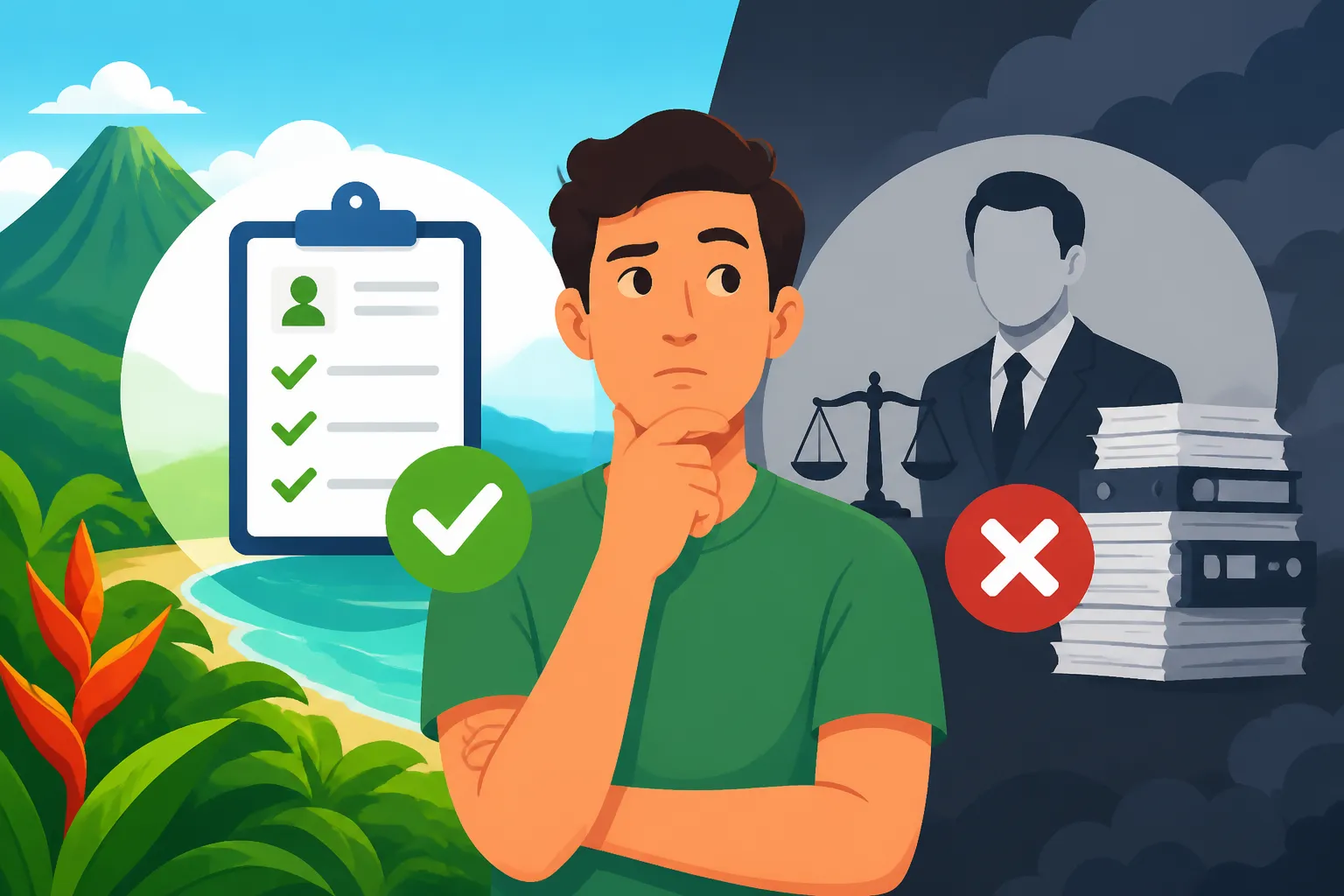
Ultimately, the decision of whether to tackle your Costa Rican residency without a lawyer is a deeply personal one. For a truly straightforward case, with impeccable organization, fluent Spanish, infinite patience, and a high tolerance for bureaucracy, it might be achievable. However, for most expats, especially those with any complexities in their background or a lower tolerance for administrative headaches, investing in a reputable immigration lawyer is often the wisest, most efficient, and ultimately less stressful path to making Costa Rica your legal home. Consider your individual circumstances, risk tolerance, and the value of your time and peace of mind before embarking on this significant journey. For a comprehensive overview of the legalities of making the move, check out Understanding How to Move to Costa Rica Legally from Abroad (2027).
Disclaimer
Please remember that this guide offers general information based on common expat experiences and publicly available information regarding Costa Rican residency as of 2026. Immigration laws and procedures can change rapidly and without notice. It is always recommended to consult with a qualified Costa Rican immigration attorney for advice tailored to your specific situation. This content is not a substitute for professional legal advice.