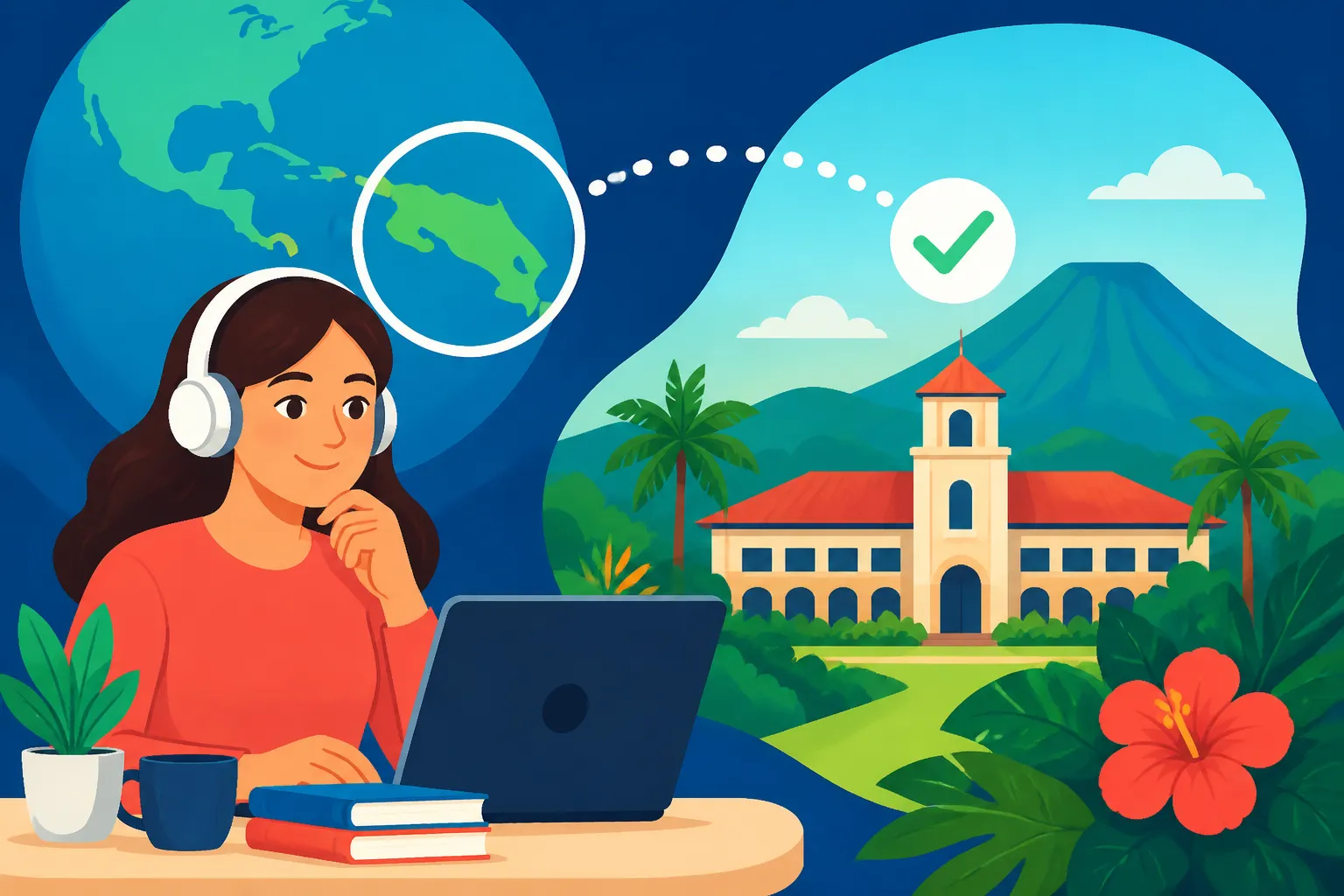
Can I Study Online at a Costa Rican University from Abroad?
So, you're dreaming of Pura Vida but not quite ready to pack up your entire life, or maybe you just want to earn a degree from a Costa Rican institution without leaving your current home? It’s a completely valid question, and one I hear often from folks who are intrigued by Costa Rica but aren't yet able to make the full leap. The good news is, yes, it is absolutely possible to study online at a Costa Rican university from abroad, but like most things tico, it comes with its own set of delightful (and sometimes frustrating) quirks and considerations. This isn't just about clicking 'enroll'; it's about understanding the nuances of the Costa Rican academic landscape from a distance, and I’m here to walk you through it.
The Reality of Online Learning from a Costa Rican Institution
Let’s get real for a moment. The idea of getting an education from Costa Rica while sipping coffee in your current kitchen sounds idyllic, right? And for many, it truly is. Costa Rica has a robust and highly respected higher education system, particularly its public universities, and they’ve embraced online learning, especially in recent years. However, "online" here can mean different things, and it's not always the slick, fully asynchronous experience you might be used to from North American or European institutions.
First, you need to differentiate between institutions. Costa Rica has both public and private universities. The public universities, such as the Universidad de Costa Rica (UCR), Universidad Nacional (UNA), and Tecnológico de Costa Rica (TEC), are generally very strong academically and are often significantly more affordable, even for international students. However, their online offerings might be more limited or structured differently, often requiring synchronous participation at specific Costa Rican times, which can be a real headache if you're in a wildly different time zone. Imagine trying to attend a live class at 7 PM Costa Rican time when you’re in Europe or Asia! It’s doable, but it requires serious dedication and a willingness to adapt your schedule. The private universities, like Universidad Fidélitas or Universidad Latina, often have more flexible and varied online programs designed to cater to a broader, including international, audience. They might offer more asynchronous options, but the trade-off is usually a higher tuition cost.
Another thing to wrap your head around is the language. While some private universities and specialized programs might offer courses or even entire degrees in English, the vast majority of Costa Rican university education is conducted entirely in Spanish. Even if a program claims to be "English-friendly," the administrative processes, support staff, and even fellow students might operate primarily in Spanish. If your Spanish isn't up to par, this could be a major barrier, not just to understanding lectures but to engaging with the material, participating in discussions, and navigating assignments. You might find yourself needing to brush up on your Spanish skills, and platforms like iTalki can be a godsend for getting one-on-one practice to boost your confidence and comprehension. Don’t underestimate the linguistic immersion needed, even for online study. You can find more insights on this in our comprehensive guide, Learning Spanish in Costa Rica: A Complete Guide for Expats.
Choosing the Right Costa Rican Institution for Remote Study
Picking the right university is a huge decision, whether you're moving here or studying from afar. For online education specifically, you'll want to dig deep into each institution's offerings and their track record with distance learning.
Public Universities: Quality and Affordability with Potential Flexibility Challenges
Costa Rica's public universities are jewels in the crown of the nation's education system. They are generally recognized for academic rigor and often have strong research programs. The main players are:
- Universidad de Costa Rica (UCR): Often ranked as the top university in Central America, UCR has some online and hybrid programs, particularly at the postgraduate level or in specific departments. However, fully online undergraduate degrees designed for international students abroad are less common. Their focus is primarily on on-campus learning. You might find individual courses offered online, but assembling a full degree entirely online from abroad through UCR could be challenging and require very careful planning. For a deeper dive into applying, check out How to Apply to the University of Costa Rica as an International Student.
- Universidad Nacional (UNA): Similar to UCR, UNA is highly respected. They do have some distance education initiatives, particularly through their campus in Sarapiquí or specific faculties, but again, a comprehensive suite of online degrees for international students living abroad might be limited.
- Tecnológico de Costa Rica (TEC): As the name suggests, TEC specializes in science, technology, engineering, and mathematics (STEM) fields. They are innovative and have explored virtual learning extensively, particularly for technical and engineering diplomas. If you're looking for a tech-focused program, TEC might have more suitable online options, but again, language and synchronous requirements remain key considerations.
- Universidad Estatal a Distancia (UNED): This is Costa Rica's dedicated distance learning university, and it’s probably your best bet if you're looking for a public institution with a strong online presence. UNED was built for remote education, offering a wide array of undergraduate and postgraduate programs. Their materials are often self-paced, though they might still have mandatory online interactions or exams that require a specific schedule. The courses are almost exclusively in Spanish, so a solid grasp of the language is non-negotiable.
Private Universities: Flexibility and Diversity with Higher Costs
Private universities in Costa Rica often cater more directly to the demands of the modern workforce and can be more agile in developing online programs. They tend to have more international students and might offer more administrative support in English.
- Universidad Latina de Costa Rica: This is one of the larger private universities and has a substantial offering of online programs in various fields, from business to health sciences and humanities. They often have more flexible scheduling options.
- Universidad Fidélitas: Known for its focus on engineering, architecture, and design, Fidélitas has invested significantly in virtual learning platforms. They are generally quite modern in their approach to online education and might be a good fit for those seeking technical degrees from abroad.
- Universidad Americana (UAM): Another private institution that offers several online and hybrid programs.
When evaluating any institution, regardless of whether it's public or private, always check for accreditation. In Costa Rica, the National Council of University Rectors (CONARE) oversees the public universities, ensuring quality. For all universities, accreditation by the National System of Accreditation of Higher Education (SINAES) is a mark of quality. This is crucial for ensuring your degree is recognized internationally and for any future career or academic pursuits. Our pillar article, The Complete Guide to Studying at a Costa Rican University (2027), has even more details on navigating the higher education system here.
Here’s a quick overview of what to consider:
| Feature | Public Universities (e.g., UNED) | Private Universities (e.g., ULatina, Fidélitas) |
|---|---|---|
| Accreditation | CONARE (public system oversight), SINAES (program) | SINAES (program), CONESUP (private university oversight) |
| Language | Predominantly Spanish | Mostly Spanish, some English-friendly programs/support |
| Cost | Significantly lower, even for international students | Higher tuition fees |
| Flexibility | May have more synchronous requirements, fixed schedules | Often more asynchronous options, flexible scheduling |
| Program Range | Broad, traditional disciplines, strong research | Broad, often career-focused, practical applications |
| Support for Expats | Generally less tailored, might require more self-navigation | Often more robust, bilingual administrative staff |
| Technology | Can vary; UNED is strong in distance learning | Generally modern learning management systems |
Application Process and Requirements from Afar
Okay, so you’ve scouted out a few universities and found a program that catches your eye. Now comes the fun part: applying! Even though you're doing this from abroad, the application process for Costa Rican universities can feel a bit like a bureaucratic tango, especially if you’re used to streamlined online applications elsewhere. Don't be surprised if there's a good amount of paperwork involved.
Document Collection and Apostille
You'll almost certainly need to provide certified copies of your academic transcripts and diplomas from your previous education. For international students, these documents generally need to be apostilled in your home country. An apostille is an international certification that makes your document legally recognized in Costa Rica (which is a signatory to the Hague Apostille Convention). If your country isn't part of the Hague Convention, you'll likely need consular legalization, which is a more complex process involving your country’s Ministry of Foreign Affairs and the Costa Rican consulate. This step alone can take weeks or even months, so start early! Our post What Documents Do I Need to Enroll at a Costa Rican University? offers a helpful checklist.
Beyond academic records, expect to provide:
- A copy of your passport.
- A birth certificate (also likely needing an apostille).
- Sometimes, a certificate of good conduct or a criminal background check, especially for certain postgraduate programs.
- Proof of financial solvency (to show you can pay tuition, though this is less stringent for online students not seeking a visa).
Language Proficiency and Degree Recognition
As mentioned, Spanish proficiency is often a must. If the program is in Spanish, you might need to submit proof of language proficiency, such as a DELE certificate or another recognized test score. Even if the program is technically offered in English, having strong Spanish skills will make your life significantly easier in all non-academic interactions.
Another critical step, especially for postgraduate studies, is the recognition (or equipolación) of your foreign degree by the Costa Rican Ministry of Public Education (MEP) or the National Council of Higher Education (CONARE). This process can be lengthy and requires submitting all your apostilled documents. It's essentially Costa Rica saying, "Yes, your Bachelor's from X University in Y Country is equivalent to a Costa Rican Bachelor's degree." You can learn more about this process in How to Get Your Foreign Degree Recognized in Costa Rica. For online studies where you're not seeking an in-country visa, this might sometimes be a less immediate requirement at the application stage, but it will certainly be necessary if you ever plan to work or further your studies in Costa Rica with that degree.
Enrollment and Payment
Once accepted, the enrollment process usually involves registering for courses through the university's online portal. Payment for tuition and fees will also be handled online. Most universities accept international wire transfers or credit card payments, though be mindful of exchange rates and potential international transaction fees. It's wise to clarify the exact payment methods and deadlines well in advance.
Practical Considerations and Expat Tips for Remote Learning
Studying online from abroad sounds convenient, but it introduces its own set of practical challenges that, as an expat who’s navigated the Costa Rican system for years, I can tell you are very real.
Time Zones and Synchronous Classes
This is probably the biggest logistical hurdle. Costa Rica operates on Central Standard Time (CST) and does not observe Daylight Saving Time. This means its time zone is GMT-6 year-round. If you're studying from, say, Europe, you could be 7-8 hours ahead, and classes that require real-time attendance could mean late nights or early mornings for you. Be absolutely clear with the admissions office about the precise schedule format of any online program. Are classes recorded? Are there mandatory live discussion groups? How flexible are exam times? Don't assume anything; ask every question.
Internet Stability and Technical Requirements
While Costa Rica has made great strides in internet infrastructure, you're relying on your internet connection wherever you are. Ensure you have a stable, high-speed connection that can handle video calls, large file downloads, and online proctored exams if required. Some programs might have specific software requirements, so make sure your computer meets those specs.
Academic Culture and Expectations
Even though you’re online, you’ll be interacting with a different academic culture. Costa Rican universities, particularly the public ones, can have a more formal, hierarchical structure than some Western universities. Communication with professors might be more formal, and punctuality (even online) is valued. Don’t be afraid to ask questions, but do so respectfully. Be proactive in reaching out to professors or student support if you're struggling, rather than waiting for them to check in on you.
Community and Networking
One of the great joys of university life is the community. Online learning from abroad can sometimes feel isolating. Seek out opportunities to connect with fellow students, even virtually. Many universities have online forums or social media groups. Engaging with your peers can enrich your learning experience and help you feel more connected to the institution and Costa Rica itself. This is another area where even basic Spanish skills can open doors, allowing you to participate more fully.
Future Implications for Residency and Taxes
Let's say your online studies inspire you so much that you decide to move to Costa Rica permanently. Excellent! Your degree might open doors, but remember that enrolling in an online program from abroad does not automatically grant you any special immigration status in Costa Rica. If you plan to eventually move here, you'll need to explore the various residency options available, such as the Digital Nomad Visa, Pensionado (Retiree) Residency, or Rentista Residency, or perhaps even find a job that sponsors a work permit. Your degree will be valuable, but it's a separate track from your immigration journey.
Also, consider the tax implications. While Costa Rica operates on a territorial tax system, meaning it generally only taxes income generated within Costa Rica, your tax residency status in your current country will dictate how you handle any income or financial aid related to your studies. If you eventually move to Costa Rica and become a tax resident, knowing the ins and outs of the system here will be crucial. This is where resources like Taxes for Expats become incredibly valuable, helping you understand your obligations both abroad and, should you decide to relocate, here in Costa Rica. You’ll want to be well-versed in topics like Understanding Costa Rica's Territorial Taxation of Foreign Income to avoid any surprises.
Studying online at a Costa Rican university from abroad is a fantastic way to immerse yourself in Pura Vida academically, often at a more affordable cost than many other international options, and certainly less expensive than our article on The Cost of Healthcare in Costa Rica: A Complete Breakdown for Foreigners (2026) might suggest for medical treatments! Just remember to do your homework, be prepared for administrative hurdles, and embrace the adventure.
Disclaimer
Please remember that I am an expat blogger and not a legal, financial, or educational professional. The information provided in this guide is based on general knowledge, personal experience, and research, and is intended for informational purposes only. University policies, immigration laws, and tax regulations in Costa Rica can change frequently. It is always highly recommended to consult directly with the admissions office of your chosen Costa Rican university, an immigration attorney, and a tax specialist for the most current and personalized advice regarding your specific situation.