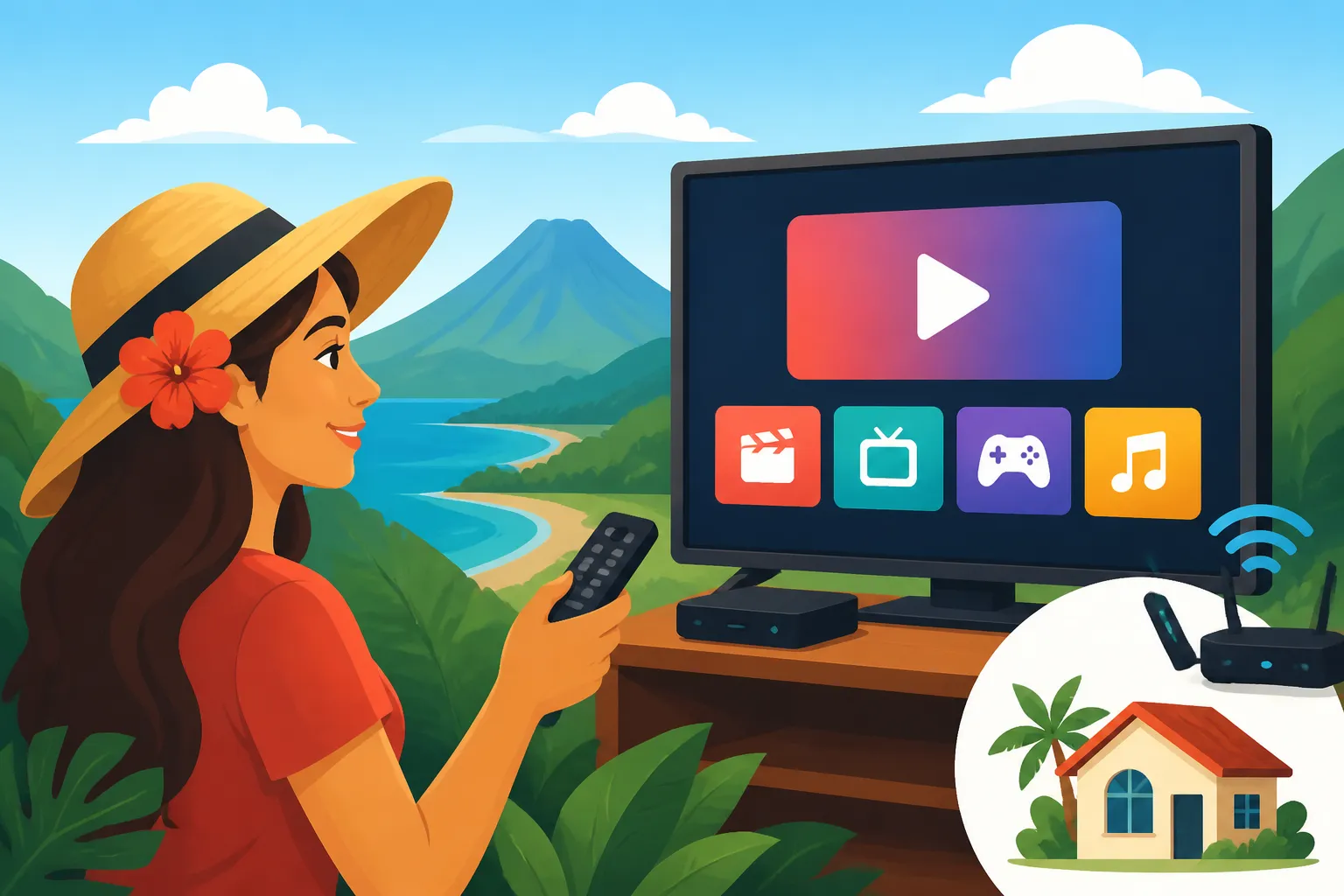
How to Set Up Streaming and TV Service in Costa Rica
One of the small comforts that truly makes a new house feel like home, especially after the whirlwind of moving to Costa Rica, is settling down on the couch and unwinding with your favorite show or movie. But let me tell you, navigating the world of TV and streaming services here isn't always as straightforward as it might be back home. From internet speeds to local content, this guide will walk you through everything you need to know to get your entertainment hub up and running in paradise, so you can finally kick back and enjoy a little slice of familiar comfort.
Understanding the Landscape of TV and Streaming in Costa Rica
When you first arrive in Costa Rica, you might assume that getting your favorite shows and movies will be just like anywhere else. You plug in your smart TV, sign into Netflix, and away you go. And while that's largely true for international streaming services, the local TV landscape has its own quirks and charms that are worth understanding. It’s a mix of the familiar and the distinctly Tico.
Traditional Cable and Satellite Options
Back in the day, before streaming took over the world, cable and satellite were the ways to get TV here. And they’re still very much alive and well, particularly if you appreciate local programming or want a more comprehensive channel lineup than basic streaming might offer. The major players you’ll hear about are Kolbi (from ICE), Liberty (formerly Tigo), and Claro. Each of these providers offers various packages that bundle internet, cable TV, and sometimes even landline phone services.
You’ll find that basic cable packages usually include a mix of Costa Rican channels, a decent selection of Latin American channels, and some international ones, often with Spanish dubbing or subtitles. If you’re looking for a wider array of English-language channels or premium movie channels, you’ll typically need to opt for a higher-tier package, which, naturally, comes with a higher price tag. The good news is that these services are generally reliable, and the signal quality is usually quite good, especially in urban and semi-urban areas. Installation can take a few days to a week after you sign up, and it often involves a technician coming to your home to run cables and set up the equipment. It’s not always a quick plug-and-play situation, but once it’s done, it tends to be quite stable. Remember that prices and channel lineups can vary, so it’s always a good idea to check their current offerings and compare them directly, which usually means a visit to a local office or navigating their (often Spanish-only) websites.
Internet-Based Streaming Services
Now, for what most expats really care about: Netflix, Amazon Prime Video, Disney+, HBO Max (now Max), Apple TV+, and all the other international heavy hitters. The fantastic news is that most of these major streaming platforms are readily available in Costa Rica. You can simply download the apps on your smart TV or streaming device, sign in with your existing accounts (or create new ones), and start watching.
However, there’s a crucial caveat: content libraries vary by region. What you could watch on Netflix in the US or Canada might not be available on Netflix Costa Rica, and vice-versa. This is due to licensing agreements and regional distribution rights. You’ll often find a strong selection of Spanish-language content, both local and from other Latin American countries, alongside a good portion of popular international movies and series. For many expats, this is a minor inconvenience, as the sheer volume of available content is still vast. For others, particularly those who follow specific shows or sports, this regional restriction can be a real headache. Keep in mind that some services might require a local Costa Rican payment method or address to sign up directly, although often your international credit card will work just fine. Local alternatives like cable providers or even streaming apps for Costa Rican channels might exist, but they usually cater to a Spanish-speaking audience and have much smaller libraries compared to global giants.
Getting Your Internet Connection Ready for Streaming
Let’s be honest: in today's world, "TV service" often just means having really good internet. Without a robust and reliable internet connection, your streaming dreams in Costa Rica will quickly turn into buffering nightmares. This is where you really need to put in some thought and research, because not all internet is created equal, especially when you’re relying on it for your nightly entertainment fix.
Choosing an Internet Service Provider ISP
Your choice of Internet Service Provider (ISP) is arguably the most critical decision for your streaming setup. In Costa Rica, you primarily have a few big players: Kolbi (the internet arm of ICE, the state-owned utility company), Liberty, and Tigo. In some areas, especially newer developments or specific regions, you might also find smaller, more localized providers that offer fiber optic connections.
Kolbi, being part of ICE, has a wide reach across the country and often offers a stable service. Liberty, having absorbed the operations of previous cable providers like Tigo and Cabletica, is a strong contender, particularly for cable internet. Tigo, while still having its own presence, often refers to Liberty for residential services now. When you’re choosing, you’ll want to consider the type of connection available in your specific area. Fiber optic is king for streaming, offering the fastest and most stable speeds, but its availability is still growing outside of major urban centers like San José, Escazú, and Heredia. Cable internet is a solid second option, generally reliable and widely available. DSL, while still present in some older infrastructure areas, is usually too slow and inconsistent for a good streaming experience, so try to avoid it if possible.
It's absolutely essential to inquire about the actual speeds they guarantee, not just "up to" speeds, and to understand their service level agreements. Ask neighbors in your specific community what their experiences are. What works well in one neighborhood might be abysmal just a few kilometers away. You'll want to investigate how to set up internet and cable in Costa Rica as part of your move-in process, as this is a utility you simply cannot do without. Many expats find bundling services from one provider, like internet and a basic cable package, can sometimes offer better value.
Internet Speed Requirements for Streaming
So, how fast does your internet really need to be? This isn't just a number on a package; it directly impacts your viewing quality and frustration levels. When you’re trying to stream high-definition content, let alone glorious 4K, you’ll burn through bandwidth faster than you can say "Pura Vida!"
Here’s a general guideline for recommended internet speeds for streaming:
| Streaming Quality | Minimum Recommended Speed | Ideal Speed for Multiple Users/Devices |
|---|---|---|
| Standard Definition (SD) | 3-5 Mbps | 5-10 Mbps |
| High Definition (HD 720p/1080p) | 5-10 Mbps | 15-25 Mbps |
| Ultra HD (4K) | 20-25 Mbps | 50+ Mbps |
These are per-stream recommendations. If you have multiple people in your household simultaneously streaming, gaming, or working remotely (which, let's be honest, many of us are doing, especially when you're working remotely from Costa Rica), you'll need significantly more bandwidth. A good rule of thumb for a family that streams frequently is to aim for at least 50-100 Mbps download speed, especially if you want to enjoy 4K content without constant buffering.
Beyond download speed, consider upload speed, though it's less critical for consuming streaming content, it's vital if you're doing video calls or uploading large files. Also, pay attention to data caps. While less common with home internet plans in Costa Rica compared to mobile data, some lower-tier plans might still have them. Ensure your chosen plan offers unlimited data or a cap high enough that you won't hit it midway through the month. An unreliable internet connection can be one of the most maddening aspects of setting up a home here, so prioritize this.
Navigating Geo-Restrictions and Enhancing Your Streaming Experience
Once you have your internet sorted, you might quickly run into the reality of geo-restrictions. This is the internet's way of reminding you that you're not in Kansas anymore, even if your streaming service pretends you are. But fear not, there are tried and true methods to circumnavigate these digital borders and truly enhance your overall streaming experience.
The VPN Solution
Ah, the Virtual Private Network, or VPN. This is your best friend when it comes to unlocking content that isn't available in Costa Rica. A VPN essentially encrypts your internet connection and routes it through a server in another country. To a streaming service, it then appears as if you are browsing from that country, not from your cozy casa in Costa Rica. This means if you want to watch the US Netflix library, you connect to a US server, and voilà!
Choosing a good VPN for streaming is critical. Free VPNs often come with slow speeds, data caps, and questionable privacy practices, which are all terrible for streaming. You'll want a reputable paid VPN service known for its fast speeds, numerous server locations (especially in your home country), and strong encryption. Providers like NordVPN, ExpressVPN, and Surfshark are popular choices among expats for their reliability and performance. Be aware that streaming services are constantly trying to block VPNs, so it's a bit of a cat-and-mouse game. Some VPNs are better at consistently bypassing these blocks than others. Always check recent reviews or forums for current performance, as what works one month might be detected the next. While using a VPN isn't illegal in Costa Rica, it might go against the terms of service for some streaming platforms, so proceed with awareness. But for many expats, it's the only way to get a full range of content from back home.
Smart TVs, Streaming Devices, and Casting
Once you've got your internet humming and your VPN ready (if needed), you need something to actually play the content on. Most modern Smart TVs come with built-in apps for popular streaming services. You can connect them to your Wi-Fi, download your apps, and you’re good to go. However, if your TV isn't "smart" or you prefer a more streamlined interface, streaming devices are the way to go.
Devices like Roku, Amazon Fire Stick, and Apple TV are incredibly popular among expats here. They plug into your TV's HDMI port, connect to your Wi-Fi, and offer a user-friendly interface to access all your streaming apps. They also tend to be better at integrating VPN services (often at the router level) or offering app stores that are less geographically restricted than some Smart TV operating systems. You can purchase these devices directly in Costa Rica at electronics stores like Monge, Gollo, or through online marketplaces, but sometimes the selection might be limited or prices higher than in your home country. Many expats simply bring their preferred devices with them when they move to Costa Rica. Just make sure you bring the correct power adapters or a good quality surge protector.
Chromecast is another fantastic option for "casting" content from your phone, tablet, or computer directly to your TV. It's simple, affordable, and works seamlessly with most streaming apps. The beauty of these devices is their portability and ease of setup. Even if you encounter a language barrier when initially setting up your internet, getting one of these devices running is usually straightforward. For those constantly on the go, or needing to ensure connectivity while initially settling in or travelling, a portable hotspot device with a local eSIM from providers like Airalo could even serve as a temporary streaming solution for mobile devices, although not ideal for main home viewing.
Local Content and Alternatives
While many expats arrive eager to continue watching their favorite shows from home, immersing yourself in local Costa Rican content can be a hugely rewarding experience. It's not just about entertainment; it's a window into the culture, the humor, and the daily lives of Ticos. Plus, it's an excellent way to practice your Spanish!
Costa Rican TV Channels and Local News
Costa Rica has several national television channels that broadcast a variety of programming. Teletica (Channel 7), Repretel (Channels 4 and 6), and Canal 13 (Sinart) are the big ones. You'll find everything from daily news broadcasts to telenovelas, local talk shows, cultural programs, and live sports. The quality of production has steadily improved over the years, and many shows offer a genuine glimpse into Costa Rican society and current events.
To access these channels, you typically don't need a fancy setup. A basic antenna can often pick up the major national channels, especially if you're in or near an urban area. If you opt for a cable package from Kolbi or Liberty, these local channels will be a standard part of even the most basic offering. For expats who enjoy following local politics, community events, or just want to feel more connected to their new home, tuning into the local news (Noticias Repretel, Telenoticias) can be incredibly insightful. It helps you understand the national conversation and pick up on local slang and expressions you won't learn from a textbook.
Spanish Language Immersion Through Local Media
For anyone serious about learning or improving their Spanish, diving into Costa Rican TV is a game-changer. Forget flashcards for a bit and turn on the TV! It provides contextual learning that textbooks simply can't replicate. You'll hear natural conversational speed, different accents, and contemporary vocabulary.
Start with something visually engaging, like a nature documentary about Costa Rica (there are plenty!) or a local cooking show, where the visuals can help you understand what's being said. Telenovelas, while sometimes a bit dramatic, are fantastic for language learning because the plots are often simple to follow, and the dialogue is usually very clear. Don't be afraid to use subtitles (in Spanish!) at first. This helps connect the spoken word with the written word, improving both your listening comprehension and reading skills. You might even find dedicated channels or segments focusing on Costa Rican culture, history, or music, which are not only entertaining but also deepen your appreciation for your new home. This is a much more enjoyable way to learn than just rote memorization, and it makes those long evenings at home feel more productive.
The Nitty-Gritty: Installation, Costs, and Troubleshooting
Alright, let’s talk brass tacks. Getting your TV and internet set up is one thing, but understanding the process, the actual financial outlay, and what to do when things inevitably go sideways is another. As an expat, you'll find that patience is not just a virtue, but a necessity when dealing with utilities in Costa Rica.
Installation Process and Technical Support
When you sign up for internet or cable TV services in Costa Rica, be prepared for a slightly different experience than you might be used to. First, you'll need to visit a service center or call a customer service line (often in Spanish) to arrange for installation. You'll typically need your DIMEX (residency card) or passport, a utility bill showing your address, and sometimes a local phone number. If you're still in your first 90 days, figuring out how to set up utilities (ICE/AyA) in Costa Rica will be high on your priority list, and this is similar.
Scheduling the installation usually involves a window of time – think half a day, sometimes a full day. Ticos often say "ahorita" which can mean "right now," "later today," or "sometime this week," so flexibility is key! Technicians will arrive to run cables, set up modems and routers, and connect your TV equipment. While many technicians are professional and efficient, language barriers can occasionally be an issue. If your Spanish isn't strong, it's a good idea to have a Tico friend or neighbor available to help translate if any complex questions arise. Make sure they test the connection before leaving and show you how everything works. Keep their contact information handy, as well as your account number, for any future support needs. Troubleshooting often starts with the usual "unplug it and plug it back in," but for more complex issues, you might need to call customer service again or schedule another technical visit.
Budgeting for Your Entertainment
The cost of living in Costa Rica for expats includes these utility bills, and entertainment can certainly add up. Here’s a general idea of what you might expect to pay:
- Internet: This will be your primary expense. For reliable streaming speeds (50-100 Mbps), expect to pay between $40-$80 USD per month. Fiber optic tends to be at the higher end but offers superior performance.
- Cable TV: Basic cable packages typically range from $20-$40 USD per month. If you want premium channels or a wider selection of English-language content, you could easily pay $50-$80+ USD.
- Streaming Services: These are usually charged in USD and are comparable to what you'd pay in North America or Europe.
- Netflix: ~$10-$20 USD/month (depending on plan)
- Amazon Prime Video: ~$6-$9 USD/month (often bundled with Prime shopping)
- Disney+, Max, Apple TV+: ~$7-$15 USD/month each
- Specialty sports or international content apps: Variable, often $10-$30+ USD/month
So, if you want a robust internet connection, a mid-tier cable package, and two or three international streaming services, you could easily be looking at a monthly entertainment bill of $100-$200 USD. This is an important factor when considering the overall cost of living. Many expats opt to skip cable TV entirely and rely solely on high-speed internet and streaming services, which can significantly cut down on monthly expenses. Weigh your personal preferences for local vs. international content and your budget carefully. When you are looking into how much it costs to set up a home in Costa Rica, remember to factor in these recurring entertainment costs.
| Provider (Primary Offerings) | Connection Types | Typical Speeds (Download) | Estimated Monthly Cost (USD) | Availability | Notes for Expats |
|---|---|---|---|---|---|
| Kolbi (ICE) (Internet, Cable, Phone) | Fiber, Cable, DSL | 25 Mbps – 500+ Mbps | $40 – $100+ | Wide (rural to urban) | State-owned, broad coverage, good customer service in larger areas. |
| Liberty (Internet, Cable, Phone) | Fiber, Cable | 50 Mbps – 1 Gbps | $50 – $120+ | Primarily urban/semi-urban | Strong competitor, often good speeds in cable areas. |
| Claro (Internet, Mobile, Phone) | Fiber (limited), DSL, Mobile | 20 Mbps – 200 Mbps | $35 – $80+ | Growing fiber, strong mobile | Good option for mobile data-based internet; home fiber still expanding. |
| Smaller Fiber Optic Providers (e.g., Gigantes del Atlántico, local co-ops) | Fiber | 100 Mbps – 1 Gbps | $60 – $150+ | Specific regions/developments | Excellent speeds, but highly localized and may have less English support. |
Note: These are estimated ranges and can change based on specific packages, promotions, and location. Always check current pricing directly with providers.
Disclaimer
The information provided in this guide is intended for general informational purposes only and does not constitute professional advice. While we strive to keep the information accurate and up-to-date, laws, regulations, prices, and service availability in Costa Rica can change rapidly. Always consult with official sources, service providers, or legal professionals for the most current and specific information relevant to your personal situation. We are not responsible for any actions taken based on the information provided herein.